





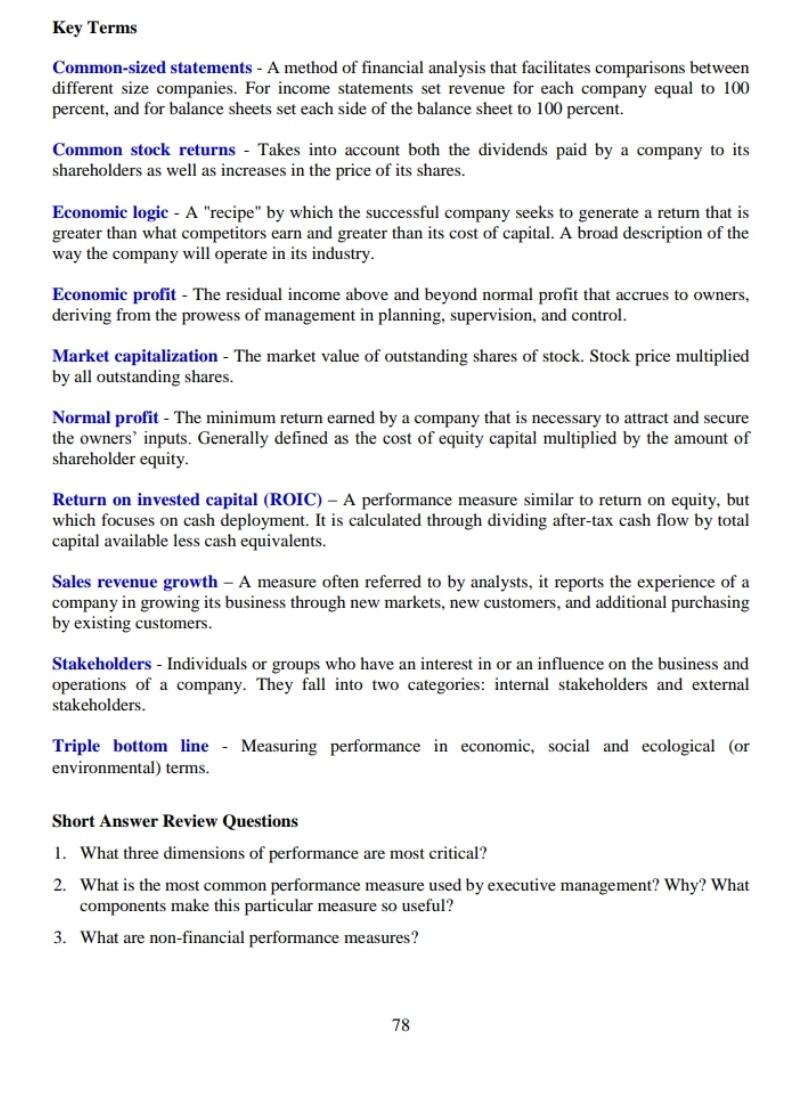
Question: Key Terms Common-sized statements - A method of financial analysis that facilitates comparisons between different size companies. For income statements set revenue for each company
Key Terms Common-sized statements - A method ofKey Terms Common-sized statements - A method of

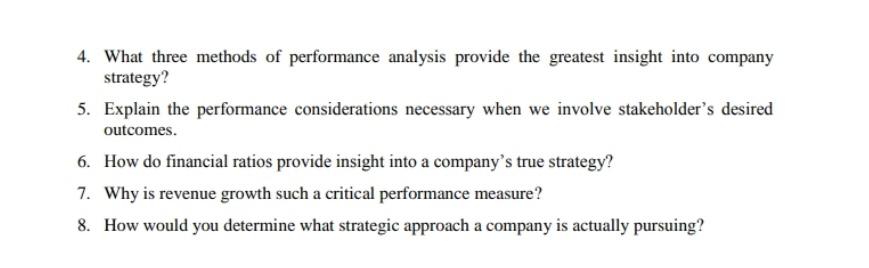
Key Terms Common-sized statements - A method of financial analysis that facilitates comparisons between different size companies. For income statements set revenue for each company equal to 100 percent, and for balance sheets set each side of the balance sheet to 100 percent. Common stock returns - Takes into account both the dividends paid by a company to its shareholders as well as increases in the price of its shares. Economic logic - A "recipe" by which the successful company seeks to generate a return that is greater than what competitors earn and greater than its cost of capital. A broad description of the way the company will operate in its industry. Economic profit - The residual income above and beyond normal profit that accrues to owners, deriving from the prowess of management in planning, supervision, and control. Market capitalization - The market value of outstanding shares of stock. Stock price multiplied by all outstanding shares. Normal profit - The minimum return earned by a company that is necessary to attract and secure the owners' inputs. Generally defined as the cost of equity capital multiplied by the amount of shareholder equity. Return on invested capital (ROIC) - A performance measure similar to return on equity, but which focuses on cash deployment. It is calculated through dividing after-tax cash flow by total capital available less cash equivalents. Sales revenue growth - A measure often referred to by analysts, it reports the experience of a company in growing its business through new markets, new customers, and additional purchasing by existing customers. Stakeholders - Individuals or groups who have an interest in or an influence on the business and operations of a company. They fall into two categories: internal stakeholders and external stakeholders. Triple bottom line - Measuring performance in economic, social and ecological (or environmental) terms. Short Answer Review Questions 1. What three dimensions of performance are most critical? 2. What is the most common performance measure used by executive management? Why? What components make this particular measure so useful? 3. What are non-financial performance measures? 78 4. What three methods of performance analysis provide the greatest insight into company strategy? 5. Explain the performance considerations necessary when we involve stakeholder's desired outcomes. 6. How do financial ratios provide insight into a company's true strategy? 7. Why is revenue growth such a critical performance measure? 8. How would you determine what strategic approach a company is actually pursuing

Step by Step Solution

There are 3 Steps involved in it

1 Expert Approved Answer
Step: 1 Unlock blur-text-image

Question Has Been Solved by an Expert!

Get step-by-step solutions from verified subject matter experts

Step: 2 Unlock
Step: 3 Unlock

Students Have Also Explored These Related General Management Questions!