







Question: Kimmel, Accounting, 7e Help System Announcements CALCULATOR PRINTER VERSION BACK NEXT Exercise 20-07 a-b Riggs Company purchases sails and produces sailboats. It currently produces 1,270
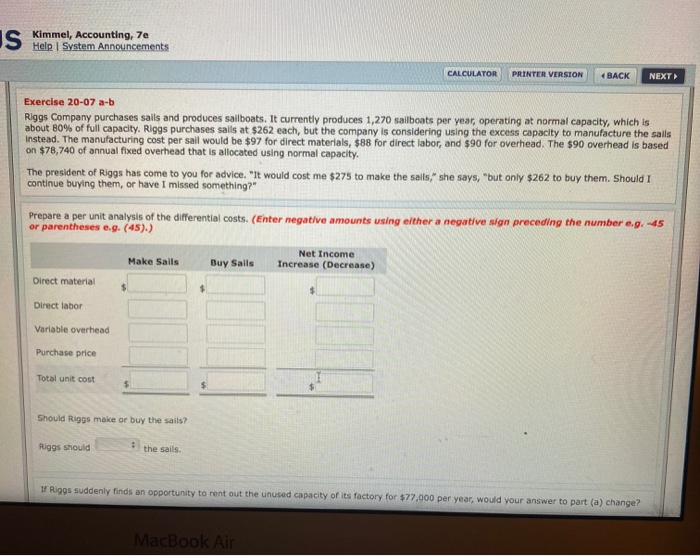
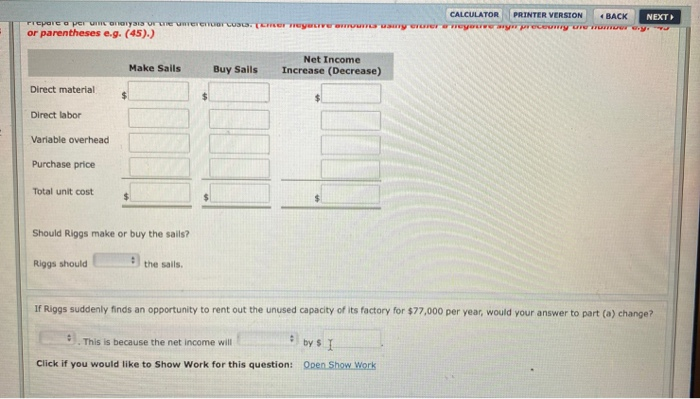
Kimmel, Accounting, 7e Help System Announcements CALCULATOR PRINTER VERSION BACK NEXT Exercise 20-07 a-b Riggs Company purchases sails and produces sailboats. It currently produces 1,270 sailboats per year, operating at normal capacity, which is about 80% of full capacity. Riggs purchases sails at $262 each, but the company is considering using the excess capacity to manufacture the sails Instead. The manufacturing cost per sail would be $97 for direct materials, $88 for direct labor, and $90 for overhead. The $90 overhead is based on $78,740 of annual fixed overhead that is allocated using normal capacity. The president of Riggs has come to you for advice. "It would cost me $275 to make the sails," she says, "but only $262 to buy them. Should I continue buying them, or have I missed something?" Prepare a per unit analysis of the differential costs. (Enter negative amounts using either a negative sign preceding the number .g. -45 or parentheses e.g. (45).) Make Sails Buy Sails Net Income Increase (Decrease) Direct material Direct labor Variable overhead Purchase price Total unit cost Should Riggs make or buy the sails? Riggs should the sails. Riggs suddenly finds an opportunity to rent out the unused capacity of its factory for $77,000 per year, would your answer to part (a) change? MacBook Air CALCULATOR PRINTER VERSION BACK rur Fry NEXT Prepare Per Bri or parentheses e.g. (45).) Make Sails Buy Sails Net Income Increase (Decrease) Direct material Direct labor Variable overhead Purchase price Total unit cost Should Riggs make or buy the sails? Riggs should the sails If Riggs suddenly finds an opportunity to rent out the unused capacity of its factory for $77,000 per year, would your answer to part (a) change? This is because the net income will by 5 I Click if you would like to Show Work for this question: Open Show Work Kimmel, Accounting, 7e Help System Announcements CALCULATOR PRINTER VERSION BACK NEXT Exercise 20-07 a-b Riggs Company purchases sails and produces sailboats. It currently produces 1,270 sailboats per year, operating at normal capacity, which is about 80% of full capacity. Riggs purchases sails at $262 each, but the company is considering using the excess capacity to manufacture the sails Instead. The manufacturing cost per sail would be $97 for direct materials, $88 for direct labor, and $90 for overhead. The $90 overhead is based on $78,740 of annual fixed overhead that is allocated using normal capacity. The president of Riggs has come to you for advice. "It would cost me $275 to make the sails," she says, "but only $262 to buy them. Should I continue buying them, or have I missed something?" Prepare a per unit analysis of the differential costs. (Enter negative amounts using either a negative sign preceding the number .g. -45 or parentheses e.g. (45).) Make Sails Buy Sails Net Income Increase (Decrease) Direct material Direct labor Variable overhead Purchase price Total unit cost Should Riggs make or buy the sails? Riggs should the sails. Riggs suddenly finds an opportunity to rent out the unused capacity of its factory for $77,000 per year, would your answer to part (a) change? MacBook Air CALCULATOR PRINTER VERSION BACK rur Fry NEXT Prepare Per Bri or parentheses e.g. (45).) Make Sails Buy Sails Net Income Increase (Decrease) Direct material Direct labor Variable overhead Purchase price Total unit cost Should Riggs make or buy the sails? Riggs should the sails If Riggs suddenly finds an opportunity to rent out the unused capacity of its factory for $77,000 per year, would your answer to part (a) change? This is because the net income will by 5 I Click if you would like to Show Work for this question: Open Show Work
Step by Step Solution
There are 3 Steps involved in it

Get step-by-step solutions from verified subject matter experts
 Study Help