Question: KINDLY ANSWER ALL THE MCQS BECAUSE I ONLY HAVE LAST QUESTION LEFT TO ASK PLEASE CONSIDER MY REQUEST. AND SOME ARE CORRECTLY ANSWERED BUT SOME
KINDLY ANSWER ALL THE MCQS BECAUSE I ONLY HAVE LAST QUESTION LEFT TO ASK PLEASE CONSIDER MY REQUEST. AND SOME ARE CORRECTLY ANSWERED BUT SOME ARE NOT. AND THIS IS OF COMMUNICATION SKILLS I HOPE SOMEONE WILL CONSIDER MY REQUEST AND WILL ANSWER THESE. THANKS IN ADVANCE
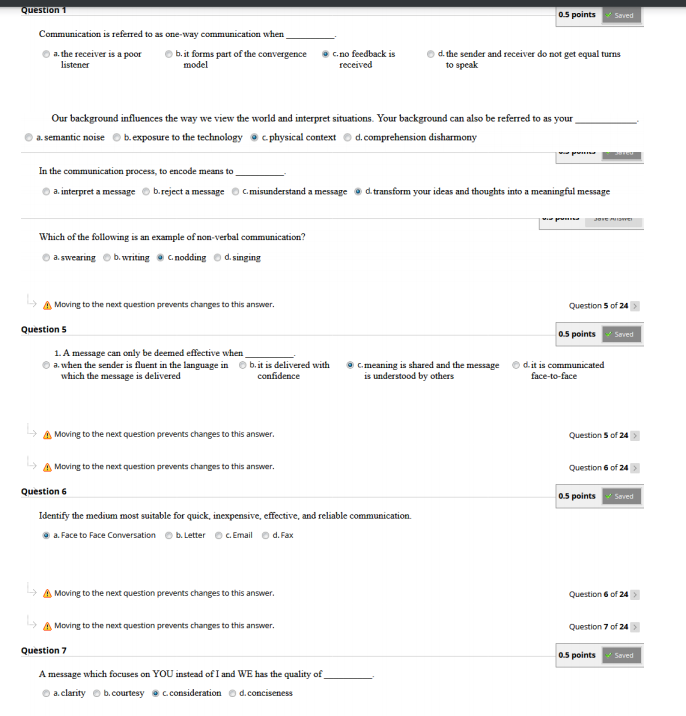
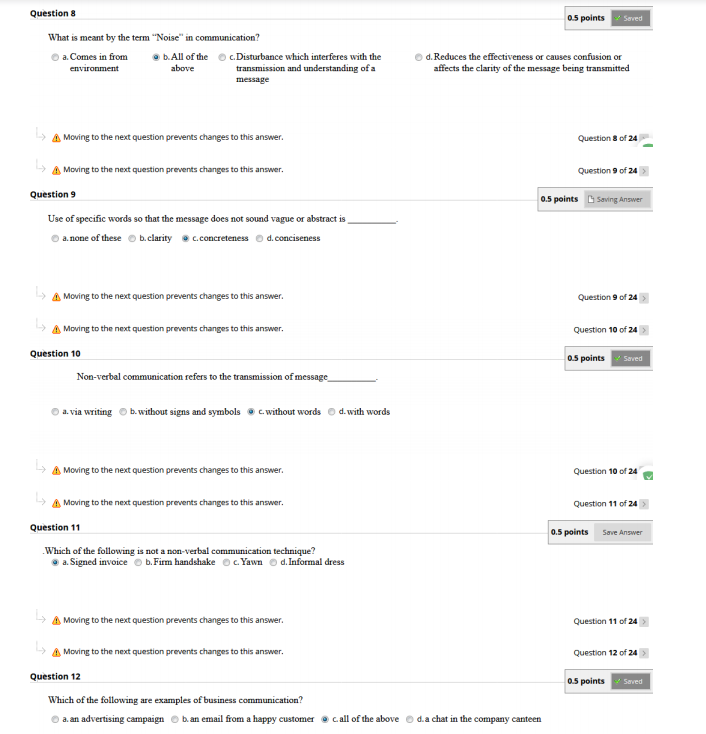
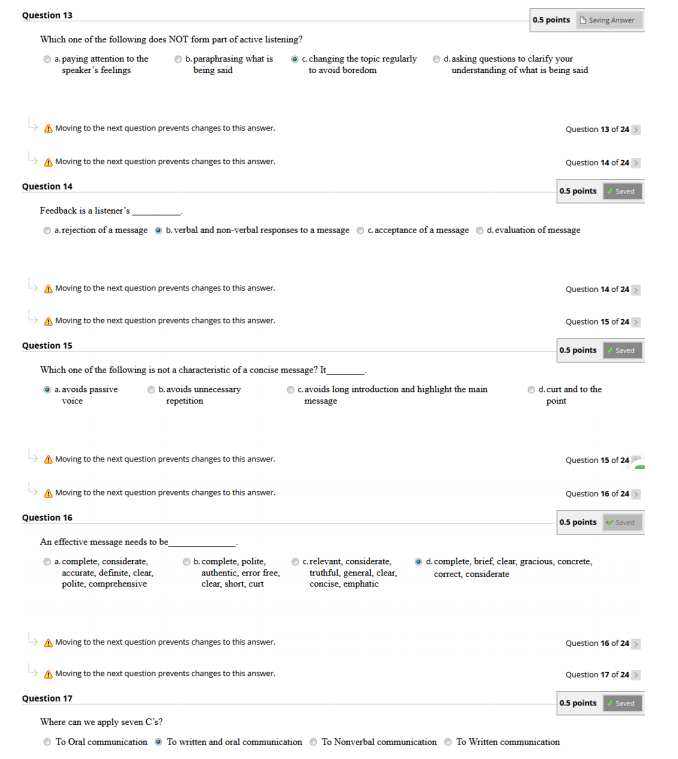
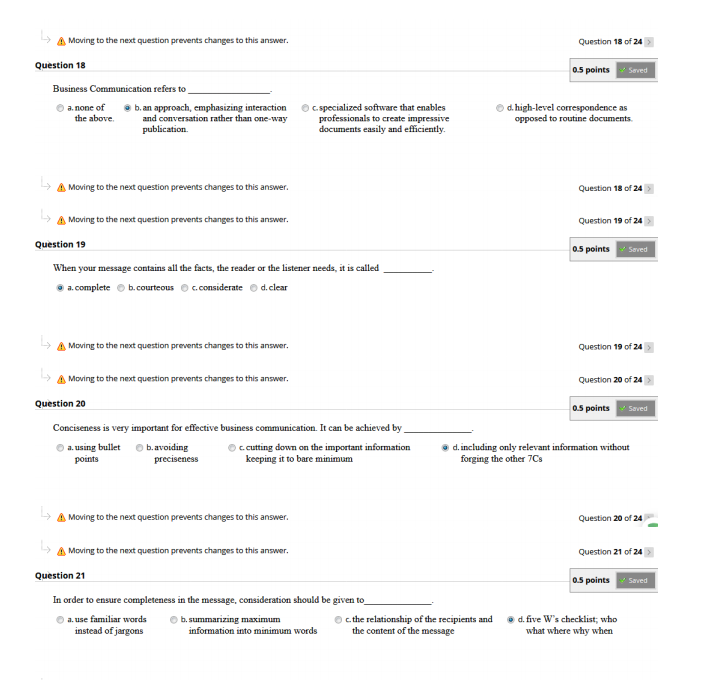
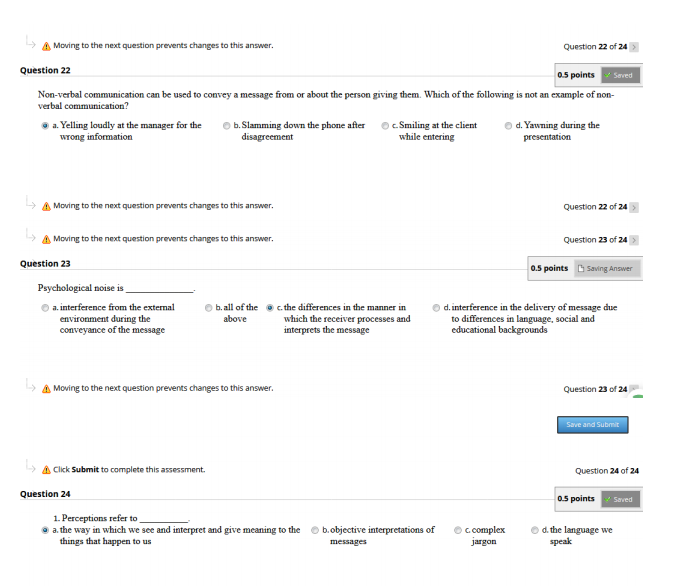
Question 0.5 points Saved Communication is referred to as one-way communication when a. the receiver is a poor listener b.it forms part of the convergence model c.no feedback is received d. the sender and receiver do not get equal turns to speak Our background influences the way we view the world and interpret situations. Your background can also be referred to as your a.semantic noise b.exposure to the technology c-physical context d. comprehension disharmony In the communication process, to encode means to a. interpret a message b.reject a message c. misunderstand a message de transform your ideas and thoughts into a meaningful message JOVENS Which of the following is an example of non-verbal communication? a swearing b. writing a Cnodding d. singing A Moving to the next question prevents changes to this answer. Question 5 of 24 Questions 0.5 points Seved 1. A message can only be deemed effective when a. when the sender is fluent in the language in which the message is delivered b.it is delivered with confidence c.meaning is shared and the message is understood by others d. it is communicated face-to-face A Moving to the next question prevents changes to this answer. Question 5 of 24 A Moving to the next question prevents changes to this answer. Question 6 of 24 Question 6 0.5 points Served Identify the medium most suitable for quick, inexpensive, effective, and reliable communication a. Face to Face Conversation Ob. Letter C. Email d. Fax A Moving to the next question prevents changes to this answer. Question 6 of 24 > A Moving to the next question prevents changes to this answer. Question 7 of 24 Question 7 0.5 points Saved A message which focuses on YOU instead of I and WE has the quality of a.clarity ob.courtesy c.consideration d.conciseness Question 8 0.5 points Seved What is meant by the term "Noise in communication? a. Comes in from b. All of the c. Disturbance which interferes with the environment above transmission and understanding of a message d. Reduces the effectiveness or causes confusion or affects the clarity of the message being transmitted A Moving to the next question prevents changes to this answer. Question 8 of 24 A Moving to the next question prevents changes to this answer. Question 9 of 24 0.5 points Saving Answer Question 9 Use of specific words so that the message does not sound vague or abstract is a. none of these b. clarity c.concreteness d. conciseness A Moving to the next question prevents changes to this answer. Question 9 of 24 A Moving to the next question prevents changes to this answer. Question 10 of 24 Question 10 0.5 points Saved Non-verbal communication refers to the transmission of message a. via writing b. without signs and symbols c. without words d. with words A Moving to the next question prevents changes to this answer. Question 10 of 24 A Moving to the next question prevents changes to this answer. Question 11 of 24 Question 11 0.5 points Save Answer Which of the following is not a non-verbal communication technique? - a. Signed invoice b. Firm handshake c. Yawnd. Informal dress A Moving to the next question prevents changes to this answer. Question 11 of 24 A Moving to the next question prevents changes to this answer. Question 12 of 24 Question 12 0.5 points Saved Which of the following are examples of business communication? a. an advertising campaign b. an email from a happy customer call of the above da chat in the company canteen Question 13 0.5 points Saving Answer Which one of the following does NOT form part of active listening? a. paying attention to the b.paraphrasing what is c.changing the topic regularly speaker's feelings being said to avoid boredom d asking questions to clarify your understanding of what is being said A Moving to the next question prevents changes to this answer. Question 13 of 24 A Moving to the next question prevents changes to this answer. Question 14 of 24 Question 14 0.5 points Saved Feedback is a listener's a.rejection of a message b.verbal and non-verbal responses to a message c.acceptance of a message devaluation of message A Moving to the next question prevents changes to this answer. Question 14 of 24 A Moving to the next question prevents changes to this answer. Question 15 of 24 Question 15 0.5 points Saved Which one of the following is not a characteristic of a concise message? It_ a. avoids passive b. avoids unnecessary Cavoids long introduction and highlight the main voice repetition message d.curt and to the point 4 A Moving to the next question prevents changes to this answer. Question 15 of 24 A Moving to the next question prevents changes to this answer. Question 16 of 24 Question 16 0.5 points Saved An effective message needs to be a.complete, considerate, accurate, definite, clear, polite, comprehensive b.complete, polite, authentic, error free, clear, short, curt crelevant, considerate, truthful, general, clear, concise, emphatic d. complete, brief, clear, gracious, concrete, correct, considerate L Moving to the next question prevents changes to this answer. Question 16 of 24 A Moving to the next question prevents changes to this answer. Question 17 of 24 Question 17 0.5 points Saved Where can we apply seven C's? To Oral communication To written and oral communication To Nonverbal communication To Written communication A Moving to the next question prevents changes to this answer. Question 18 of 24 Question 18 0.5 points Seved Business Communication refers to anone of b. an approach, emphasizing interaction the above and conversation rather than one-way publication c. specialized software that enables professionals to create impressive documents easily and efficiently d. high-level correspondence as opposed to routine documents A Moving to the next question prevents changes to this answer. Question 18 of 24 A Moving to the next question prevents changes to this answer. Question 19 of 24 Question 19 0.5 points Saved When your message contains all the facts, the reader or the listener needs, it is called a.complete b.courteous c.considerated.clear L A Moving to the next question prevents changes to this answer. Question 19 of 24 A Moving to the next question prevents changes to this answer. Question 20 of 24 > Question 20 0.5 points Saved Conciseness is very important for effective business communication. It can be achieved by a using bullet b. avoiding c. cutting down on the important information points preciseness keeping it to bare minimum d. including only relevant information without forging the other 7CS A Moving to the next question prevents changes to this answer. Question 20 of 24 A Moving to the next question prevents changes to this answer. Question 21 of 24 Question 21 0.5 points Saved In order to ensure completeness in the message, consideration should be given to a use familiar words b. summarizing maximum c. the relationship of the recipients and instead of jargons information into minimum words the content of the message d. five W's checklist; who what where why when A Moving to the next question prevents changes to this answer. Question 22 of 24 > Question 22 0.5 points Seved Non-verbal communication can be used to convey a message from or about the person giving them. Which of the following is not an example of non- verbal communication? a. Yelling loudly at the manager for the b. Slamming down the phone after Smiling at the client d. Yawming during the wrong information disagreement while entering presentation A Moving to the next question prevents changes to this answer. Question 22 of 24 A Moving to the next question prevents changes to this answer. Question 23 of 24 Question 23 0.5 points Saving Answer Psychological noise is a interference from the external environment during the conveyance of the message b.all of the c. the differences in the manner in above which the receiver processes and interprets the message d. interference in the delivery of message due to differences in language, social and educational backgrounds L A Moving to the next question prevents changes to this answer. Question 23 of 24 Save and Submit Click Submit to complete this assessment. Question 24 of 24 Question 24 0.5 points Saved 1. Perceptions refer to a. the way in which we see and interpret and give meaning to the things that happen to us b.objective interpretations of messages c complex jargon d. the language we speak









 Study Help