







Question: Kindly answer explain bullet . The dataset Hours is a subset of the 1976 Panel Study of Income Dynamics (PSID) that contains the following 19
Kindly answer explain bullet .
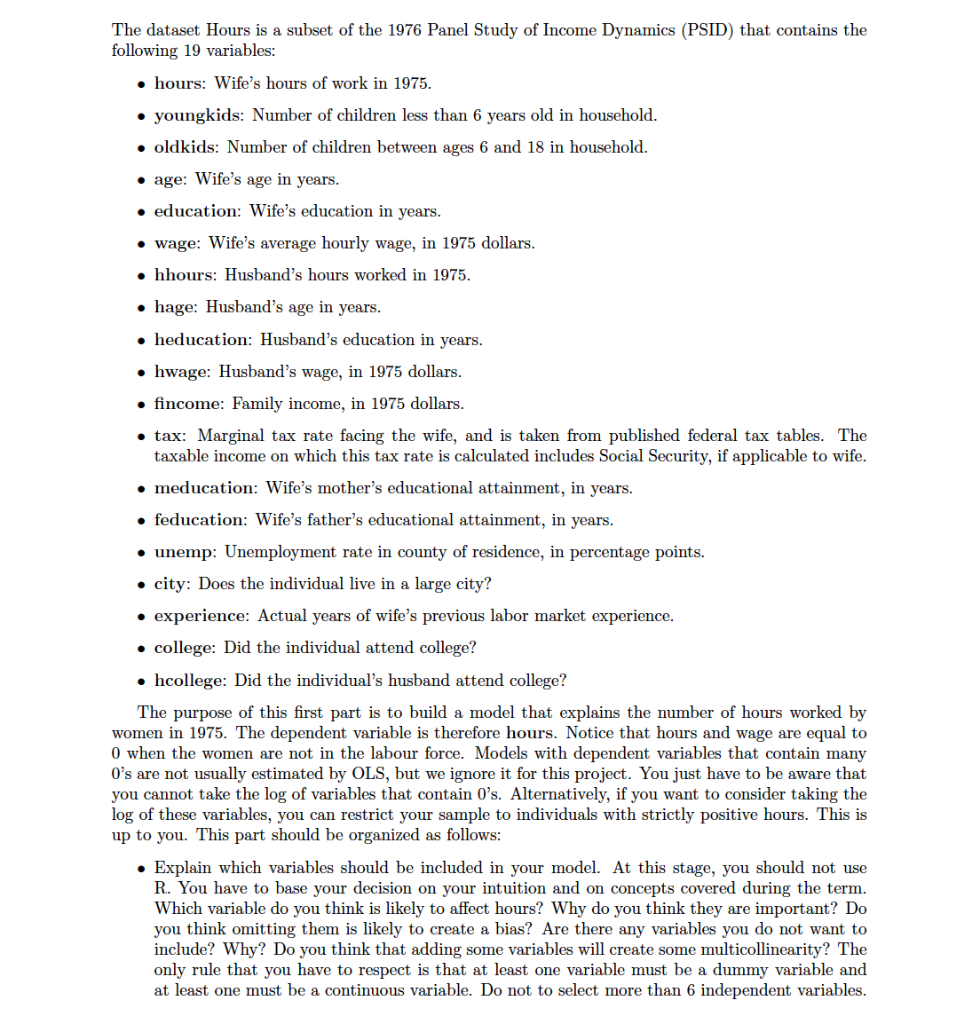
The dataset Hours is a subset of the 1976 Panel Study of Income Dynamics (PSID) that contains the following 19 variables: hours: Wife's hours of work in 1975. youngkids: Number of children less than 6 years old in household. oldkids: Number of children between ages 6 and 18 in household. age: Wife's age in years. education: Wife's education in years. wage: Wife's average hourly wage, in 1975 dollars. hhours: Husband's hours worked in 1975. hage: Husband's age in years. heducation: Husband's education in years. hwage: Husband's wage, in 1975 dollars. fincome: Family income, in 1975 dollars. tax: Marginal tax rate facing the wife, and is taken from published federal tax tables. The taxable income on which this tax rate is calculated includes Social Security, if applicable to wife. meducation: Wife's mother's educational attainment, in years. feducation: Wife's father's educational attainment, in years. unemp: Unemployment rate in county of residence, in percentage points. city: Does the individual live in a large city? experience: Actual years of wife's previous labor market experience. college: Did the individual attend college? hcollege: Did the individual's husband attend college? The purpose of this first part is to build a model that explains the number of hours worked by women in 1975. The dependent variable is therefore hours. Notice that hours and wage are equal to O when the women are not in the labour force. Models with dependent variables that contain many O's are not usually estimated by OLS, but we ignore it for this project. You just have to be aware that you cannot take the log of variables that contain 0's. Alternatively, if you want to consider taking the log of these variables, you can restrict your sample to individuals with strictly positive hours. This is up to you. This part should be organized as follows: Explain which variables should be included in your model. At this stage, you should not use R. You have to base your decision on your intuition and on concepts covered during the term. Which variable do you think is likely to affect hours? Why do you think they are important? Do you think omitting them is likely to create a bias? Are there any variables you do not want to include? Why? Do you think that adding some variables will create some multicollinearity? The only rule that you have to respect is that at least one variable must be a dummy variable and at least one must be a continuous variable. Do not to select more than 6 independent variables. The dataset Hours is a subset of the 1976 Panel Study of Income Dynamics (PSID) that contains the following 19 variables: hours: Wife's hours of work in 1975. youngkids: Number of children less than 6 years old in household. oldkids: Number of children between ages 6 and 18 in household. age: Wife's age in years. education: Wife's education in years. wage: Wife's average hourly wage, in 1975 dollars. hhours: Husband's hours worked in 1975. hage: Husband's age in years. heducation: Husband's education in years. hwage: Husband's wage, in 1975 dollars. fincome: Family income, in 1975 dollars. tax: Marginal tax rate facing the wife, and is taken from published federal tax tables. The taxable income on which this tax rate is calculated includes Social Security, if applicable to wife. meducation: Wife's mother's educational attainment, in years. feducation: Wife's father's educational attainment, in years. unemp: Unemployment rate in county of residence, in percentage points. city: Does the individual live in a large city? experience: Actual years of wife's previous labor market experience. college: Did the individual attend college? hcollege: Did the individual's husband attend college? The purpose of this first part is to build a model that explains the number of hours worked by women in 1975. The dependent variable is therefore hours. Notice that hours and wage are equal to O when the women are not in the labour force. Models with dependent variables that contain many O's are not usually estimated by OLS, but we ignore it for this project. You just have to be aware that you cannot take the log of variables that contain 0's. Alternatively, if you want to consider taking the log of these variables, you can restrict your sample to individuals with strictly positive hours. This is up to you. This part should be organized as follows: Explain which variables should be included in your model. At this stage, you should not use R. You have to base your decision on your intuition and on concepts covered during the term. Which variable do you think is likely to affect hours? Why do you think they are important? Do you think omitting them is likely to create a bias? Are there any variables you do not want to include? Why? Do you think that adding some variables will create some multicollinearity? The only rule that you have to respect is that at least one variable must be a dummy variable and at least one must be a continuous variable. Do not to select more than 6 independent variables
Step by Step Solution
There are 3 Steps involved in it

Get step-by-step solutions from verified subject matter experts
 Study Help