







Question: Kindly Answer me this questions based on the points mentioned in 2nd and 3rd Photo 1. Complete a SWOT analysis for Tim Hortons based on
Kindly Answer me this questions based on the points mentioned in 2nd and 3rd Photo 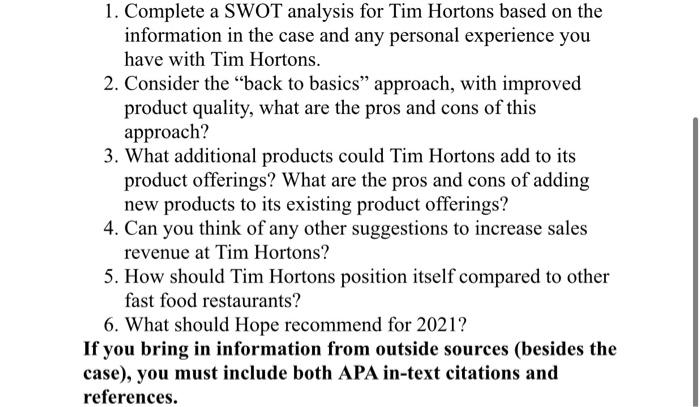
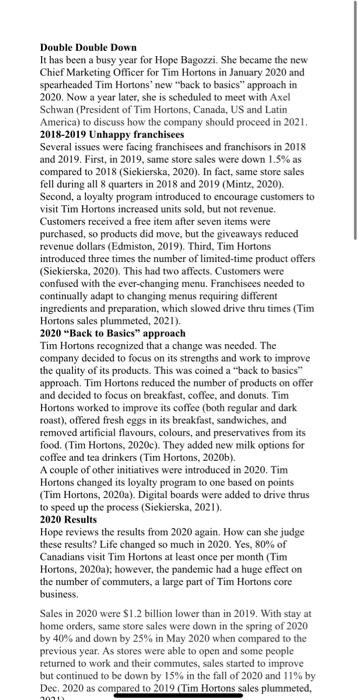
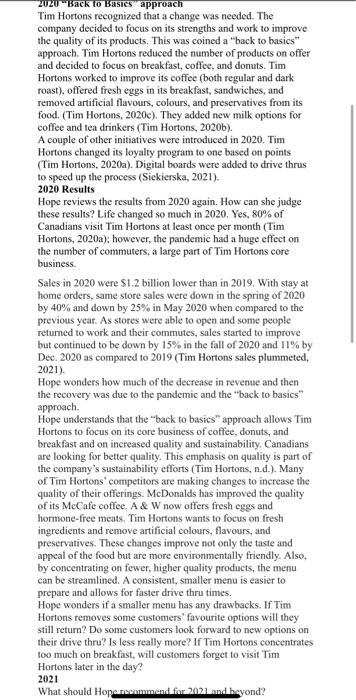
1. Complete a SWOT analysis for Tim Hortons based on the information in the case and any personal experience you have with Tim Hortons. 2. Consider the "back to basics" approach, with improved product quality, what are the pros and cons of this approach? 3. What additional products could Tim Hortons add to its product offerings? What are the pros and cons of adding new products to its existing product offerings? 4. Can you think of any other suggestions to increase sales revenue at Tim Hortons? 5. How should Tim Hortons position itself compared to other fast food restaurants? 6. What should Hope recommend for 2021? If you bring in information from outside sources (besides the case), you must include both APA in-text citations and references. Double Double Down It has been a busy year for Hope Bagozzi. She became the new Chief Marketing Officer for Tim Hortons in January 2020 and spearheaded Tim Hortons' new "back to basics" approach in 2020. Now a year later, she is scheduled to meet with Axel Schwan (President of Tim Hortons, Canada, US and Latin America) to discuss how the company should proceed in 2021. 2018-2019 Unhappy franchisees Several issues were facing franchisees and franchisors in 2018 and 2019. First, in 2019, same store sales were down 1.5% as compared to 2018 (Siekierska, 2020). In fact, same store sales fell during all & quarters in 2018 and 2019 (Mintz, 2020). Second, a loyalty program introduced to encourage customers to visit Tim Hortons increased units sold, but not revenue. Customers received a free item after seven items were purchased, so products did move, but the giveaways reduced revenue dollars (Edmiston, 2019). Third, Tim Hortons introduced three times the number of limited-time product offers (Siekierska, 2020). This had two affects. Customers were confused with the ever-changing menu. Franchisees needed to continually adapt to changing menus requiring different ingredients and preparation, which slowed drive thru times (Tim Hortons sales plummeted, 2021). 2020 "Back to Basics" approach Tim Hortons recognized that a change was needed. The company decided to focus on its strengths and work to improve the quality of its products. This was coined a "back to basics" approach. Tim Hortons reduced the number of products on offer and decided to focus on breakfast, coffee, and donuts. Tim Hortons worked to improve its coffee (both regular and dark roast), offered fresh eggs in its breakfast, sandwiches, and removed artificial flavours, colours, and preservatives from its food. (Tim Hortons, 2020c). They added new milk options for coffee and tea drinkers (Tim Hortons, 2020b). A couple of other initiatives were introduced in 2020. Tim Hortons changed its loyalty program to one based on points (Tim Hortons, 2020a). Digital boards were added to drive thrus to speed up the process (Siekierska, 2021). 2020 Results Hope reviews the results from 2020 again. How can she judge these results? Life changed so much in 2020. Yes, 80% of Canadians visit Tim Hortons at least once per month (Tim Hortons, 2020a); however, the pandemic had a huge effect on the number of commuters, a large part of Tim Hortons core business Sales in 2020 were $1.2 billion lower than in 2019. With stay at home orders, same store sales were down in the spring of 2020 by 40% and down by 25% in May 2020 when compared to the previous year. As stores were able to open and some people returned to work and their commutes, sales started to improve but continued to be down by 15% in the fall of 2020 and 11% by Dec, 2020 as compared to 2019 (Tim Hortons sales plummeted, 2011 2020 "Back to Basics approach Tim Hortons recognized that a change was needed. The company decided to focus on its strengths and work to improve the quality of its products. This was coined a "back to basics" approach. Tim Hortons reduced the number of products on offer and decided to focus on breakfast, coffee, and donuts. Tim Hortons worked to improve its coffee (both regular and dark roast), offered fresh eggs in its breakfast, sandwiches, and removed artificial flavours, colours, and preservatives from its food. (Tim Hortons, 2020c). They added new milk options for coffee and tea drinkers (Tim Hortons, 2020b). A couple of other initiatives were introduced in 2020. Tim Hortons changed its loyalty program to one based on points (Tim Hortons, 2020a). Digital boards were added to drive thrus to speed up the process (Siekierska, 2021). 2020 Results Hope reviews the results from 2020 again. How can she judge these results? Life changed so much in 2020. Yes, 80% of Canadians visit Tim Hortons at least once per month (Tim Hortons, 2020a); however, the pandemic had a huge effect on the number of commuters, a large part of Tim Hortons core business Sales in 2020 were $1.2 billion lower than in 2019. With stay at home orders, same store sales were down in the spring of 2020 by 40% and down by 25% in May 2020 when compared to the previous year. As stores were able to open and some people returned to work and their commutes, sales started to improve but continued to be down by 15% in the fall of 2020 and 11% by Dec. 2020 as compared to 2019 (Tim Hortons sales plummeted, 2021). Hope wonders how much of the decrease in revenue and then the recovery was due to the pandemic and the "back to basics" approach. Hope understands that the back to basics" approach allows Tim Hortons to focus on its core business of coffee, donuts, and breakfast and on increased quality and sustainability. Canadians are looking for better quality. This emphasis on quality is part of the company's sustainability efforts (Tim Hortons, n.d.). Many of Tim Hortons' competitors are making changes to increase the quality of their offerings. McDonalds has improved the quality of its McCafe coffee. A & W now offers fresh eggs and hormone-free meats. Tim Hortons wants to focus on fresh ingredients and remove artificial colours, flavours, and preservatives. These changes improve not only the taste and appeal of the food but are more environmentally friendly. Also, by concentrating on fewer, higher quality products, the menu can be streamlined. A consistent, smaller menu is easier to prepare and allows for faster drive thru times. Hope wonders if a smaller menu has any drawbacks. If Tim Hortons removes some customers' favourite options will they still return? Do some customers look forward to new options on their drive thru? Is less really more? If Tim Hortons concentrates too much on breakfast, will customers forget to visit Tim Hortons later in the day? 2021 What should Hope wommend for 2021 and beyond
Step by Step Solution
There are 3 Steps involved in it
1 Expert Approved Answer
Step: 1 Unlock

Question Has Been Solved by an Expert!
Get step-by-step solutions from verified subject matter experts
Step: 2 Unlock
Step: 3 Unlock
 Study Help