







Question: Kindly answer the below 3 questions based on Indian School of Business case study by Tuhin Harit | Vikram Kuriyan | Geetika Shah You will
Kindly answer the below 3 questions based on Indian School of Business case study by Tuhin Harit | Vikram Kuriyan | Geetika Shah
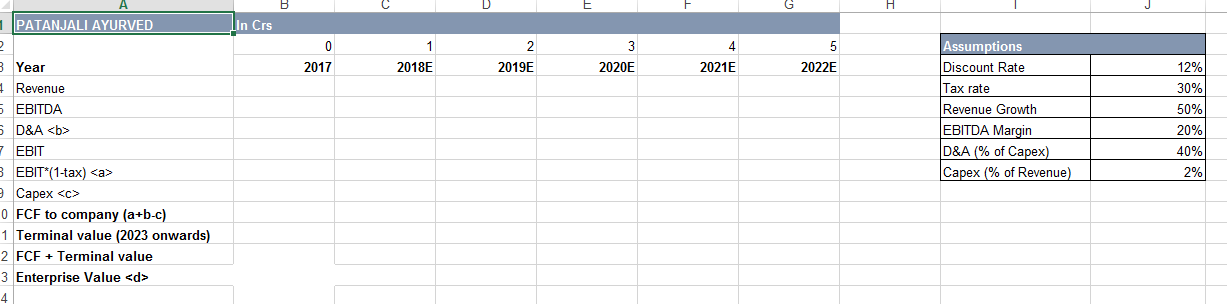
You will now help Smith perform the valuation of Patanjali. Use the following assumptions for your calculations from the years 2018 to 2022. Remember, you are performing the valuation at the end of 2017.
Smith has given you the following assumptions based to work with.
Assumptions:
- Revenue Growth = 50%
- EBITDA Margin = 20%
- D&A (as % of Capex) = 40%
- Capex (as % of Revenue) = 2%
- Discount rate = 12%
- Tax rate = 30%
Use the 2017 revenue value given in Exhibit 2: 10,000 cr.
Additional simplifying assumptions:
- The company has negligible debt. Debt can be considered as 0.
- Working capital remains constant throughout. So there is no change in net working capital.
- The free cash flows from 2023 onwards are constant and equal to the 2022 value. They continue forever.
Notes for solving this question:
- Since we are ignoring debt, i.e. there is no interest, Net income = EBIT (1 - tax rate)
- Use the same assumptions as the previous question to calculate net income in 2017
Question 2A: Smith wants to check the value of Patanjali using the multiples method. Help him calculate Patanjalis equity value in 2017 using the P/E multiple of Dabur given in Exhibit 1. Please explain your calculations. (5 marks)
Question 2B: Help Smith calculate Patanjalis equity value in 2017 using the P/E multiple of Britannia given in Exhibit 1. Please explain your calculations. (5 marks)
\begin{tabular}{|c|c|c|c|c|c|c|c|c|} \hline PATANJALI AYURVED & \multicolumn{6}{|l|}{lnCrs} & & \\ \hline & 0 & 1 & 2 & 3 & 4 & 5 & \multicolumn{2}{|l|}{ Assumptions } \\ \hline & 2017 & 2018E & 2019E & 2020E & 2021E & 2022E & Discount Rate & 12% \\ \hline Revenue & & & & & & & Tax rate & 30% \\ \hline EBITDA & & & & & & & Revenue Growth & 50% \\ \hlineD&A & & & & & & & EBITDA Margin & 20% \\ \hline EBIT & & & & & & & D\&A (\% of Capex) & 40% \\ \hline EBIT(1tax)
Step by Step Solution
There are 3 Steps involved in it

Get step-by-step solutions from verified subject matter experts
 Study Help