







Question: Kindly answer these mcqs QUESTION 5 (Maximum time to spend in this question: 15 min) Let a and b are positive constants. The inverse Laplace
Kindly answer these mcqs
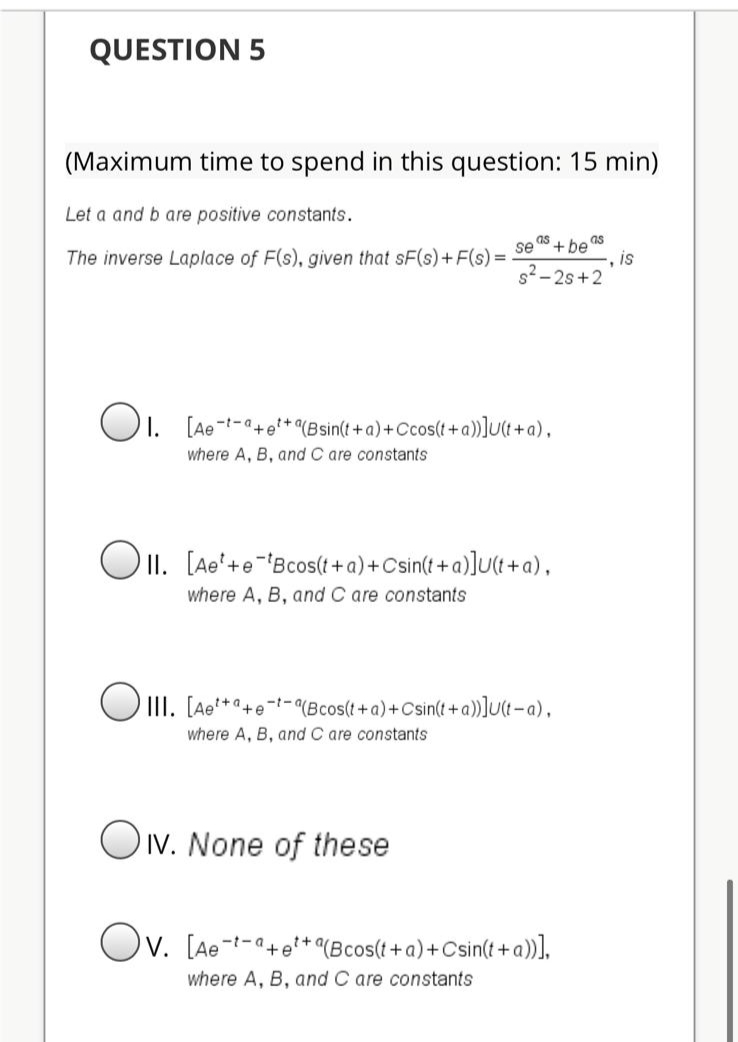
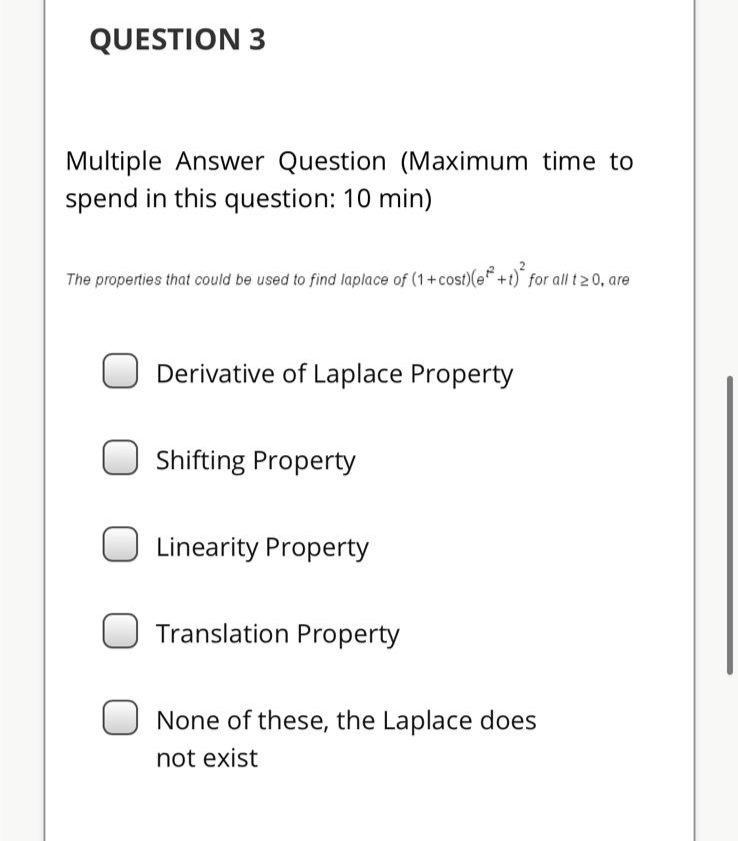
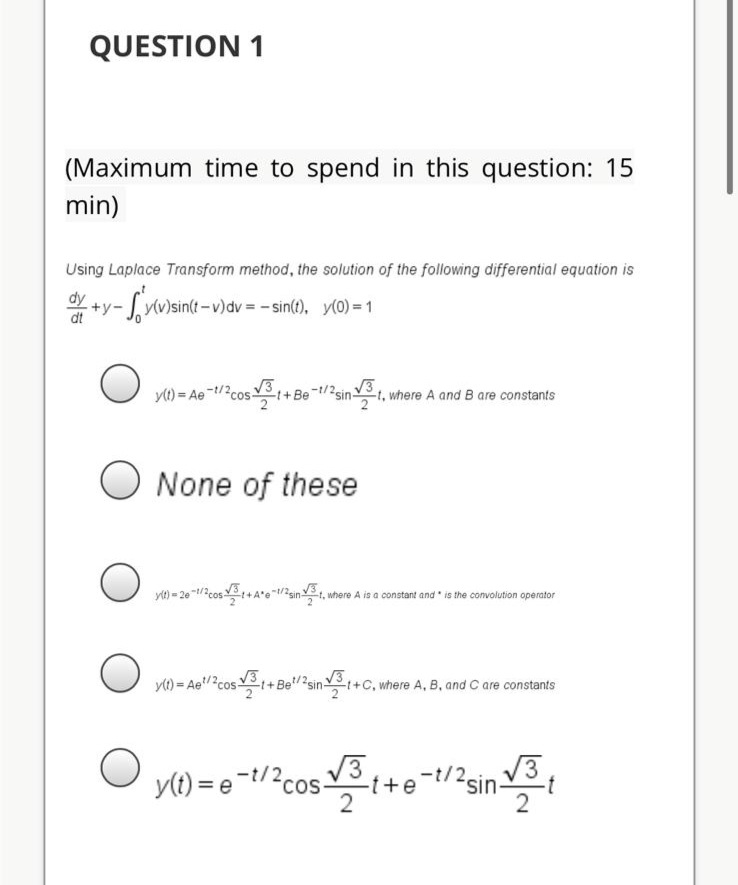
QUESTION 5 (Maximum time to spend in this question: 15 min) Let a and b are positive constants. The inverse Laplace of F(s), given that SF(s) + F(s) _ se"+ be $2 -2s+ 2 is Ol. [ Ae -1- 0 +8 '+ (Bsin(1+ a)+ Ccos(1+a)]U(i+a), where A, B, and C are constants Oil. [Ae'te Bcos(t+a) + Csin(t + a)]U(1 + a), where A, B, and C are constants OIll. [Aetta +8-1-(Bcos(1+a)+ Csin(t +a)ju(t-a), where A, B, and C are constants OIV. None of these OV. [Ae-1-+'+ (Bcos(1+a)+Csin(1 + a)], where A, B, and C are constantsQUESTION 3 Multiple Answer Question (Maximum time to spend in this question: 10 min) 2 The properties that could be used lo find laplooa of {1 + r:osi:ll[a':I + i} for all i 2 D. are C] Derivative of Laplace Property O Shifting Property C] Linearity Property O Translation Property O None of these, the Laplace does not exist QUESTION 1 (Maximum time to spend in this question: 15 min) Using Laplace Transform method, the solution of the following differential equation is dy + y - [ y(v)sin(t-v)dv= - sin(1). >(0)=1 MM) =AB -1/2cos VE 1+ Be -1/2 gin -1, where A and B are constants None of these O W!) = 20-1/2cos 13 14 A'e"(/2gin , where A is a constant and " is the convolution operator O V(!) = Ae'/2cos V31+ Be /2sin VS 1+C. where A, B, and C are constants y(1) =e-1/2cos V3tte-1/2sin V3 2
Step by Step Solution
There are 3 Steps involved in it

Get step-by-step solutions from verified subject matter experts
 Study Help