







Question: kindly assist with solution for this problem....question can be seen in the textbook in the picture. Deen, Problem 9-12 - Channel with Cross Flow Suppose
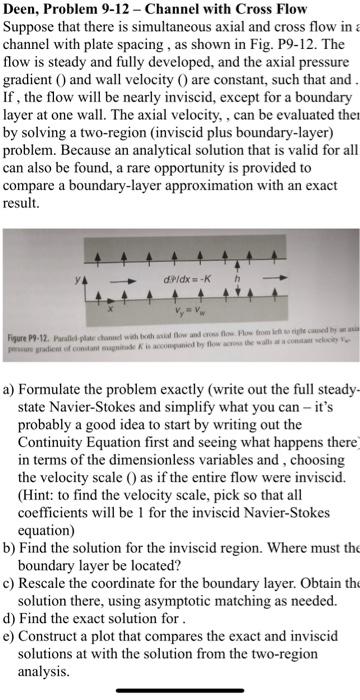
Deen, Problem 9-12 - Channel with Cross Flow Suppose that there is simultaneous axial and cross flow in ? channel with plate spacing, as shown in Fig. P9-12. The flow is steady and fully developed, and the axial pressure gradient () and wall velocity () are constant, such that and . If , the flow will be nearly inviscid, except for a boundary layer at one wall. The axial velocity, , can be evaluated ther by solving a two-region (inviscid plus boundary-layer) problem. Because an analytical solution that is valid for all can also be found, a rare opportunity is provided to compare a boundary-layer approximation with an exact result. a) Formulate the problem exactly (write out the full steady. state Navier-Stokes and simplify what you can - it's probably a good idea to start by writing out the Continuity Equation first and seeing what happens there in terms of the dimensionless variables and , choosing the velocity scale () as if the entire flow were inviscid. (Hint: to find the velocity scale, pick so that all coefficients will be 1 for the inviscid Navier-Stokes equation) b) Find the solution for the inviscid region. Where must the boundary layer be located? c) Rescale the coordinate for the boundary layer. Obtain th solution there, using asymptotic matching as needed. d) Find the exact solution for . e) Construct a plot that compares the exact and inviscid solutions at with the solution from the two-region analysis
Step by Step Solution
There are 3 Steps involved in it

Get step-by-step solutions from verified subject matter experts
 Study Help