







Question: Kindly assist with the question below. Its based on optimal stopping in stochastic differential equation and Brownian motion. A good explanation with steps will be
Kindly assist with the question below. Its based on optimal stopping in stochastic differential equation and Brownian motion. A good explanation with steps will be very much appreciated. Thank you.
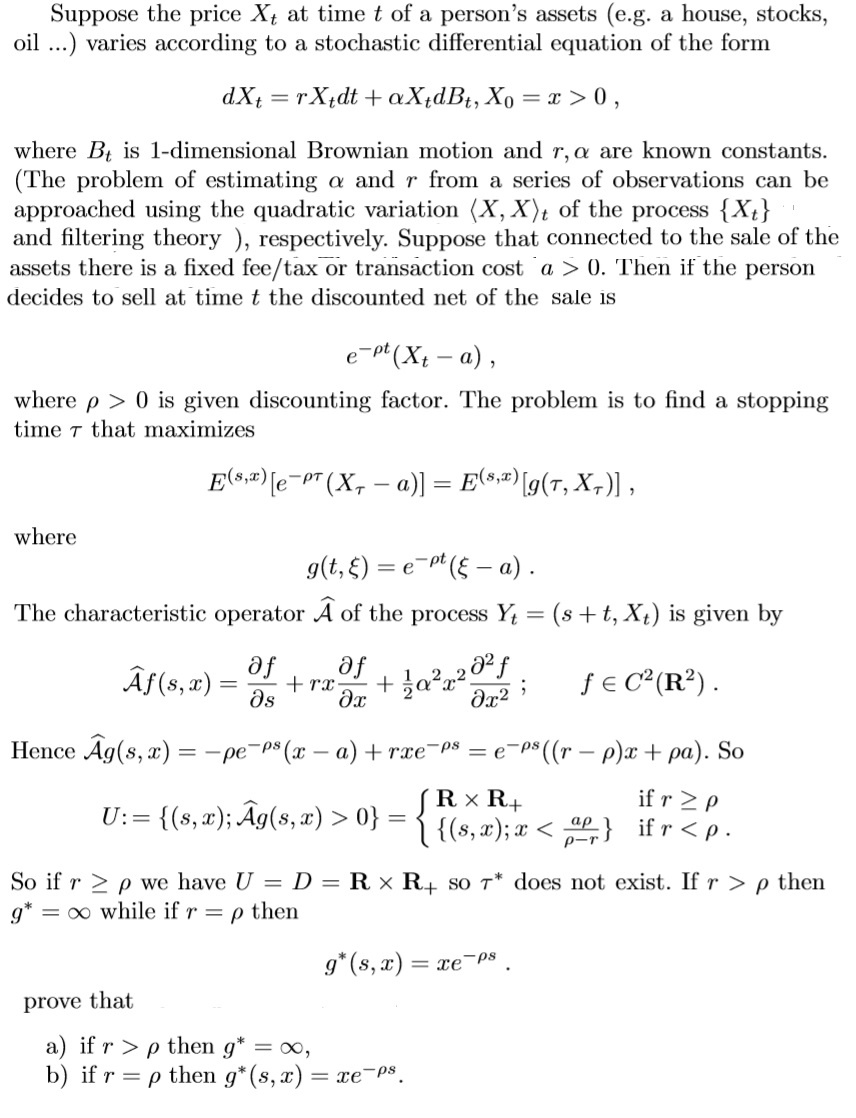
Suppose the price X: at time t of a person's assets (eg. a house, stocks, oil...) varies according to a stochastic differential equation of the form (1X1, = TXtdt + deBf,X = ID 2} 0 1 where Bt is l-dimensional Brownian motion and no: are known constants. (The problem of estimating a and r from a series of observations can be approached using the quadratic variation (X X )t of the process {Xi} ' and ltering theory ), respectively. Suppose that connected to the sale of the assets there' IS a xed fec/ tax or transaction cost a > 0. Then if the person decides to sell at time t the discounted net of the sale is e_pt(Xf- _ a) 3 where p > D is given discounting factor. The problem is to nd a stopping time 1' that maximizes E(S'$)[3_W(Xr all = E(\"$)[9(T,Xr)l . where 96: E} = 6"\"(5 - a)- The characteristic operatOr E of the process Y: = (s + t, X:) is given by As, :13): f 33+mai + 102.13%; I E 02(R2) . Hence Egs, ct) = pe\""' (:1: a) + rare9* = 3'93\"?\" p):r + pa). So a RXR+ ifrzp U:= s,a:;./-l 3,3: >0 = _ a - {( ) g( ) } {{(s,a:),:rpthen 9* = 00 while if r = p then g*(s,:r) = 333"\" . prove that a) ifr>ptheng*=oo, b) if 'r = p then g*(s,:r) = Icep\
Step by Step Solution
There are 3 Steps involved in it

Get step-by-step solutions from verified subject matter experts
 Study Help