







Question: Kindly do if you will be able to answer all questions QUESTION ONE It is generally agreed that sales revenue should only be 'realized and
Kindly do if you will be able to answer all questions 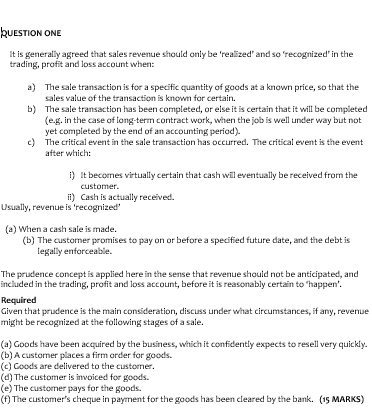
QUESTION ONE It is generally agreed that sales revenue should only be 'realized and so 'recognized' in the trading, profit and loss account when: a) The sale transaction is for a specific quantity of goods at a known price, so that the sales value of the transaction is known for certain. b) The sale transaction has been completed, or else it is certain that it will be completed (e.g. in the case of long-term contract work, when the job is well under way but not yet completed by the end of an accounting period). c) The critical event in the sale transaction has occurred. The critical event is the event after which: i) it becomes virtually certain that cash will eventually be received from the customer. ii) Cash is actually received. Usually, revenue is recognized (a) When a cash sale is made. (b) The customer promises to pay on or before a specified future date, and the debt is legally enforceable. The prudence concept is applied here in the sense that revenue should not be anticipated, and included in the trading, profit and loss account, before it is reasonably certain to 'happen'. Required Given that prudence is the main consideration, discuss under what circumstances, if any, revenue might be recognized at the following stages of a sale. (a) Goods have been acquired by the business, which it confidently expects to resell very quickly. (b) A customer places a firm order for goods. (c) Goods are delivered to the customer. (d) The customer is invoiced for goods. (e) The customer pays for the goods. (f) The customer's cheque in payment for the goods has been cleared by the bank. (15 MARKS) QUESTION ONE It is generally agreed that sales revenue should only be 'realized and so 'recognized' in the trading, profit and loss account when: a) The sale transaction is for a specific quantity of goods at a known price, so that the sales value of the transaction is known for certain. b) The sale transaction has been completed, or else it is certain that it will be completed (e.g. in the case of long-term contract work, when the job is well under way but not yet completed by the end of an accounting period). c) The critical event in the sale transaction has occurred. The critical event is the event after which: i) it becomes virtually certain that cash will eventually be received from the customer. ii) Cash is actually received. Usually, revenue is recognized (a) When a cash sale is made. (b) The customer promises to pay on or before a specified future date, and the debt is legally enforceable. The prudence concept is applied here in the sense that revenue should not be anticipated, and included in the trading, profit and loss account, before it is reasonably certain to 'happen'. Required Given that prudence is the main consideration, discuss under what circumstances, if any, revenue might be recognized at the following stages of a sale. (a) Goods have been acquired by the business, which it confidently expects to resell very quickly. (b) A customer places a firm order for goods. (c) Goods are delivered to the customer. (d) The customer is invoiced for goods. (e) The customer pays for the goods. (f) The customer's cheque in payment for the goods has been cleared by the bank. (15 MARKS)
Step by Step Solution
There are 3 Steps involved in it

Get step-by-step solutions from verified subject matter experts
 Study Help