







Question: kindly do it quickly and Stepwise kindly do all parts ill give Positive Upvotes..................... please mark all parts please............ I. ASSUMPTIONS Consider a slotted multiaccess
kindly do it quickly and Stepwise
kindly do all parts ill give Positive Upvotes.....................
please mark all parts please............
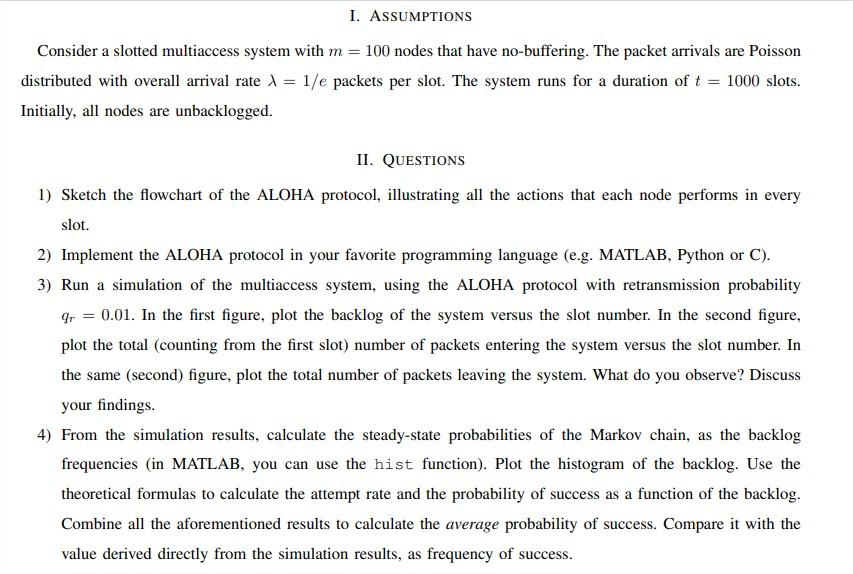
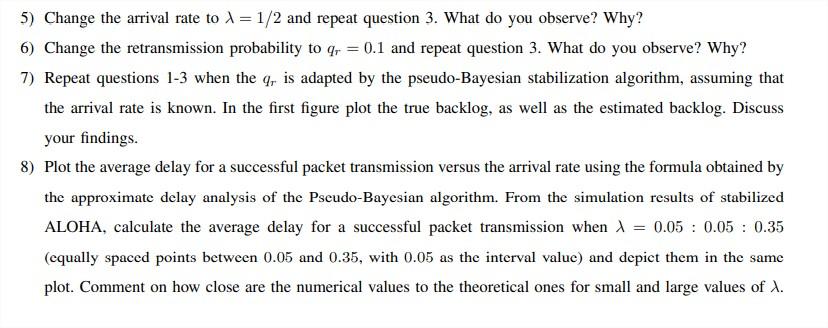
I. ASSUMPTIONS Consider a slotted multiaccess system with m = 100 nodes that have no-buffering. The packet arrivals are Poisson distributed with overall arrival rate = 1/e packets per slot. The system runs for a duration of t = 1000 slots. Initially, all nodes are unbacklogged. II. QUESTIONS 1) Sketch the flowchart of the ALOHA protocol, illustrating all the actions that each node performs in every slot. 2) Implement the ALOHA protocol in your favorite programming language (e.g. MATLAB, Python or C). 3) Run a simulation of the multiaccess system, using the ALOHA protocol with retransmission probability gr = 0.01. In the first figure, plot the backlog of the system versus the slot number. In the second figure, plot the total (counting from the first slot) number of packets entering the system versus the slot number. In the same (second) figure, plot the total number of packets leaving the system. What do you observe? Discuss your findings. 4) From the simulation results, calculate the steady-state probabilities of the Markov chain, as the backlog frequencies in MATLAB, you can use the hist function). Plot the histogram of the backlog. Use the theoretical formulas to calculate the attempt rate and the probability of success as a function of the backlog. Combine all the aforementioned results to calculate the average probability of success. Compare it with the value derived directly from the simulation results, as frequency of success. 5) Change the arrival rate to 1 =1/2 and repeat question 3. What do you observe? Why? 6) Change the retransmission probability to qr = 0.1 and repeat question 3. What do you observe? Why? 7) Repeat questions 1-3 when the q, is adapted by the pseudo-Bayesian stabilization algorithm, assuming that the arrival rate is known. In the first figure plot the true backlog, as well as the estimated backlog. Discuss your findings. 8) Plot the average delay for a successful packet transmission versus the arrival rate using the formula obtained by the approximate delay analysis of the Pseudo-Bayesian algorithm. From the simulation results of stabilized ALOHA, calculate the average delay for a successful packet transmission when = 0.05 : 0.05 : 0.35 (equally spaced points between 0.05 and 0.35, with 0.05 as the interval value) and depict them in the same plot. Comment on how close are the numerical values to the theoretical ones for small and large values of A. = I. ASSUMPTIONS Consider a slotted multiaccess system with m = 100 nodes that have no-buffering. The packet arrivals are Poisson distributed with overall arrival rate = 1/e packets per slot. The system runs for a duration of t = 1000 slots. Initially, all nodes are unbacklogged. II. QUESTIONS 1) Sketch the flowchart of the ALOHA protocol, illustrating all the actions that each node performs in every slot. 2) Implement the ALOHA protocol in your favorite programming language (e.g. MATLAB, Python or C). 3) Run a simulation of the multiaccess system, using the ALOHA protocol with retransmission probability gr = 0.01. In the first figure, plot the backlog of the system versus the slot number. In the second figure, plot the total (counting from the first slot) number of packets entering the system versus the slot number. In the same (second) figure, plot the total number of packets leaving the system. What do you observe? Discuss your findings. 4) From the simulation results, calculate the steady-state probabilities of the Markov chain, as the backlog frequencies in MATLAB, you can use the hist function). Plot the histogram of the backlog. Use the theoretical formulas to calculate the attempt rate and the probability of success as a function of the backlog. Combine all the aforementioned results to calculate the average probability of success. Compare it with the value derived directly from the simulation results, as frequency of success. 5) Change the arrival rate to 1 =1/2 and repeat question 3. What do you observe? Why? 6) Change the retransmission probability to qr = 0.1 and repeat question 3. What do you observe? Why? 7) Repeat questions 1-3 when the q, is adapted by the pseudo-Bayesian stabilization algorithm, assuming that the arrival rate is known. In the first figure plot the true backlog, as well as the estimated backlog. Discuss your findings. 8) Plot the average delay for a successful packet transmission versus the arrival rate using the formula obtained by the approximate delay analysis of the Pseudo-Bayesian algorithm. From the simulation results of stabilized ALOHA, calculate the average delay for a successful packet transmission when = 0.05 : 0.05 : 0.35 (equally spaced points between 0.05 and 0.35, with 0.05 as the interval value) and depict them in the same plot. Comment on how close are the numerical values to the theoretical ones for small and large values of A. =
Step by Step Solution
There are 3 Steps involved in it

Get step-by-step solutions from verified subject matter experts
 Study Help