







Question: Kindly provide solutions to these problems Consider a situation in which a risk-neutral principal wishes to contract an agent to work on a project. The
Kindly provide solutions to these problems
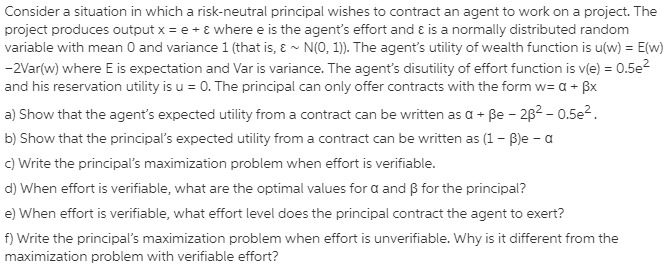
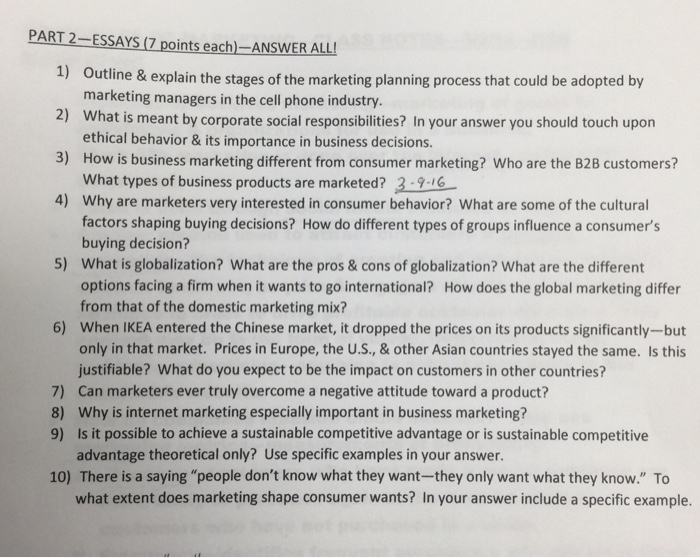
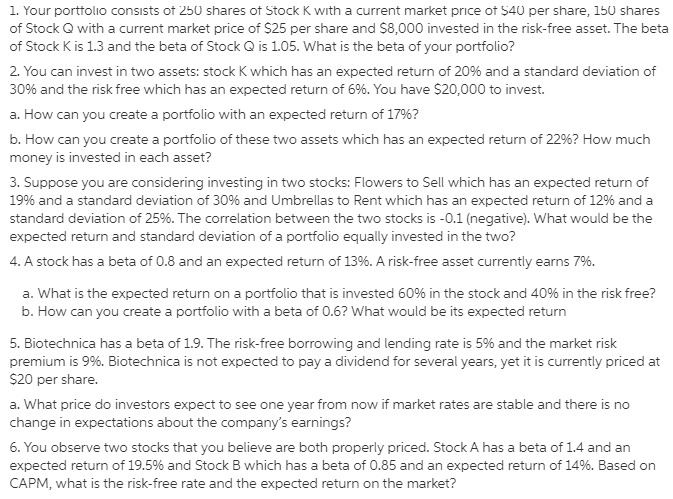
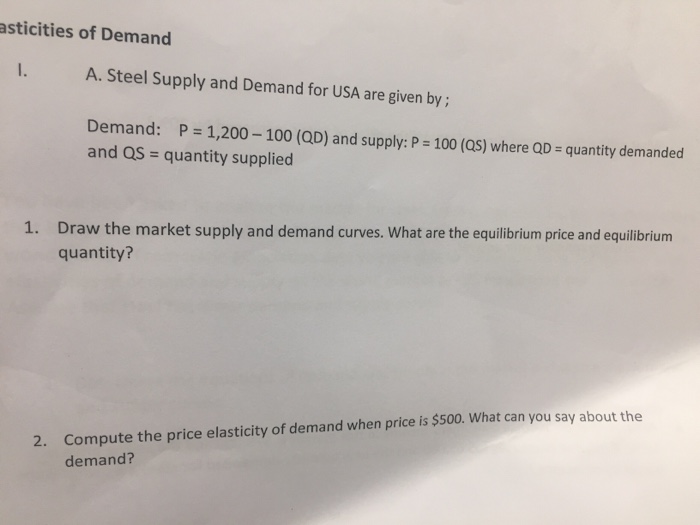
Consider a situation in which a risk-neutral principal wishes to contract an agent to work on a project. The project produces output x = e + $ where e is the agent's effort and & is a normally distributed random variable with mean 0 and variance 1 (that is, & ~ N(0, 1)). The agent's utility of wealth function is u(w) = E(w) -2Var(w) where E is expectation and Var is variance. The agent's disutility of effort function is v(e) = 0.5e- and his reservation utility is u = 0. The principal can only offer contracts with the form w= a + Bx a) Show that the agent's expected utility from a contract can be written as a + Be - 282 - 0.5e2. b) Show that the principal's expected utility from a contract can be written as (1 - B)e - a c) Write the principal's maximization problem when effort is verifiable. d) When effort is verifiable, what are the optimal values for a and B for the principal? e) When effort is verifiable, what effort level does the principal contract the agent to exert? f) Write the principal's maximization problem when effort is unverifiable. Why is it different from the maximization problem with verifiable effort?PART 2-ESSAYS (7 points each)-ANSWER ALL! 1) Outline & explain the stages of the marketing planning process that could be adopted by marketing managers in the cell phone industry. 2) What is meant by corporate social responsibilities? In your answer you should touch upon ethical behavior & its importance in business decisions. 3) How is business marketing different from consumer marketing? Who are the B2B customers? What types of business products are marketed? 3 -9-16 4) Why are marketers very interested in consumer behavior? What are some of the cultural factors shaping buying decisions? How do different types of groups influence a consumer's buying decision? 5) What is globalization? What are the pros & cons of globalization? What are the different options facing a firm when it wants to go international? How does the global marketing differ from that of the domestic marketing mix? 6) When IKEA entered the Chinese market, it dropped the prices on its products significantly-but only in that market. Prices in Europe, the U.S., & other Asian countries stayed the same. Is this justifiable? What do you expect to be the impact on customers in other countries? 7) Can marketers ever truly overcome a negative attitude toward a product? 8) Why is internet marketing especially important in business marketing? 9) Is it possible to achieve a sustainable competitive advantage or is sustainable competitive advantage theoretical only? Use specific examples in your answer. 10) There is a saying "people don't know what they want-they only want what they know." To what extent does marketing shape consumer wants? In your answer include a specific example.1. \"four portfolio consists ot 25D shares o'r Stock K wrth a current market price of 54:1 per share, 15U shares of Stock ID with a current market price of $25 per share and 58,000 invested in the risk-free asset. The beta of Stock K. is 1.3 and the beta of Stock ID is 195. What is the beta of your portfolio? 2 You can invest in two assets: stock Kwhich has an expected return of 29% and a Standard deviation of 313% and the risk free which has an expected return of 5%. You have 520,909 to invest. a. How can you create a portfolio with an expected return of 12%? b. How can you create a portfolio of these two assets which has an expected return of 22%? How much money is invested in each asset? 3. Suppose you are considering investing in two stocks: Flowers to Sell which has an expected return of 19% and a standard deviation of 39% and Umbrellas to Rent which has an expected return of 12% and a standard deviation of 25%. The correlation between the two stocks is I|3.1I[negative]. What would be the expected retum and standard deviation of a portfolio equally invested in the two? 4. A stock has a beta of 0.3 and an expected return of 13%. A risk-free asset currently earns 2%. a. What is the expected return on a portfolio that is invested 513% in the stock and 413% in the risit free? b. How can you create a portfolio with a beta of 0.5? What would be its expected return 5. Biotechnica has a beta of 1.9. The riskfree borrowing and lending rate is 5% and the market rislt premium is 9%. Biotech nica is not expected to pay a dividend for several yea rs, yet it is currently priced at 320 per share. a. What price do investors expect to see one year from now if market rates are stable and there is no change in expectations about the company's earnings? 6. You observe two stocks that you believe are both properly priced. Stock A has a beta of 1.4 and an expected retum of 19.5% and Stock 5 which has a beta of (185 and an expected return of 14% Based on CAPM, what is the risk-free rate and the expected return on the market? asticities of Demand 1. A. Steel Supply and Demand for USA are given by ; Demand: P = 1,200 -100 (QD) and supply: P = 100 (QS) where QD = quantity demanded and QS = quantity supplied 1. Draw the market supply and demand curves. What are the equilibrium price and equilibrium quantity? 2. Compute the price elasticity of demand when price is $500. What can you say about the demand
Step by Step Solution
There are 3 Steps involved in it

Get step-by-step solutions from verified subject matter experts
 Study Help