Question: Kindly Solve this case study Quickly please in 4 hours ............ Part A: Developing a strategy to lead change (1,500 words 40% of the marks)
Kindly Solve this case study Quickly please in 4 hours ............
Part A: Developing a strategy to lead change (1,500 words 40% of the marks)
Task 1 - Strategy Report Produce a 1,500 word report which completes sub-tasks a) and b) below:
a) Using appropriate tools, critically evaluate the operating environment of your chosen case study company and complete a strategic analysis.
b) Propose a strategic change management plan identifying your own leadership style.
Task 2 Launch Materials (1,500 words equivalent 40% of the marks)
a) Create Launch Materials (or similar intervention) to brief your "colleagues" about the Change Programme (including, for instance, project name, logo, tag line, information leaflets and PPT template slides as well as your supporting notes - see below) OR
b) Create Launch Webinar (or similar intervention) for the change programme (10 minutes including, for instance, project name, logo, tag line, PPT slides if applicable, and your audio narration, as well as your supporting notes - see below). OR
c) Design a teaching session on a specific Creativity and Innovation technique (10 minutes recorded session including lesson plan, materials and your audio narration as well as your supporting notes - see below) OR
d) Create two Short-term wins: based upon your analysis in Task 1, design and present two new innovative products, services and/or processes for your case study company (including , for instance, visuals, name, logo, tag line and information leaflets as well as your supporting notes - see below).
Part B: Personal and Professional Account (500 words 10% of the marks)
Task 3:
Write a critical reflective personal and professional account, answering the following question: What skills and behaviours do I need to develop in order to creatively implement a programme of innovative change in a range of contemporary organisations?
Case Study are given below in the form of picture....
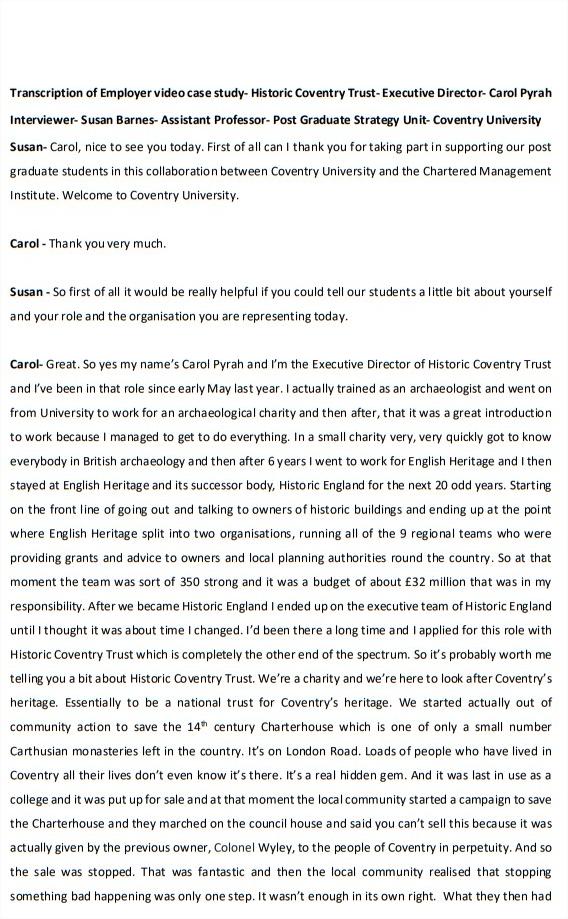
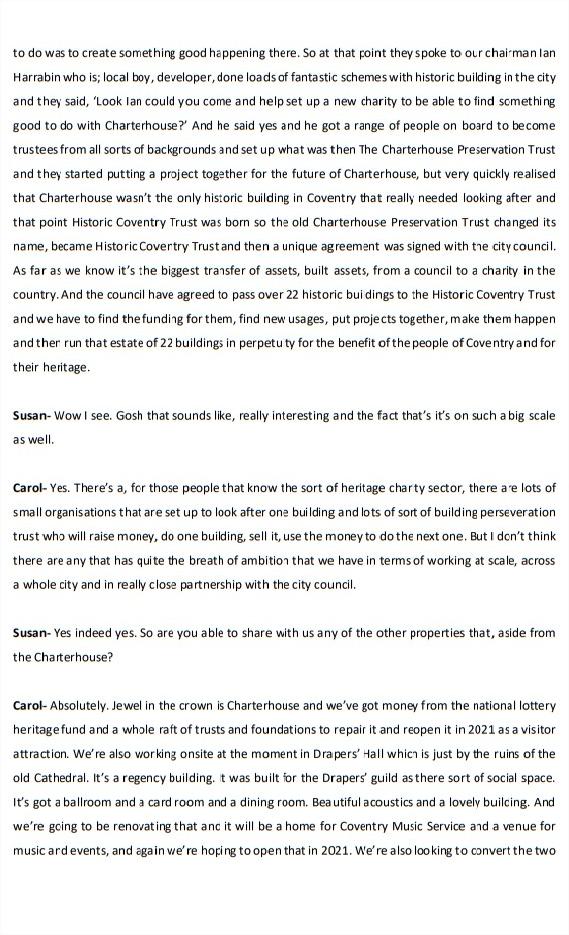
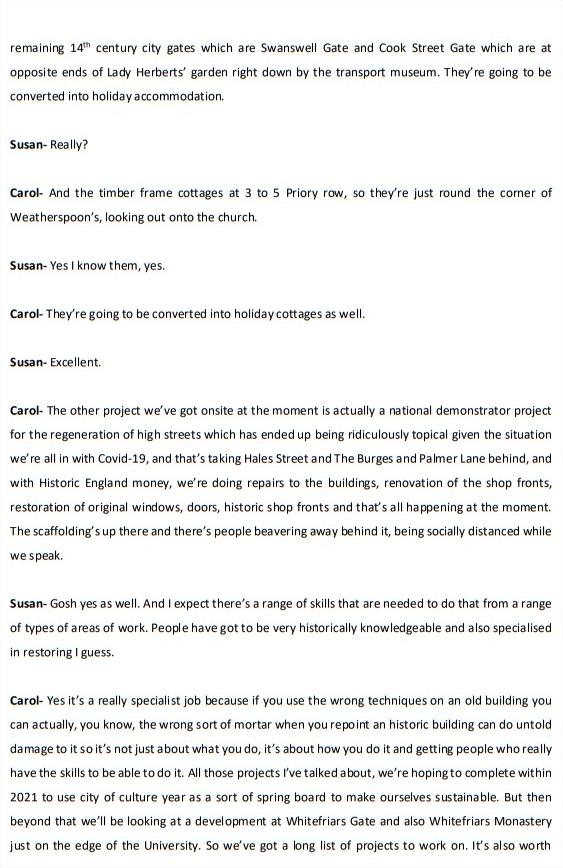
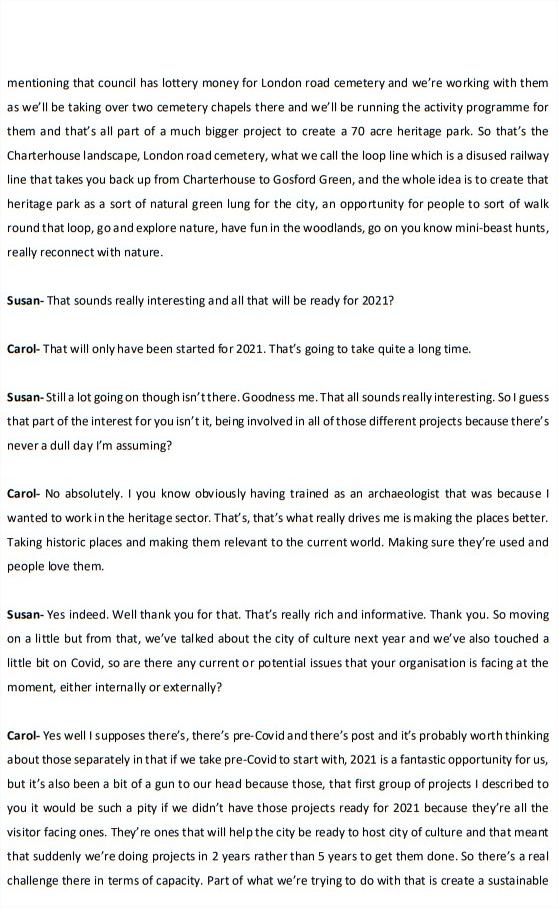
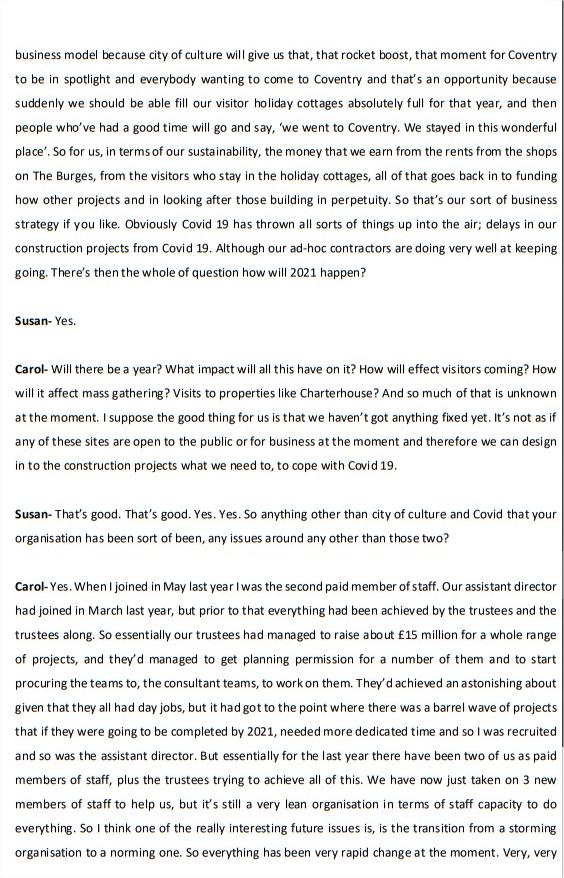
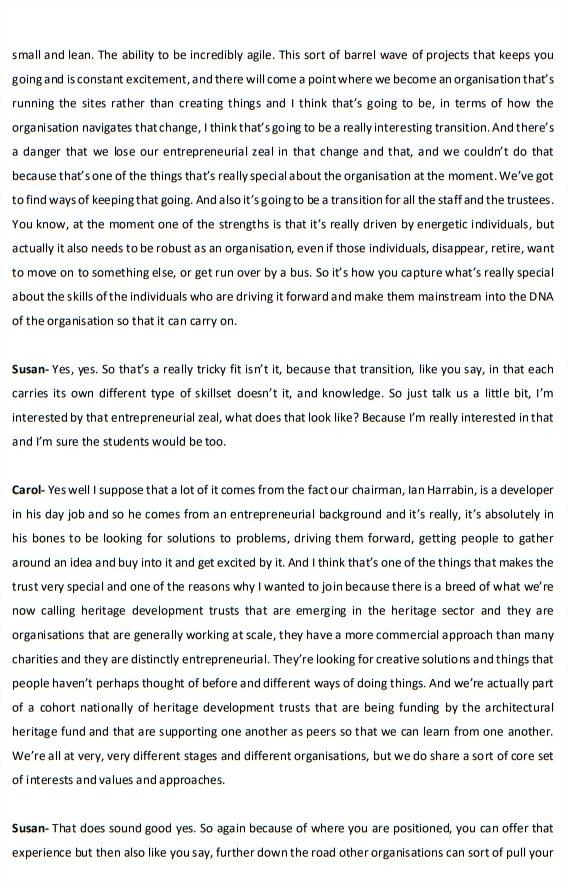
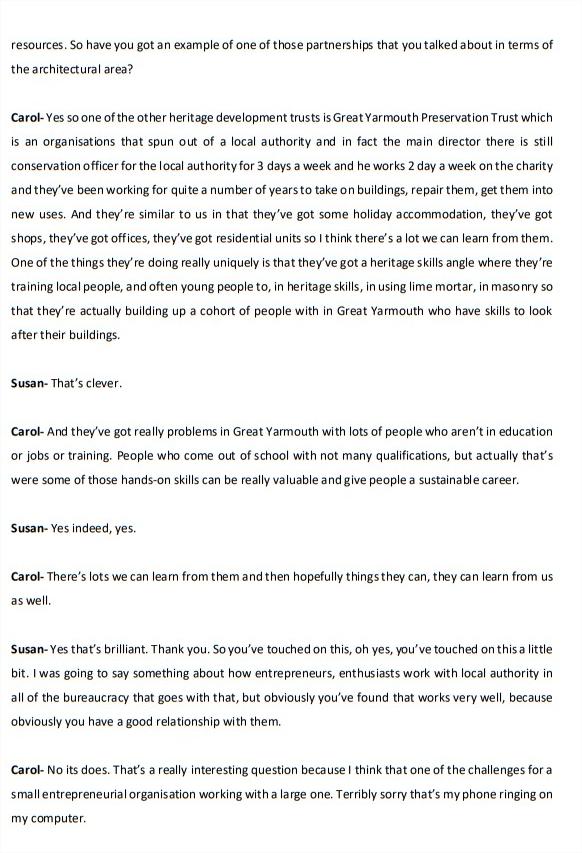
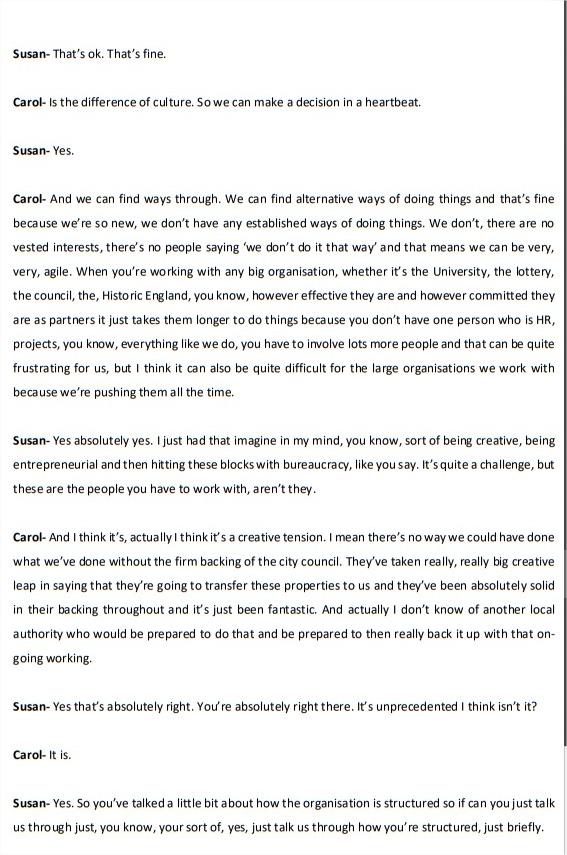
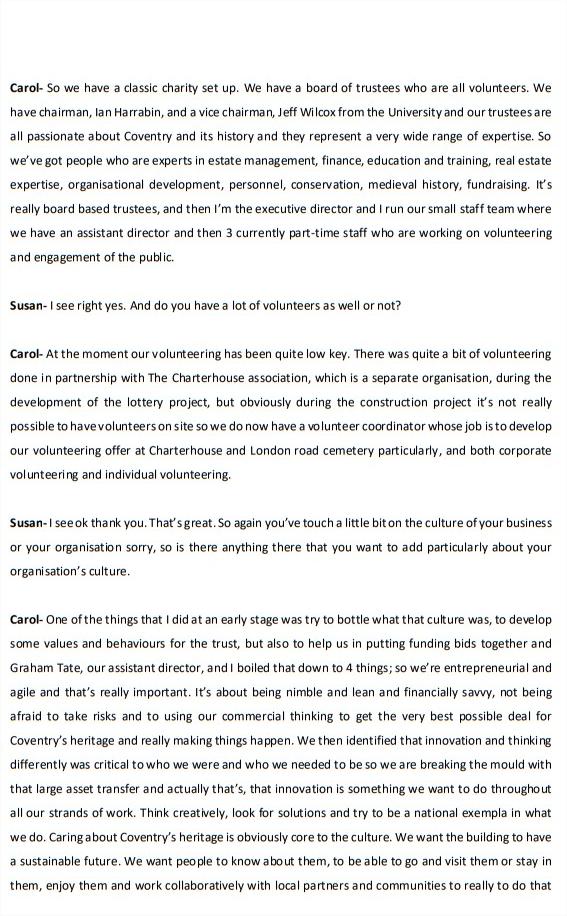
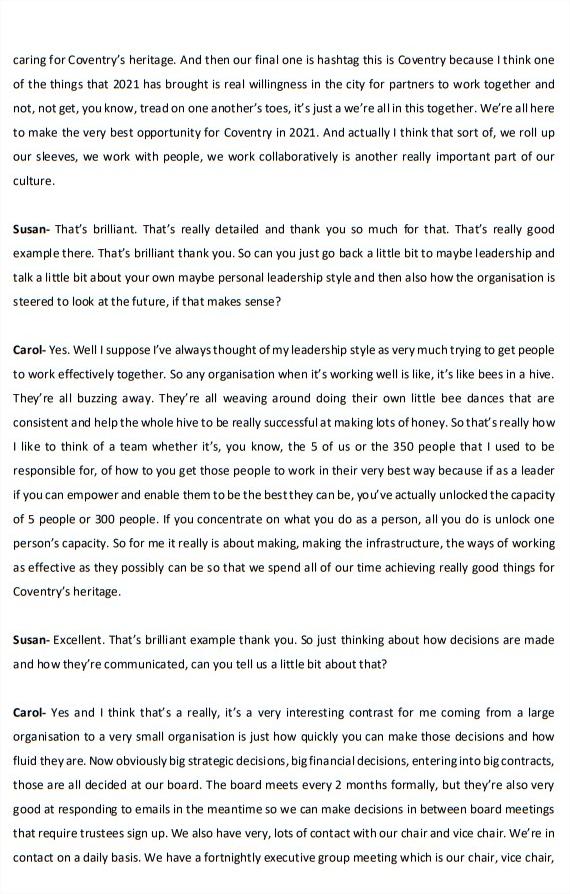
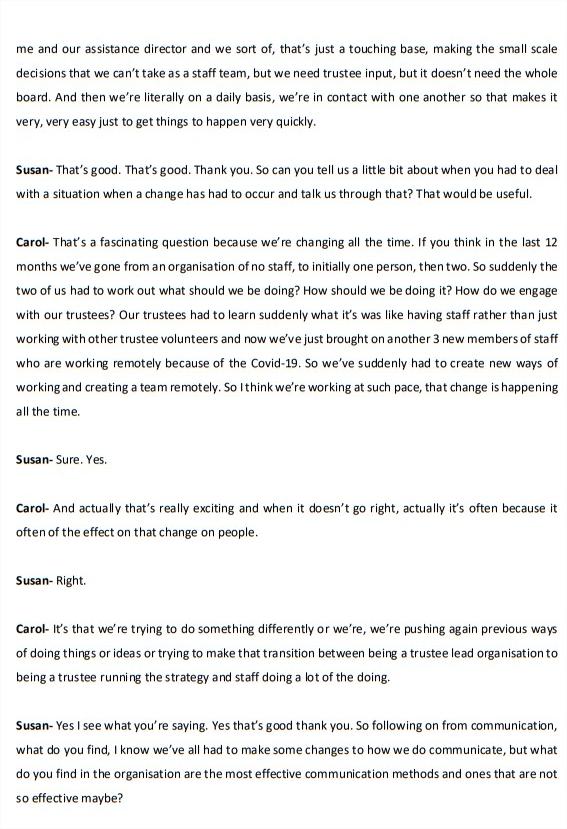
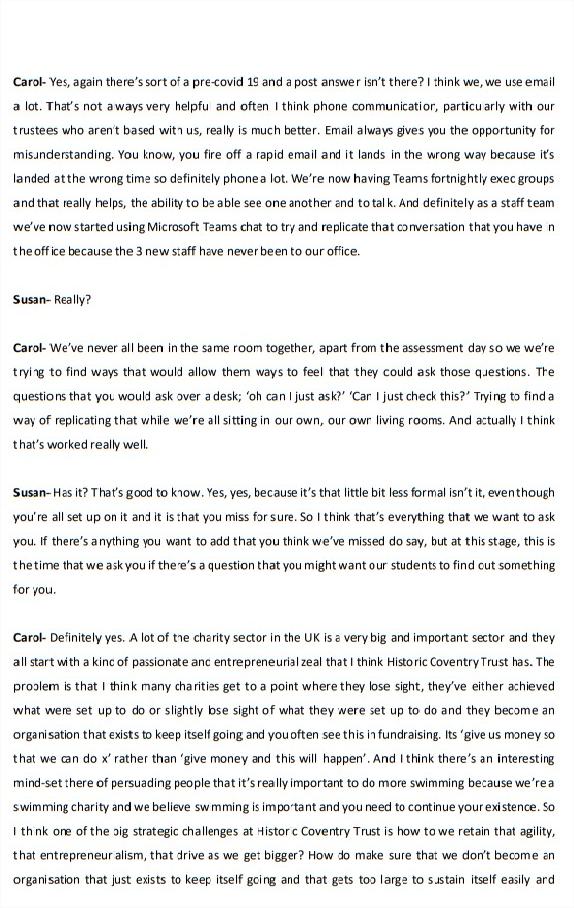
Transcription of Employer video case study- Historic Coventry Trust-Executive Director-Carol Pyrah Interviewer-Susan Barnes- Assistant Professor- Post Graduate Strategy Unit- Coventry University Susan-Carol, nice to see you today. First of all can I thank you for taking part in supporting our post graduate students in this collaboration between Coventry University and the Chartered Management Institute. Welcome to Coventry University. Carol - Thank you very much. Susan - So first of all it would be really helpful if you could tell our students a little bit about yourself and your role and the organisation you are representing today. Carol- Great. So yes my name's Carol Pyrah and I'm the Executive Director of Historic Coventry Trust and I've been in that role since early May last year. I actually trained as an archaeologist and went on from University to work for an archaeological charity and then after, that it was a great introduction to work because I managed to get to do everything. In a small charity very, very quickly got to know everybody in British archaeology and then after 6 years I went to work for English Heritage and I then stayed at English Heritage and its successor body, Historic England for the next 20 odd years. Starting on the front line of going out and talking to owners of historic buildings and ending up at the point where English Heritage split into two organisations, running all of the 9 regional teams who were providing grants and advice to owners and local planning authorities round the country. So at that moment the team was sort of 350 strong and it was a budget of about 32 million that was in my responsibility. After we became Historic England I ended up on the executive team of Historic England until I thought it was about time I changed. I'd been there a long time and I applied for this role with Historic Coventry Trust which is completely the other end of the spectrum. So it's probably worth me telling you a bit about Historic Coventry Trust. We're a charity and we're here to look after Coventry's heritage. Essentially to be a national trust for Coventry's heritage. We started actually out of community action to save the 14* century Charterhouse which is one of only a small number Carthusian monasteries left in the country. It's on London Road. Loads of people who have lived in Coventry all their lives don't even know it's there. It's a real hidden gem. And it was last in use as a college and it was put up for sale and at that moment the local community started a campaign to save the Charterhouse and they marched on the council house and said you can't sell this because it was actually given by the previous owner, Colonel Wyley, to the people of Coventry in perpetuity. And so the sale was stopped. That was fantastic and then the local community realised that stopping something bad happening was only one step. It wasn't enough in its own right. What they then had to do was to create something good happening there. So at that point they spoke to our chairmanlan Harrabin who is; local boy, developer,done loads of fantastic schemes with historic building in the city and they said, 'Look lan could you come and help set up a new charity to be able to find something good to do with Charterhouse?' And he said yes and he got a range of people on board to become trustees from all sorts of backgrounds and set up what was then The Charterhouse Preservation Trust and they started putting a project together for the future of Charterhouse, but very quickly realised that Charterhouse wasn't the only historic building in Coventry that really needed looking after and that point Historic Coventry Trust was born so the old Charterhouse Preservation Trust changed its name, became Historic Covertry Trust and then a unique agreement was signed with the city council. As far as we know it's the biggest transfer of assets, built assets, from a council to a charity in the country. And the council have agreed to pass over 22 historic buidings to the Historic Coventry Trust and we have to find the funding for them, find new usages, put projects together, make them happen and ther run that estate of 22 buildings in perpetuty for the benefit of the people of Coventry and for their heritage. a Susan-Wow I see. Gosh that sounds like, really interesting and the fact that's it's on such a big scale as well. Carol-Yes. There's a, for those people that know the sort of heritage charty sector, there are lots of small organisations that are set up to look after one building and lots of sort of building perseveration trust who will raise money, do one building, sell it, use the money to do the next one. But I don't think there are any that has quite the breath of ambition that we have in terms of working at scale, across a whole city and in really close partnership with the city council. Susan-Yes indeed yes. So are you able to share with us any of the other properties that, aside from the Charterhouse? Carol-Absolutely. Jewel in the crown is Charterhouse and we've got money from the national lottery heritage fund and a whole raft of trusts and foundations to repair it and reopen it in 2021 as a visitor attraction. We're also working onsite at the moment in Drapers' Hall which is just by the ruins of the old Cathedral. It's a regency building. t was built for the Drapers guild as there sort of social space. It's got a ballroom and a card room and a dining room. Bea utiful acoustics and a lovely builcing. And we're going to be renovating that anc it will be a home for Coventry Music Service and a venue for music ard events, and again we're hoping to open that in 2021. We're also looking to convert the two remaining 14th century city gates which are Swanswell Gate and Cook Street Gate which are at opposite ends of Lady Herberts' garden right down by the transport museum. They're going to be converted into holiday accommodation Susan- Really? Carol And the timber frame cottages at 3 to 5 Priory row, so they're just round the corner of Weatherspoon's, looking out onto the church. Susan- Yes I know them, yes. Carol-They're going to be converted into holiday cottages as well. Susan- Excellent Carol- The other project we've got onsite at the moment is actually a national demonstrator project for the regeneration of high streets which has ended up being ridiculously topical given the situation we're all in with Covid-19, and that's taking Hales Street and The Burges and Palmer Lane behind, and with Historic England money, we're doing repairs to the buildings, renovation of the shop fronts, restoration of original windows, doors, historic shop fronts and that's all happening at the moment. The scaffolding's up there and there's people beavering away behind it, being socially distanced while we speak. Susan-Gosh yes as well. And I expect there's a range of skills that are needed to do that from a range of types of areas of work. People have got to be very historically knowledgeable and also specialised in restoring I guess. Carol Yes it's a really specialist job because if you use the wrong techniques on an old building you can actually, you know, the wrong sort of mortar when you repoint an historic building can do untold damage to it so it's not just about what you do, it's about how you do it and getting people who really have the skills to be able to do it. All those projects I've talked about, we're hoping to complete within 2021 to use city of culture year as a sort of spring board to make ourselves sustainable. But then beyond that we'll be looking at a development at Whitefriars Gate and also Whitefriars Monastery just on the edge of the University. So we've got a long list of projects to work on. It's also worth mentioning that council has lottery money for London road cemetery and we're working with them as we'll be taking over two cemetery chapels there and we'll be running the activity programme for them and that's all part of a much bigger project to create a 70 acre heritage park. So that's the Charterhouse landscape, London road cemetery, what we call the loop line which is a disused railway line that takes you back up from Charterhouse to Gosford Green, and the whole idea is to create that heritage park as a sort of natural green lung for the city, an opportunity for people to sort of walk round that loop, go and explore nature, have fun in the woodlands, go on you know mini-beast hunts, really reconnect with nature. Susan- That sounds really interesting and all that will be ready for 2021? Carol- That will only have been started for 2021. That's going to take quite a long time. Susan-Still a lot going on though isn'tthere. Goodness me. That all sounds really interesting. So I guess that part of the interest for you isn't it, being involved in all of those different projects because there's never a dull day I'm assuming? Carol- No absolutely. I you know obviously having trained as an archaeologist that was because I wanted to work in the heritage sector. That's, that's what really drives me is making the places better. Taking historic places and making them relevant to the current world. Making sure they're used and people love them. Susan- Yes indeed. Well thank you for that. That's really rich and informative. Thank you. So moving on a little but from that, we've talked about the city of culture next year and we've also touched a little bit on Covid, so are there any current or potential issues that your organisation is facing at the moment, either internally or externally? Carol Yes well I supposes there's, there's pre-Covid and there's post and it's probably worth thinking about those separately in that if we take pre-Covid to start with, 2021 is a fantastic opportunity for us, but it's also been a bit of a gun to our head because those that first group of projects described to you it would be such a pity if we didn't have those projects ready for 2021 because they're all the visitor facing ones. They're ones that will help the city be ready to host city of culture and that meant that suddenly we're doing projects in 2 years rather than 5 years to get them done. So there's a real challenge there in terms of capacity. Part of what we're trying to do with that is create a sustainable 2 business model because city of culture will give us that, that rocket boost, that moment for Coventry to be in spotlight and everybody wanting to come to Coventry and that's an opportunity because suddenly we should be able fill our visitor holiday cottages absolutely full for that year, and then people who've had a good time will go and say, 'we went to Coventry. We stayed in this wonderful place'. So for us, in terms of our sustainability, the money that we earn from the rents from the shops on The Burges, from the visitors who stay in the holiday cottages, all of that goes back in to funding how other projects and in looking after those building in perpetuity. So that's our sort of business strategy if you like. Obviously Covid 19 has thrown all sorts of things up into the air; delays in our construction projects from Covid 19. Although our ad-hoc contractors are doing very well at keeping going. There's then the whole of question how will 2021 happen? Susan-Yes. Carol- Will there be a year? What impact will all this have on it? How will effect visitors coming? How will it affect mass gathering? Visits to properties like Charterhouse? And so much of that is unknown at the moment. I suppose the good thing for us is that we haven't got anything fixed yet. It's not as if any of these sites are open to the public or for business at the moment and therefore we can design in to the construction projects what we need to, to cope with Covid 19. Susan- That's good. That's good. Yes. Yes. So anything other than city of culture and Covid that your organisation has been sort of been, any issues around any other than those two? Carol-Yes. When I joined in May last year I was the second paid member of staff. Our assistant director had joined in March last year, but prior to that everything had been achieved by the trustees and the trustees along. So essentially our trustees had managed to raise about 15 million for a whole range of projects, and they'd managed to get planning permission for a number of them and to start procuring the teams to, the consultant teams, to work on them. They'd achieved an astonishing about given that they all had day jobs, but it had got to the point where there was a barrel wave of projects that if they were going to be completed by 2021, needed more dedicated time and so I was recruited and so was the assistant director. But essentially for the last year there have been two of us as paid members of staff, plus the trustees trying to achieve all of this. We have now just taken on 3 new members of staff to help us, but it's still a very lean organisation in terms of staff capacity to do everything. So I think one of the really interesting future issues is, is the transition from a storming organisation to a norming one. So everything has been very rapid change at the moment. Very, very small and lean. The ability to be incredibly agile. This sort of barrel wave of projects that keeps you going and is constant excitement, and there will come a point where we become an organisation that's running the sites rather than creating things and I think that's going to be, in terms of how the organisation navigates that change, I think that's going to be a really interesting transition. And there's a danger that we lose our entrepreneurial zeal in that change and that, and we couldn't do that because that's one of the things that's really special about the organisation at the moment. We've got to find ways of keeping that going. And also it's going to be a transition for all the staff and the trustees. You know, at the moment one of the strengths is that it's really driven by energetic individuals, but actually it also needs to be robust as an organisation, even if those individuals, disappear, retire, want to move on to something else, or get run over by a bus. So it's how you capture what's really special about the skills of the individuals who are driving it forward and make them mainstream into the DNA of the organisation so that it can carry on Susan-Yes, yes. So that's a really tricky fit isn't it, because that transition, like you say, in that each carries its own different type of skillset doesn't it, and knowledge. So just talk us a little bit, I'm interested by that entrepreneurial zeal, what does that look like? Because I'm really interested in that and I'm sure the students would be too. Carol Yes well I suppose that a lot of it comes from the fact our chairman, lan Harrabin, is a developer in his day job and so he comes from an entrepreneurial background and it's really, it's absolutely in his bones to be looking for solutions to problems, driving them forward, getting people to gather around an idea and buy into it and get excited by it. And I think that's one of the things that makes the trust very special and one of the reasons why I wanted to join because there is a breed of what we're now calling heritage development trusts that are emerging in the heritage sector and they are organisations that are generally working at scale, they have a more commercial approach than many charities and they are distinctly entrepreneurial. They're looking for creative solutions and things that people haven't perhaps thought of before and different ways of doing things. And we're actually part of a cohort nationally of heritage development trusts that are being funding by the architectural heritage fund and that are supporting one another as peers so that we can learn from one another. We're all at very, very different stages and different organisations, but we do share a sort of core set of interests and values and approaches. Susan- That does sound good yes. So again because of where you are positioned, you can offer that experience but then also like you say, further down the road other organisations can sort of pull your resources. So have you got an example of one of those partnerships that you talked about in terms of the architectural area? Carol-Yes so one of the other heritage development trusts is Great Yarmouth Preservation Trust which is an organisations that spun out of a local authority and in fact the main director there is still conservation officer for the local authority for 3 days a week and he works 2 day a week on the charity and they've been working for quite a number of years to take on buildings, repair them, get them into new uses. And they're similar to us in that they've got some holiday accommodation, they've got shops, they've got offices, they've got residential units so I think there's a lot we can learn from them. One of the things they're doing really uniquely is that they've got a heritage skills angle where they're training local people, and often young people to, in heritage skills, in using lime mortar, in masonry so that they're actually building up a cohort of people with in Great Yarmouth who have skills to look after their buildings. Susan- That's clever. Carol-And they've got really problems in Great Yarmouth with lots of people who aren't in education or jobs or training. People who come out of school with not many qualifications, but actually that's were some of those hands-on skills can be really valuable and give people a sustainable career. Susan-Yes indeed, yes. Carol- There's lots we can learn from them and then hopefully things they can, they can learn from us as well. Susan-Yes that's brilliant. Thank you. So you've touched on this, oh yes, you've touched on this a little bit. I was going to say something about how entrepreneurs, enthusiasts work with local authority in all of the bureaucracy that goes with that, but obviously you've found that works very well, because obviously you have a good relationship with them. Carol- No its does. That's a really interesting question because I think that one of the challenges for a small entrepreneurial organisation working with a large one. Terribly sorry that's my phone ringing on my computer. Susan- That's ok. That's fine. Carol- Is the difference of culture. So we can make a decision in a heartbeat. Susan-Yes. Carol And we can find ways through. We can find alternative ways of doing things and that's fine because we're so new, we don't have any established ways of doing things. We don't, there are no vested interests, there's no people saying 'we don't do it that way and that means we can be very, very, agile. When you're working with any big organisation, whether it's the University, the lottery, the council, the, Historic England, you know, however effective they are and however committed they are as partners it just takes them longer to do things because you don't have one person who is HR, projects, you know, everything like we do, you have to involve lots more people and that can be quite frustrating for us, but I think it can also be quite difficult for the large organisations we work with because we're pushing them all the time. Susan-Yes absolutely yes. I just had that imagine in my mind, you know, sort of being creative, being entrepreneurial and then hitting these blocks with bureaucracy, like you say. It's quite a challenge, but these are the people you have to work with, aren't they. Carol- And I think it's, actually I think it's a creative tension. I mean there's no way we could have done what we've done without the firm backing of the city council. They've taken really, really big creative leap in saying that they're going to transfer these properties to us and they've been absolutely solid in their backing throughout and it's just been fantastic. And actually I don't know of another local authority who would be prepared to do that and be prepared to then really back it up with that on- going working. Susan-Yes that's absolutely right. You're absolutely right there. It's unprecedented I think isn't it? Carol- it is. Susan-Yes. So you've talked a little bit about how the organisation is structured so if can you just talk us through just, you know, your sort of, yes, just talk us through how you're structured, just briefly. Carol- So we have a classic charity set up. We have a board of trustees who are all volunteers. We have chairman, lan Harrabin, and a vice chairman, Jeff Wilcox from the University and our trustees are all passionate about Coventry and its history and they represent a very wide range of expertise. So we've got people who are experts in estate management, finance, education and training, real estate expertise, organisational development, personnel, conservation, medieval history, fundraising. It's really board based trustees, and then I'm the executive director and I run our small staff team where we have an assistant director and then 3 currently part-time staff who are working on volunteering and engagement of the public. Susan- I see right yes. And do you have a lot of volunteers as well or not? Carol- At the moment our volunteering has been quite low key. There was quite a bit of volunteering done in partnership with The Charterhouse association, which is a separate organisation, during the development of the lottery project, but obviously during the construction project it's not really possible to have volunteers on site so we do now have a volunteer coordinator whose job is to develop our volunteering offer at Charterhouse and London road cemetery particularly, and both corporate volunteering and individual volunteering. Susan-I see ok thank you. That's great. So again you've touch a little bit on the culture of your business or your organisation sorry, so is there anything there that you want to add particularly about your organisation's culture. Carol- One of the things that I did at an early stage was try to bottle what that culture was, to develop some values and behaviours for the trust, but also to help us in putting funding bids together and Graham Tate, our assistant director, and I boiled that down to 4 things; so we're entrepreneurial and agile and that's really important. It's about being nimble and lean and financially savvy, not being afraid to take risks and to using our commercial thinking to get the very best possible deal for Coventry's heritage and really making things happen. We then identified that innovation and thinking differently was critical to who we were and who we needed to be so we are breaking the mould with that large asset transfer and actually that's, that innovation is something we want to do throughout all our strands of work. Think creatively, look for solutions and try to be a national exempla in what we do. Caring about Coventry's heritage is obviously core to the culture. We want the building to have a sustainable future. We want people to know about them, to be able to go and visit them or stay in them, enjoy them and work collaboratively with local partners and communities to really to do that caring for Coventry's heritage. And then our final one is hashtag this is Coventry because I think one of the things that 2021 has brought is real willingness in the city for partners to work together and not, not get, you know, tread on one another's toes, it's just a we're all in this together. We're all here to make the very best opportunity for Coventry in 2021. And actually I think that sort of, we roll up our sleeves, we work with people, we work collaboratively is another really important part of our culture. Susan- That's brilliant. That's really detailed and thank you so much for that. That's really good example there. That's brilliant thank you. So can you just go back a little bit to maybe leadership and talk a little bit about your own maybe personal leadership style and then also how the organisation is steered to look at the future, if that makes sense? Carol-Yes. Well I suppose I've always thought of my leadership style as very much trying to get people to work effectively together. So any organisation when it's working well is like, it's like bees in a hive. They're all buzzing away. They're all weaving around doing their own little bee dances that are consistent and help the whole hive to be really successful at making lots of honey. So that's really how I like to think of a team whether it's, you know, the 5 of us or the 350 people that I used to be responsible for, of how to you get those people to work in their very best way because if as a leader if you can empower and enable them to be the best they can be, you've actually unlocked the capacity of 5 people or 300 people. If you concentrate on what you do as a person, all you do is unlock one person's capacity. So for me it really is about making, making the infrastructure, the ways of working as effective as they possibly can be so that we spend all of our time achieving really good things for Coventry's heritage. Susan- Excellent. That's brilliant example thank you. So just thinking about how decisions are made and how they're communicated, can you tell us a little bit about that? Carol Yes and I think that's a really, it's a very interesting contrast for me coming from a large organisation to a very small organisation is just how quickly you can make those decisions and how fluid they are. Now obviously big strategic decisions, big financial decisions, entering into big contracts, those are all decided at our board. The board meets every 2 months formally, but they're also very good at responding to emails in the meantime so we can make decisions in between board meetings that require trustees sign up. We also have very, lots of contact with our chair and vice chair. We're in contact on a daily basis. We have a fortnightly executive group meeting which is our chair, vice chair, me and our assistance director and we sort of, that's just a touching base, making the small scale decisions that we can't take as a staff team, but we need trustee input, but it doesn't need the whole board. And then we're literally on a daily basis, we're in contact with one another so that makes it very, very easy just to get things to happen very quickly. Susan- That's good. That's good. Thank you. So can you tell us a little bit about when you had to deal with a situation when a change has had to occur and talk us through that? That would be useful. Carol- That's a fascinating question because we're changing all the time. If you think in the last 12 months we've gone from an organisation of no staff, to initially one person, then two. So suddenly the two of us had to work out what should we be doing? How should we be doing it? How do we engage with our trustees? Our trustees had to learn suddenly what it's was like having staff rather than just working with other trustee volunteers and now we've just brought on another 3 new members of staff who are working remotely because of the Covid-19. So we've suddenly had to create new ways of working and creating a team remotely. So I think we're working at such pace, that change is happening all the time. Susan-Sure. Yes. Carol- And actually that's really exciting and when it doesn't go right, actually it's often because it often of the effect on that change on people. Susan- Right Carol- It's that we're trying to do something differently or we're, we're pushing again previous ways of doing things or ideas or trying to make that transition between being a trustee lead organisation to being a trustee running the strategy and staff doing a lot of the doing. Susan-Yes I see what you're saying. Yes that's good thank you. So following on from communication, what do you find, I know we've all had to make some changes to how we do communicate, but what do you find in the organisation are the most effective communication methods and ones that are not so effective maybe? Carol-Yes, again there's sort of a pre-covid 19 and a post answer isn't there? I think we, we use email a lot. That's not aways very helpfu and often I think phone communicatior, particu arly with our trustees who aren't based with us, really is much better. Email always gives you the opportunity for misunderstanding. You know, you fire off a rapid email and it lands in the wrong way because it's landed at the wrong time so definitely phone a lot. We're now having Teams fortnightly exec groups and that really helps, the ability to be able see one another and to talk. And definitely as a staff team we've now started using Microsoft Teams chat to try and replicate that conversation that you have n the office because the 3 new staff have never been to our office. Susan- Really? Carol We've never all been in the same room together, apart from the assessment day so we we're trying to find ways that would allow them ways to feel that they could ask those questions. The questions that you would ask over a desk; 'oh can I just ask?' 'Car I just check this?' Trying to find a way of replicating that while we're all sitting in our own, our owr living rooms. And actually I think that's worked really well. Susan-Has it? That's good to know. Yes, yes, because it's that little bit less formal isn't it, eventhough you're all set up on it and it is that you miss for sure. So I think that's everything that we want to ask you. If there's anything you want to add that you think we've missed do say, but at this stage, this is the time that we ask you if the e's a question that you might want our students to find cut something for you. Carol- Definitely yes. A lot of the charity sector in the UK is a very big and important sector and they all start with a kinc of passionate and entrepreneurial zeal that I think Historic Coventry Trust has. The problem is that I think many charities get to a point where they lose sight, they've either achieved what were set up to do or slightly bse sight of what they were set up to do and they become an organisation that exists to keep itself going and you often see this in fundraising. Its 'give us money so that we can do x' rather than 'give money and this will happen'. And I think there's an interesting mind-set there of persuading people that it's really important to do more swimming because we're a swimming charity and we believe swmming is important and you need to continue your existence. So I th nk one of the big strategic challenges at Historc Coventry Trust is how to we retain that agility, that entrepreneur alism, that drive as we get bigger? How do make sure that we don't become an organisation that just exists to keep itself going and that gets too large to sustain itself easily ard therefore you're constantly running to keep the staff you've got going rather than actually raising money to do new things? Susan- That's an excellent question. That's certainly set them some challenges. Thank you. That's brilliant. Thanks very much. So that concludes our time together today Carol. Thank you ever such a lot for your time once again and the information that you've provided is really invaluable and our students will get to task with that, no doubts what so ever. So thank you again for your time. Bye-bye. Carol-That's a pleasure. That's great to talk to you. Transcription of Employer video case study- Historic Coventry Trust-Executive Director-Carol Pyrah Interviewer-Susan Barnes- Assistant Professor- Post Graduate Strategy Unit- Coventry University Susan-Carol, nice to see you today. First of all can I thank you for taking part in supporting our post graduate students in this collaboration between Coventry University and the Chartered Management Institute. Welcome to Coventry University. Carol - Thank you very much. Susan - So first of all it would be really helpful if you could tell our students a little bit about yourself and your role and the organisation you are representing today. Carol- Great. So yes my name's Carol Pyrah and I'm the Executive Director of Historic Coventry Trust and I've been in that role since early May last year. I actually trained as an archaeologist and went on from University to work for an archaeological charity and then after, that it was a great introduction to work because I managed to get to do everything. In a small charity very, very quickly got to know everybody in British archaeology and then after 6 years I went to work for English Heritage and I then stayed at English Heritage and its successor body, Historic England for the next 20 odd years. Starting on the front line of going out and talking to owners of historic buildings and ending up at the point where English Heritage split into two organisations, running all of the 9 regional teams who were providing grants and advice to owners and local planning authorities round the country. So at that moment the team was sort of 350 strong and it was a budget of about 32 million that was in my responsibility. After we became Historic England I ended up on the executive team of Historic England until I thought it was about time I changed. I'd been there a long time and I applied for this role with Historic Coventry Trust which is completely the other end of the spectrum. So it's probably worth me telling you a bit about Historic Coventry Trust. We're a charity and we're here to look after Coventry's heritage. Essentially to be a national trust for Coventry's heritage. We started actually out of community action to save the 14* century Charterhouse which is one of only a small number Carthusian monasteries left in the country. It's on London Road. Loads of people who have lived in Coventry all their lives don't even know it's there. It's a real hidden gem. And it was last in use as a college and it was put up for sale and at that moment the local community started a campaign to save the Charterhouse and they marched on the council house and said you can't sell this because it was actually given by the previous owner, Colonel Wyley, to the people of Coventry in perpetuity. And so the sale was stopped. That was fantastic and then the local community realised that stopping something bad happening was only one step. It wasn't enough in its own right. What they then had to do was to create something good happening there. So at that point they spoke to our chairmanlan Harrabin who is; local boy, developer,done loads of fantastic schemes with historic building in the city and they said, 'Look lan could you come and help set up a new charity to be able to find something good to do with Charterhouse?' And he said yes and he got a range of people on board to become trustees from all sorts of backgrounds and set up what was then The Charterhouse Preservation Trust and they started putting a project together for the future of Charterhouse, but very quickly realised that Charterhouse wasn't the only historic building in Coventry that really needed looking after and that point Historic Coventry Trust was born so the old Charterhouse Preservation Trust changed its name, became Historic Covertry Trust and then a unique agreement was signed with the city council. As far as we know it's the biggest transfer of assets, built assets, from a council to a charity in the country. And the council have agreed to pass over 22 historic buidings to the Historic Coventry Trust and we have to find the funding for them, find new usages, put projects together, make them happen and ther run that estate of 22 buildings in perpetuty for the benefit of the people of Coventry and for their heritage. a Susan-Wow I see. Gosh that sounds like, really interesting and the fact that's it's on such a big scale as well. Carol-Yes. There's a, for those people that know the sort of heritage charty sector, there are lots of small organisations that are set up to look after one building and lots of sort of building perseveration trust who will raise money, do one building, sell it, use the money to do the next one. But I don't think there are any that has quite the breath of ambition that we have in terms of working at scale, across a whole city and in really close partnership with the city council. Susan-Yes indeed yes. So are you able to share with us any of the other properties that, aside from the Charterhouse? Carol-Absolutely. Jewel in the crown is Charterhouse and we've got money from the national lottery heritage fund and a whole raft of trusts and foundations to repair it and reopen it in 2021 as a visitor attraction. We're also working onsite at the moment in Drapers' Hall which is just by the ruins of the old Cathedral. It's a regency building. t was built for the Drapers guild as there sort of social space. It's got a ballroom and a card room and a dining room. Bea utiful acoustics and a lovely builcing. And we're going to be renovating that anc it will be a home for Coventry Music Service and a venue for music ard events, and again we're hoping to open that in 2021. We're also looking to convert the two remaining 14th century city gates which are Swanswell Gate and Cook Street Gate which are at opposite ends of Lady Herberts' garden right down by the transport museum. They're going to be converted into holiday accommodation Susan- Really? Carol And the timber frame cottages at 3 to 5 Priory row, so they're just round the corner of Weatherspoon's, looking out onto the church. Susan- Yes I know them, yes. Carol-They're going to be converted into holiday cottages as well. Susan- Excellent Carol- The other project we've got onsite at the moment is actually a national demonstrator project for the regeneration of high streets which has ended up being ridiculously topical given the situation we're all in with Covid-19, and that's taking Hales Street and The Burges and Palmer Lane behind, and with Historic England money, we're doing repairs to the buildings, renovation of the shop fronts, restoration of original windows, doors, historic shop fronts and that's all happening at the moment. The scaffolding's up there and there's people beavering away behind it, being socially distanced while we speak. Susan-Gosh yes as well. And I expect there's a range of skills that are needed to do that from a range of types of areas of work. People have got to be very historically knowledgeable and also specialised in restoring I guess. Carol Yes it's a really specialist job because if you use the wrong techniques on an old building you can actually, you know, the wrong sort of mortar when you repoint an historic building can do untold damage to it so it's not just about what you do, it's about how you do it and getting people who really have the skills to be able to do it. All those projects I've talked about, we're hoping to complete within 2021 to use city of culture year as a sort of spring board to make ourselves sustainable. But then beyond that we'll be looking at a development at Whitefriars Gate and also Whitefriars Monastery just on the edge of the University. So we've got a long list of projects to work on. It's also worth mentioning that council has lottery money for London road cemetery and we're working with them as we'll be taking over two cemetery chapels there and we'll be running the activity programme for them and that's all part of a much bigger project to create a 70 acre heritage park. So that's the Charterhouse landscape, London road cemetery, what we call the loop line which is a disused railway line that takes you back up from Charterhouse to Gosford Green, and the whole idea is to create that heritage park as a sort of natural green lung for the city, an opportunity for people to sort of walk round that loop, go and explore nature, have fun in the woodlands, go on you know mini-beast hunts, really reconnect with nature. Susan- That sounds really interesting and all that will be ready for 2021? Carol- That will only have been started for 2021. That's going to take quite a long time. Susan-Still a lot going on though isn'tthere. Goodness me. That all sounds really interesting. So I guess that part of the interest for you isn't it, being involved in all of those different projects because there's never a dull day I'm assuming? Carol- No absolutely. I you know obviously having trained as an archaeologist that was because I wanted to work in the heritage sector. That's, that's what really drives me is making the places better. Taking historic places and making them relevant to the current world. Making sure they're used and people love them. Susan- Yes indeed. Well thank you for that. That's really rich and informative. Thank you. So moving on a little but from that, we've talked about the city of culture next year and we've also touched a little bit on Covid, so are there any current or potential issues that your organisation is facing at the moment, either internally or externally? Carol Yes well I supposes there's, there's pre-Covid and there's post and it's probably worth thinking about those separately in that if we take pre-Covid to start with, 2021 is a fantastic opportunity for us, but it's also been a bit of a gun to our head because those that first group of projects described to you it would be such a pity if we didn't have those projects ready for 2021 because they're all the visitor facing ones. They're ones that will help the city be ready to host city of culture and that meant that suddenly we're doing projects in 2 years rather than 5 years to get them done. So there's a real challenge there in terms of capacity. Part of what we're trying to do with that is create a sustainable 2 business model because city of culture will give us that, that rocket boost, that moment for Coventry to be in spotlight and everybody wanting to come to Coventry and that's an opportunity because suddenly we should be able fill our visitor holiday cottages absolutely full for that year, and then people who've had a good time will go and say, 'we went to Coventry. We stayed in this wonderful place'. So for us, in terms of our sustainability, the money that we earn from the rents from the shops on The Burges, from the visitors who stay in the holiday cottages, all of that goes back in to funding how other projects and in looking after those building in perpetuity. So that's our sort of business strategy if you like. Obviously Covid 19 has thrown all sorts of things up into the air; delays in our construction projects from Covid 19. Although our ad-hoc contractors are doing very well at keeping going. There's then the whole of question how will 2021 happen? Susan-Yes. Carol- Will there be a year? What impact will all this have on it? How will effect visitors coming? How will it affect mass gathering? Visits to properties like Charterhouse? And so much of that is unknown at the moment. I suppose the good thing for us is that we haven't got anything fixed yet. It's not as if any of these sites are open to the public or for business at the moment and therefore we can design in to the construction projects what we need to, to cope with Covid 19. Susan- That's good. That's good. Yes. Yes. So anything other than city of culture and Covid that your organisation has been sort of been, any issues around any other than those two? Carol-Yes. When I joined in May last year I was the second paid member of staff. Our assistant director had joined in March last year, but prior to that everything had been achieved by the trustees and the trustees along. So essentially our trustees had managed to raise about 15 million for a whole range of projects, and they'd managed to get planning permission for a number of them and to start procuring the teams to, the consultant teams, to work on them. They'd achieved an astonishing about given that they all had day jobs, but it had got to the point where there was a barrel wave of projects that if they were going to be completed by 2021, needed more dedicated time and so I was recruited and so was the assistant director. But essentially for the last year there have been two of us as paid members of staff, plus the trustees trying to achieve all of this. We have now just taken on 3 new members of staff to help us, but it's still a very lean organisation in terms of staff capacity to do everything. So I think one of the really interesting future issues is, is the transition from a storming organisation to a norming one. So everything has been very rapid change at the moment. Very, very small and lean. The ability to be incredibly agile. This sort of barrel wave of projects that keeps you going and is constant excitement, and there will come a point where we become an organisation that's running the sites rather than creating things and I think that's going to be, in terms of how the organisation navigates that change, I think that's going to be a really interesting transition. And there's a danger that we lose our entrepreneurial zeal in that change and that, and we couldn't do that because that's one of the things that's really special about the organisation at the moment. We've got to find ways of keeping that going. And also it's going to be a transition for all the staff and the trustees. You know, at the moment one of the strengths is that it's really driven by energetic individuals, but actually it also needs to be robust as an organisation, even if those individuals, disappear, retire, want to move on to something else, or get run over by a bus. So it's how you capture what's really special about the skills of the individuals who are driving it forward and make them mainstream into the DNA of the organisation so that it can carry on Susan-Yes, yes. So that's a really tricky fit isn't it, because that transition, like you say, in that each carries its own different type of skillset doesn't it, and knowledge. So just talk us a little bit, I'm interested by that entrepreneurial zeal, what does that look like? Because I'm really interested in that and I'm sure the students would be too. Carol Yes well I suppose that a lot of it comes from the fact our chairman, lan Harrabin, is a developer in his day job and so he comes from an entrepreneurial background and it's really, it's absolutely in his bones to be looking for solutions to problems, driving them forward, getting people to gather around an idea and buy into it and get excited by it. And I think that's one of the things that makes the trust very special and one of the reasons why I wanted to join because there is a breed of what we're now calling heritage development trusts that are emerging in the heritage sector and they are organisations that are generally working at scale, they have a more commercial approach than many charities and they are distinctly entrepreneurial. They're looking for creative solutions and things that people haven't perhaps thought of before and different ways of doing things. And we're actually part of a cohort nationally of heritage development trusts that are being funding by the architectural heritage fund and that are supporting one another as peers so that we can learn from one another. We're all at very, very different stages and different organisations, but we do share a sort of core set of interests and values and approaches. Susan- That does sound good yes. So again because of where you are positioned, you can offer that experience but then also like you say, further down the road other organisations can sort of pull your resources. So have you got an example of one of those partnerships that you talked about in terms of the architectural area? Carol-Yes so one of the other heritage development trusts is Great Yarmouth Preservation Trust which is an organisations that spun out of a local authority and in fact the main director there is still conservation officer for the local authority for 3 days a week and he works 2 day a week on the charity and they've been working for quite a number of years to take on buildings, repair them, get them into new uses. And they're similar to us in that they've got some holiday accommodation, they've got shops, they've got offices, they've got residential units so I think there's a lot we can learn from them. One of the things they're doing really uniquely is that they've got a heritage skills angle where they're training local people, and often young people to, in heritage skills, in using lime mortar, in masonry so that they're actually building up a cohort of people with in Great Yarmouth who have skills to look after their buildings. Susan- That's clever. Carol-And they've got really problems in Great Yarmouth with lots of people who aren't in education or jobs or training. People who come out of school with not many qualifications, but actually that's were some of those hands-on skills can be really valuable and give people a sustainable career. Susan-Yes indeed, yes. Carol- There's lots we can learn from them and then hopefully things they can, they can learn from us as well. Susan-Yes that's brilliant. Thank you. So you've touched on this, oh yes, you've touched on this a little bit. I was going to say something about how entrepreneurs, enthusiasts work with local authority in all of the bureaucracy that goes with that, but obviously you've found that works very well, because obviously you have a good relationship with them. Carol- No its does. That's a really interesting question because I think that one of the challenges for a small entrepreneurial organisation working with a large one. Terribly sorry that's my phone ringing on my computer. Susan- That's ok. That's fine. Carol- Is the difference of culture. So we can make a decision in a heartbeat. Susan-Yes. Carol And we can find ways through. We can find alternative ways of doing things and that's fine because we're so new, we don't have any established ways of doing things. We don't, there are no vested interests, there's no people saying 'we don't do it that way and that means we can be very, very, agile. When you're working with any big organisation, whether it's the University, the lottery, the council, the, Historic England, you know, however effective they are and however committed they are as partners it just takes them longer to do things because you don't have one person who is HR, projects, you know, everything like we do, you have to involve lots more people and that can be quite frustrating for us, but I think it can also be quite difficult for the large organisations we work with because we're pushing them all the time. Susan-Yes absolutely yes. I just had that imagine in my mind, you know, sort of being creative, being entrepreneurial and then hitting these blocks with bureaucracy, like you say. It's quite a challenge, but these are the people you have to work with, aren't they. Carol- And I think it's, actually I think it's a creative tension. I mean there's no way we could have done what we've done without the firm backing of the city council. They've taken really, really big creative leap in saying that they're going to transfer these properties to us and they've been absolutely solid in their backing throughout and it's just been fantastic. And actually I don't know of another local authority who would be prepared to do that and be prepared to then really back it up with that on- going working. Susan-Yes that's absolutely right. You're absolutely right there. It's unprecedented I think isn't it? Carol- it is. Susan-Yes. So you've talked a little bit about how the organisation is structured so if can you just talk us through just, you know, your sort of, yes, just talk us through how you're structured, just briefly. Carol- So we have a classic charity set up. We have a board of trustees who are all volunteers. We have chairman, lan Harrabin, and a vice chairman, Jeff Wilcox from the University and our trustees are all passionate about Coventry and its history and they represent a very wide range of expertise. So we've got people who are experts in estate management, finance, education and training, real estate expertise, organisational development, personnel, conservation, medieval history, fundraising. It's really board based trustees, and then I'm the executive director and I run our small staff team where we have an assistant director and then 3 currently part-time staff who are working on volunteering and engagement of the public. Susan- I see right yes. And do you have a lot of volunteers as well or not? Carol- At the moment our volunteering has been quite low key. There was quite a bit of volunteering done in partnership with The Charterhouse association, which is a separate organisation, during the development of the lottery project, but obviously during the construction project it's not really possible to have volunteers on site so we do now have a volunteer coordinator whose job is to develop our volunteering offer at Charterhouse and London road cemetery particularly, and both corporate volunteering and individual volunteering. Susan-I see ok thank you. That's great. So again you've touch a little bit on the culture of your business or your organisation sorry, so is there anything there that you want to add particularly about your organisation's culture. Carol- One of the things that I did at an early stage was try to bottle what that culture was, to develop some values and behaviours for the trust, but also to help us in putting funding bids together and Graham Tate, our assistant director, and I boiled that down to 4 things; so we're entrepreneurial and agile and that's really important. It's about being nimble and lean and financially savvy, not being afraid to take risks and to using our commercial thinking to get the very best possible deal for Coventry's heritage and really making things happen. We then identified that innovation and thinking differently was critical to who we were and who we needed to be so we are breaking the mould with that large asset transfer and actually that's, that innovation is something we want to do throughout all our strands of work. Think creatively, look for solutions and try to be a national exempla in what we do. Caring about Coventry's heritage is obviously core to the culture. We want the building to have a sustainable future. We want people to know about them, to be able to go and visit them or stay in them, enjoy them and work collaboratively with local partners and communities to really to do that caring for Coventry's heritage. And then our final one is hashtag this is Coventry because I think one of the things that 2021 has brought is real willingness in the city for partners to work together and not, not get, you know, tread on one another's toes, it's just a we're all in this together. We're all here to make the very best opportunity for Coventry in 2021. And actually I think that sort of, we roll up our sleeves, we work with people, we work collaboratively is another really important part of our culture. Susan- That's brilliant. That's really detailed and thank you so much for that. That's really good example there. That's brilliant thank you. So can you just go back a little bit to maybe leadership and talk a little bit about your own maybe personal leadership style and then also how the organisation is steered to look at the future, if that makes sense? Carol-Yes. Well I suppose I've always thought of my leadership style as very much trying to get people to work effectively together. So any organisation when it's working well is like, it's like bees in a hive. They're all buzzing away. They're all weaving around doing their own little bee dances that are consistent and help the whole hive to be really successful at making lots of honey. So that's really how I like to think of a team whether it's, you know, the 5 of us or the 350 people that I used to be responsible for, of how to you get those people to work in their very best way because if as a leader if you can empower and enable them to be the best they can be, you've actually unlocked the capacity of 5 people or 300 people. If you concentrate on what you do as a person, all you do is unlock one person's capacity. So for me it really is about making, making the infrastructure, the ways of working as effective as they possibly can be so that we spend all of our time achieving really good things for Coventry's heritage. Susan- Excellent. That's brilliant example thank you. So just thinking about how decisions are made and how they're communicated, can you tell us a little bit about that? Carol Yes and I think that's a really, it's a very interesting contrast for me coming from a large organisation to a very small organisation is just how quickly you can make those decisions and how fluid they are. Now obviously big strategic decisions, big financial decisions, entering into big contracts, those are all decided at our board. The board meets every 2 months formally, but they're also very good at responding to emails in the meantime so we can make decisions in between board meetings that require trustees sign up. We also have very, lots of contact with our chair and vice chair. We're in contact on a daily basis. We have a fortnightly executive group meeting which is our chair, vice chair, me and our assistance director and we sort of, that's just a touching base, making the small scale decisions that we can't take as a staff team, but we need trustee input, but it doesn't need the whole board. And then we're literally on a daily basis, we're in contact with one another so that makes it very, very easy just to get things to happen very quickly. Susan- That's good. That's good. Thank you. So can you tell us a little bit about when you had to deal with a situation when a change has had to occur and talk us through that? That would be useful. Carol- That's a fascinating question because we're changing all the time. If you think in the last 12 months we've gone from an organisation of no staff, to initially one person, then two. So suddenly the two of us had to work out what should we be doing? How should we be doing it? How do we engage with our trustees? Our trustees had to learn suddenly what it's was like having staff rather than just working with other trustee volunteers and now we've just brought on another 3 new members of staff who are working remotely because of the Covid-19. So we've suddenly had to create new ways of working and creating a team remotely. So I think we're working at such pace, that change is happening all the time. Susan-Sure. Yes. Carol- And actually that's really exciting and when it doesn't go right, actually it's often because it often of the effect on that change on people. Susan- Right Carol- It's that we're trying to do something differently or we're, we're pushing again previous ways of doing things or ideas or trying to make that transition between being a trustee lead organisation to being a trustee running the strategy and staff doing a lot of the doing. Susan-Yes I see what you're saying. Yes that's good thank you. So following on from communication, what do you find, I know we've all had to make some changes to how we do communicate, but what do you find in the organisation are the most effective communication methods and ones that are not so effective maybe? Carol-Yes, again there's sort of a pre-covid 19 and a post answer isn't there? I think we, we use email a lot. That's not aways very helpfu and often I think phone communicatior, particu arly with our trustees who aren't based with us, really is much better. Email always gives you the opportunity for misunderstanding. You know, you fire off a rapid email and it lands in the wrong way because it's landed at the wrong time so definitely phone a lot. We're now having Teams fortnightly exec groups and that really helps, the ability to be able see one another and to talk. And definitely as a staff team we've now started using Microsoft Teams chat to try and replicate that conversation that you have n the office because the 3 new staff have never been to our office. Susan- Really? Carol We've never all been in the same room together, apart from the assessment day so we we're trying to find ways that would allow them ways to feel that they could ask those questions. The questions that you would ask over a desk; 'oh can I just ask?' 'Car I just check this?' Trying to find a way of replicating that while we're all sitting in our own, our owr living rooms. And actually I think that's worked really well. Susan-Has it? That's good to know. Yes, yes, because it's that little bit less formal isn't it, eventhough you're all set up on it and it is that you miss for sure. So I think that's everything that we want to ask you. If there's anything you want to add that you think we've missed do say, but at this stage, this is the time that we ask you if the e's a question that you might want our students to find cut someth









 Study Help