







Question: Kl. A student performing Young's experiment with a single-colour source finds the distance between the first and the seventh dark spots to be 6.0cm. The
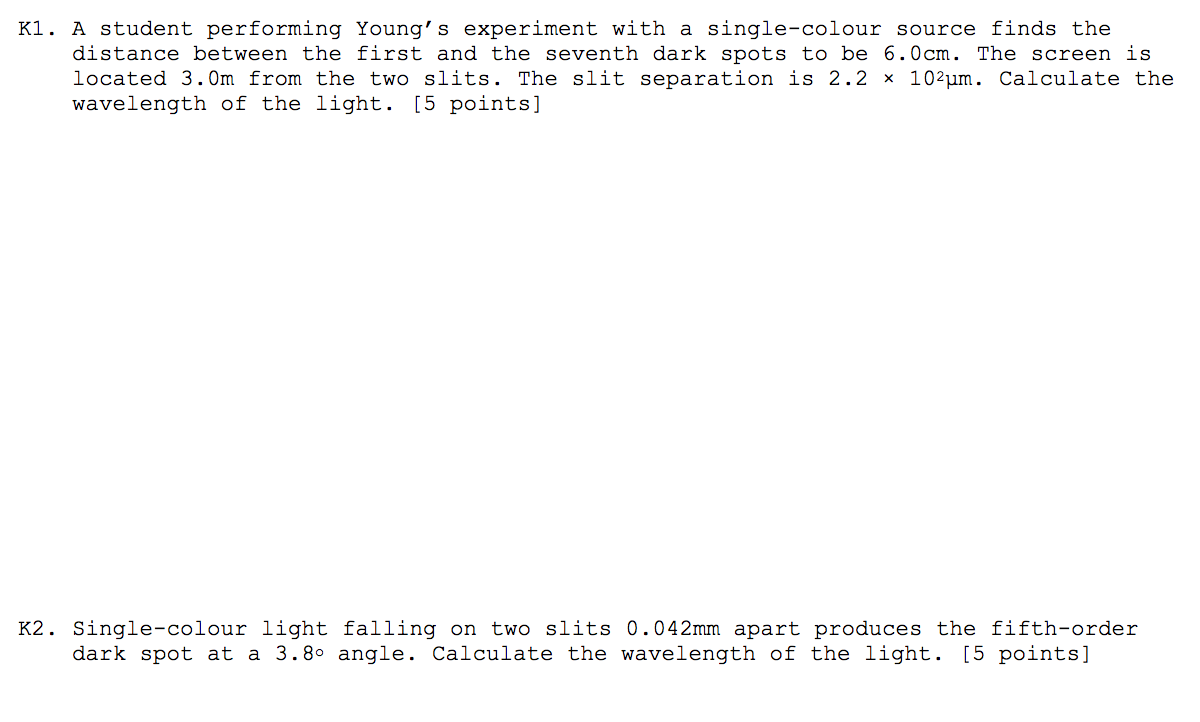
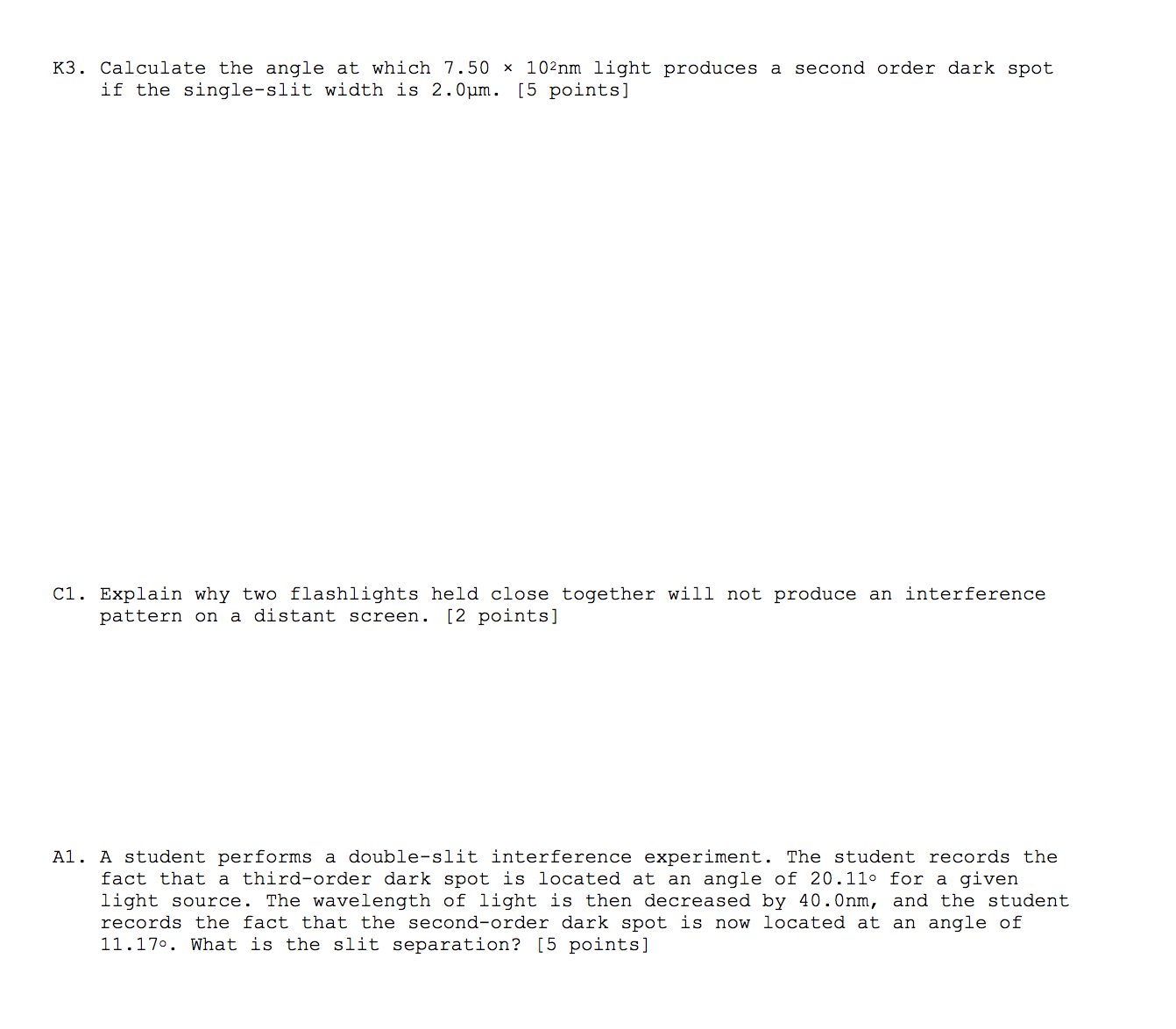

Kl. A student performing Young's experiment with a single-colour source finds the distance between the first and the seventh dark spots to be 6.0cm. The screen is located 3.0m from the two slits. The slit separation is 2.2 x lOZum. Calculate the wavelength of the light. [5 points] K2. Singlecolour light falling on two slits 0.042mm apart produces the fifth-order dark spot at a 3.80 angle. Calculate the wavelength of the light. [5 points] K3. Calculate the angle at which 7.50 x 10²nm light produces a second order dark spot if the single-slit width is 2.0pm. [5 points] Cl. Explain why two flashlights held close together will not produce an interference pattern on a distant screen. [2 points] A1. A student performs a double-slit interference experiment. The student records the fact that a third-order dark spot is located at an angle of 20.110 for a given light source. The wavelength of light is then decreased by 40.0nm, and the student records the fact that the secondorder dark spot is now located at an angle of 11.170. What is the slit separation? [5 points] A2. A single slit of width 4.50 x 10⁴m produces a firstorder dark fringe at some angle. If the width of the slit is now changed to 3.08 x 10⁴m, a secondorder dark fringe is found at three times the previous angle. What is the wavelength of the light? [5 points] Hint: sin36/sin9 = 3 - 4sin29
Step by Step Solution
There are 3 Steps involved in it

Get step-by-step solutions from verified subject matter experts
 Study Help