







Question: L 1 : Search algorithm implementation and analysis Experimental goal: Implement linear search and binary search algorithms Experimental steps 1 . Linear search implementation: -
L: Search algorithm implementation and analysis
Experimental goal: Implement linear search and binary search algorithms
Experimental steps
Linear search implementation:
Implement a method linearSearchint arr, int target to check each element in the array in turn, return the index if the target is found, otherwise return
Binary search implementation:
Implement a method binarySearchint arr, int target to find the target element in a sorted array. Use recursion or iteration to gradually divide the array into two halves until the target is found or the division cannot be continued.
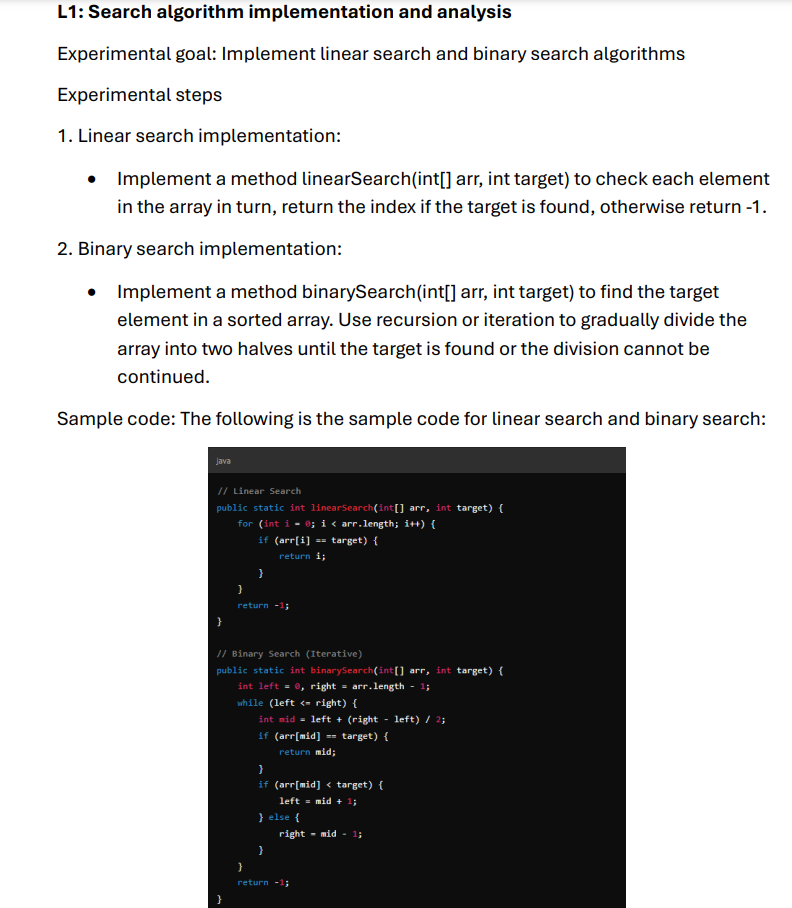
Sample code: The following is the sample code for linear search and binary search:
for int i ; i arr.length; i
if arri target
return i;
return ;
Binary Search Iterative
public static int binarySearchint arr, int target
int left right arr.length ;
while left right
int mid left right left;
if arrmid target
return mid;
if arrmid target
left mid ;
else
right mid ;
return ;
Linear Search
public static int linearSearchint arr, int target What is the time complexity of the two search algorithms? Why is there a difference in their performance for large arrays?
Why does binary search require the array to be in order?
Based on experimental data, how do linear search and binary search perform when searching for a nonexistent target?
Step by Step Solution
There are 3 Steps involved in it
1 Expert Approved Answer
Step: 1 Unlock

Question Has Been Solved by an Expert!
Get step-by-step solutions from verified subject matter experts
Step: 2 Unlock
Step: 3 Unlock
 Study Help