







Question: l. 2. 3. Project 11 Team Project: Macroeconomic Data Analysis, Macroeconomic Instability, and Policy Measures Due: September 14, 2022 This assignment is prepared to check
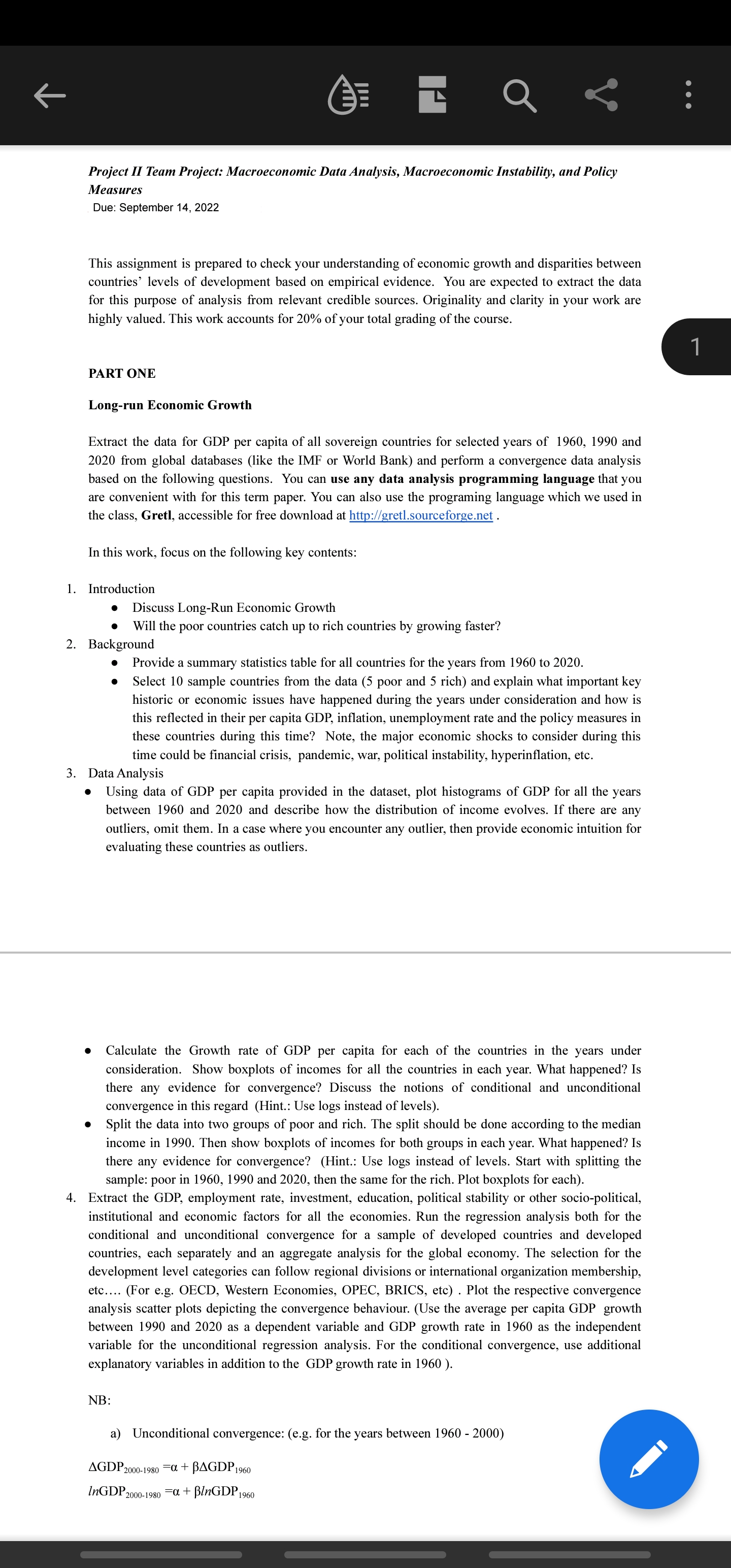
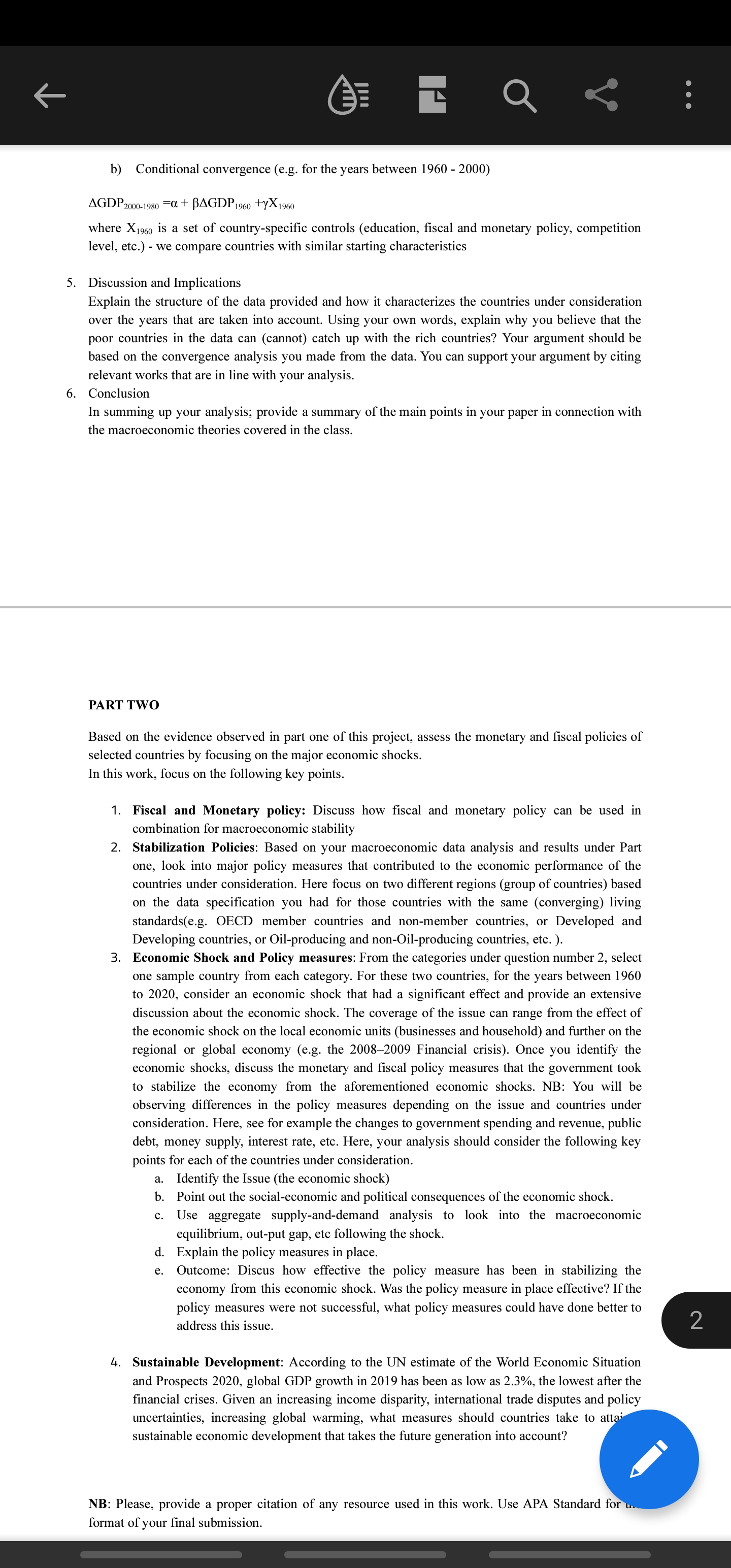
l. 2. 3. Project 11 Team Project: Macroeconomic Data Analysis, Macroeconomic Instability, and Policy Measures Due: September 14, 2022 This assignment is prepared to check your understanding of economic growth and disparities between countries' levels of development based on empirical evidence. You are expected to extract the data for this purpose of analysis from relevant credible sources. Originality and clarity in your work are highly valued. This work accounts for 20% of your total grading of the course. PART ONE Long-run Economic Growth Extract the data for GDP per capita of all sovereign countries for selected years of 1960, 1990 and 2020 from global databases (like the IMF or World Bank) and perform a convergence data analysis based on the following questions. You can use any data analysis programming language that you are convenient with for this term paper. You can also use the programing language which we used in the class, Gretl, accessible for free download at htlp://gret1.sourceforge.net . In this work, focus on the following key contents: Introduction 0 Discuss Long-Run Economic Growth 0 Will the poor countries catch up to rich countries by growing faster? Background 0 Provide a summary statistics table for all countries for the years from 1960 to 2020. 0 Select 10 sample countries from the data (5 poor and 5 rich) and explain what important key historic or economic issues have happened during the years under consideration and how is this reected in their per capita GDP, inflation, unemployment rate and the policy measures in these countries during this time? Note, the major economic shocks to consider during this time could be nancial crisis, pandemic, war, political instability, hyperination, etc. Data Analysis 0 Using data of GDP per capita provided in the dataset, plot histograms of GDP for all the years between 1960 and 2020 and describe how the distribution of income evolves. If there are any outliers, omit them. In a case where you encounter any outlier, then provide economic intuition for evaluating these countries as outliers. 0 Calculate the Growth rate of GDP per capita for each of the countries in the years under consideration. Show boxplots of incomes for all the countries in each year. What happened? Is there any evidence for convergence? Discuss the notions of conditional and unconditional convergence in this regard (Hint.: Use logs instead of levels). 0 Split the data into two groups of poor and rich. The split should be done according to the median income in 1990. Then show boxplots of incomes for both groups in each year. What happened? Is there any evidence for convergence? (Hint.: Use logs instead of levels. Start with splitting the sample: poor in 1960, 1990 and 2020, then the same for the rich. Plot boxplots for each). 4. Extract the GDP, employment rate, investment, education, political stability or other socio-political, institutional and economic factors for all the economies. Run the regression analysis both for the conditional and unconditional convergence for a sample of developed countries and developed countries, each separately and an aggregate analysis for the global economy. The selection for the development level categories can follow regional divisions or international organization membership, etc.... (For e.g. OECD, Western Economies, OPEC, BRICS, etc) . Plot the respective convergence analysis scatter plots depicting the convergence behaviour. (Use the average per capita GDP growth between 1990 and 2020 as a dependent variable and GDP growth rate in 1960 as the independent variable for the unconditional regression analysis. For the conditional convergence, use additional explanatory variables in addition to the GDP growth rate in 1960 ). NB: a) Unconditional convergence: (e.g. for the years between 1960 - 2000) AGDonoo-wso :(1 + [3AGDP1960 lnGDPzaamm :(1 + lnGDPwm b) Conditional convergence (e.g. for the years between 1960 - 2000) AGDPZOOWEO =u + BAGDPlgw +yX1960 where X19\". is a set of country-specic controls (education, scal and monetary policy, competition level, etc.) - we compare countries with similar starting characteristics 5. Discussion and Implications Explain the structure of the data provided and how it characterizes the countries under consideration over the years that are taken into account. Using your own words, explain why you believe that the poor countries in the data can (cannot) catch up with the rich countries? Your argument should be based on the convergence analysis you made from the data. You can support your argument by citing relevant works that are in line with your analysis. 6. Conclusion In summing up your analysis; provide a summary of the main points in your paper in connection with the macroeconomic theories covered in the class. PART TWO Based on the evidence observed in part one of this project, assess the monetary and scal policies of selected countries by focusing on the major economic shocks. In this work, focus on the following key points. 1. Fiscal and Monetary policy: Discuss how scal and monetary policy can be used in combination for macroeconomic stability 2. Stabilization Policies: Based on your macroeconomic data analysis and results under Part one, look into major policy measures that contributed to the economic performance of the countries under consideration. Here focus on two different regions (group of countries) based on the data specication you had for those countries with the same (converging) living standards(e.g. OECD member countries and non-member countries, or Developed and Developing countries, or Oil-producing and non-Oil-producing countries, etc. ). 3. Economic Shock and Policy measures: From the categories under question number 2. select one sample country 'om each category. For these two countries, for the years between 1960 to 2020, consider an economic shock that had a signicant effect and provide an extensive discussion about the economic shock. The coverage of the issue can range 'om the e'ect of the economic shock on the local economic units (businesses and household) and further on the regional or global economy (e.g. the 20082009 Financial crisis). Once you identify the economic shocks, discuss the monetary and scal policy measures that the government took to stabilize the economy from the aforementioned economic shocks. NB: You will be observing differences in the policy measures depending on the issue and countries under consideration. Here, see for example the changes to government spending and revenue, public debt, money supply, interest rate, etc. Here, your analysis should consider the following key points for each of the countries under consideration. a. Identify the Issue (the economic shock) b. Point out the social-economic and political consequences of the economic shock. c. Use aggregate supply-and-demand analysis to look into the macroeconomic equilibrium, out-put gap, etc following the shock. Explain the policy measures in place. e. Outcome: Discus how effective the policy measure has been in stabilizing the economy from this economic shock. Was the policy measure in place effective? If the policy measures were not successful, what policy measures could have done better to address this issue. A. Sustainable Development: According to the UN estimate of the World Economic Situation and Prospects 2020, global GDP growth in 2019 has been as low as 2.3%, the lowest aer the nancial crises. Given an increasing income disparity, international trade disputes and policy uncertainties, increasing global warming, what measures should countries take to art ' sustainable economic development that takes the iture generation into account? NB: Please, provide a proper citation of any resource used in this work. Use APA Standard for format of your nal submission
Step by Step Solution
There are 3 Steps involved in it

Get step-by-step solutions from verified subject matter experts
 Study Help