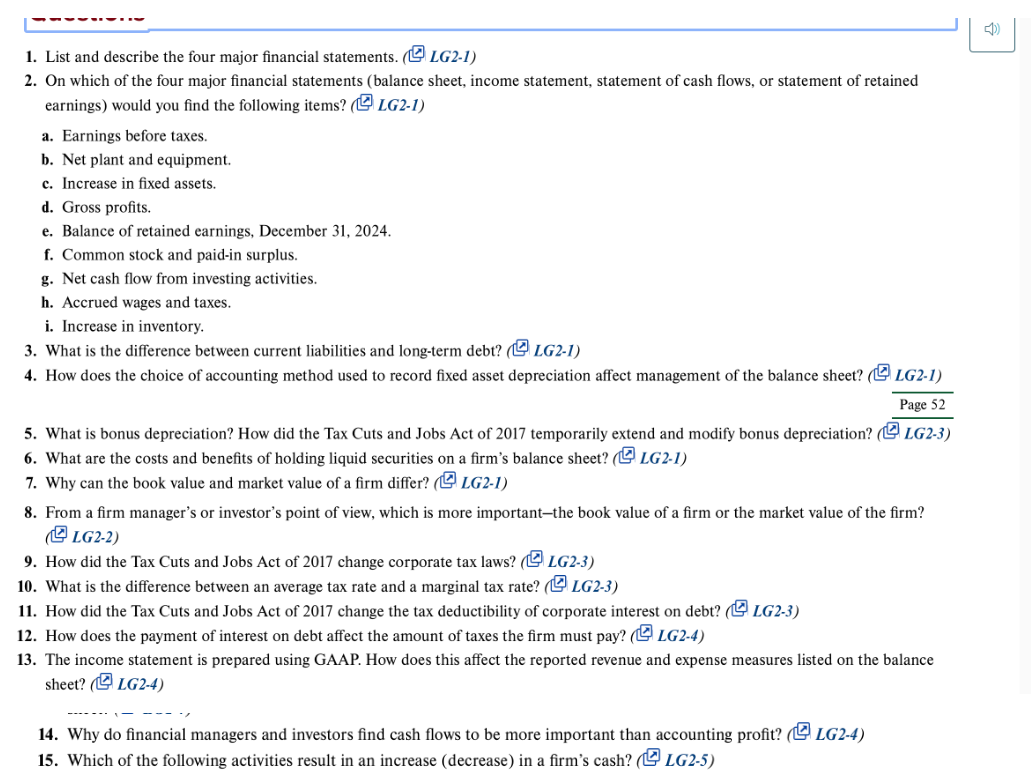
Question: L. 2. . e -y =, U List and describe the four major financial statements. LG21) On which of the four major financial statements (balance
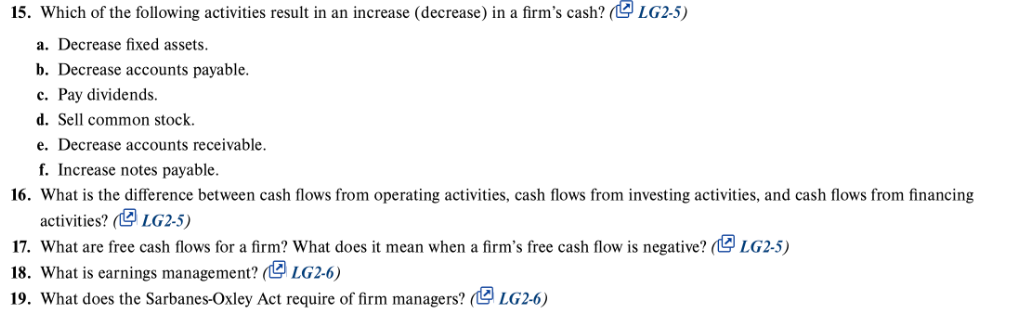
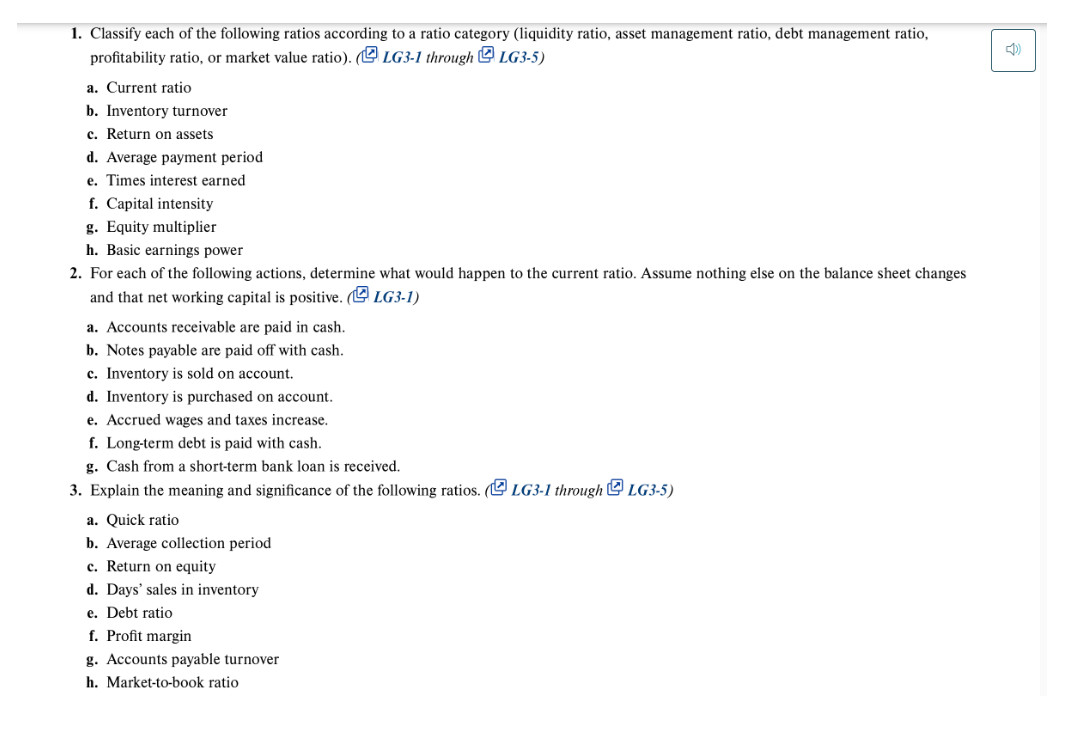
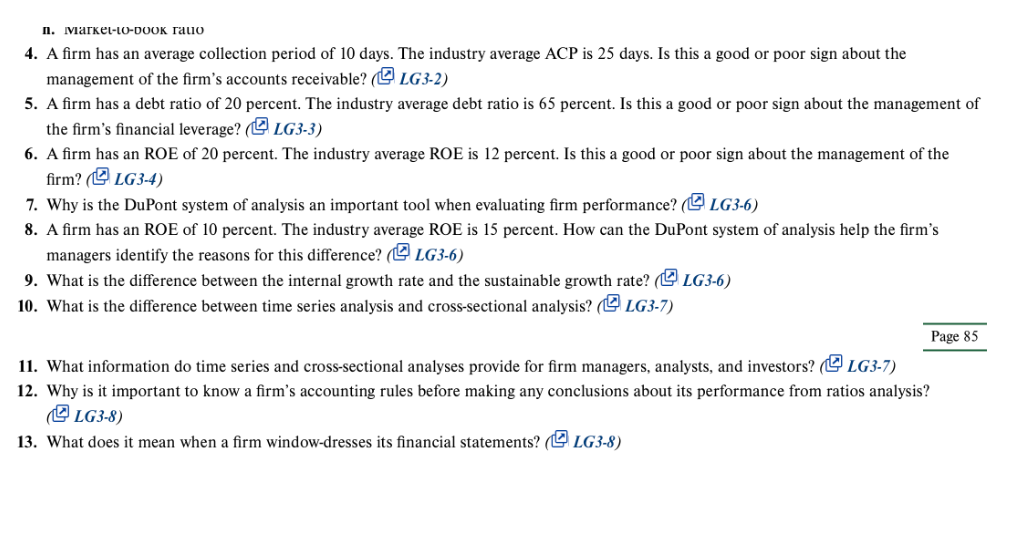
L. 2. . e -y =, U List and describe the four major financial statements. LG21) On which of the four major financial statements (balance sheet, income statement, statement of cash flows, or statement of retained earnings) would you find the following items? @ LG2 1) a. Earnings before taxes. b. Net plant and equipment, . Increase in fixed assets. d. Gross profits. e. Balance of retained earnings, December 31, 2024, f. Common stock and paid-in surplus. g. Net cash flow from investing activities. h. Accrued wages and taxes. i. Increase in inventory. . What is the difference between current liabilities and long-term debt? (@ LG2-1) . How does the choice of accounting method used to record fixed asset depreciation affect management of the balance sheet? @ 1621 ) Page 52 . What is bonus depreciation? How did the Tax Cuts and Jobs Act of 2017 temporarily extend and modify bonus depreciation? (@ LG2-3) . What are the costs and benefits of holding liquid securities on a firm's balance sheet?\" @ LG21 ) . Why can the book value and market value of a firm differ? (@ LG2-1) . From a firm manager's or investor's point of view, which is more importantthe book value of a firm or the market value of the firm? (@ 1G22 . How did the Tax Cuts and Jobs Act of 2017 change corporate tax laws? LG2-3) 10. 11. 12. 13. What is the difference between an average tax rate and a marginal tax rate? (@ LG2-3) How did the Tax Cuts and Jobs Act of 2017 change the tax deductibility of corporate interest on debt? (@ LG2-3) How does the payment of interest on debt affect the amount of taxes the firm must pay? LG24) The income statement is prepared using GAAP. How does this affect the reported revenue and expense measures listed on the balance sheet? (& LG2-4) 14. Why do financial managers and investors find cash flows to be more important than accounting profit? (@ LG2-4) 15. Which of the following activities result in an increase (decrease) in a firm's cash? (@ LG2-5) 15. Which of the following activities result in an increase (decrease) in a firm's cash? LG2-5) . Decrease fixed assets. . Decrease accounts payable. . Pay dividends. . Sell common stock. Decrease accounts receivable. Increase notes payable. 'g!'h.u"h} 16. What is the difference between cash flows from operating activities, cash flows from investing activities, and cash flows from financing activities? (@ 1G2-5) 17. What are free cash flows for a firm? What does it mean when a firm's free cash flow is negative? (@ LG2-5) 18. What is earnings management? (@ LG2-6) 19. What does the Sarbanes-Oxley Act require of firm managers? (@ LG2-6) 1. Classify each of the following ratios according to a ratio category (liquidity ratio, asset management ratio, debt management ratio, profitability ratio, or market value ratio). (@ LG3-1 through @ LG3-5) a. Current ratio b. Inventory turnover . Return on assets d. Average payment period e. Times interest earned f. Capital intensity g. Equity multiplier h. Basic earnings power 2. For each of the following actions, determine what would happen to the current ratio. Assume nothing else on the balance sheet changes and that net working capital is positive. (& LG3-1) a. Accounts receivable are paid in cash. h. Notes payable are paid off with cash. . Inventory is sold on account. d. Inventory is purchased on account. e. Accrued wages and taxes increase. f. Longterm debt is paid with cash. g. Cash from a short-term bank loan is received. 3. Explain the meaning and significance of the following ratios. LG3-1 through 15 LG3-5) a. Quick ratio b. Average collection period , Return on equity d. Days' sales in inventory Debt ratio . Profit margin - . Accounts payable turnover Market-to-book ratio = = 1L 12 13. m. IVIATKEL-LO-DOOK TELIO . A firm has an average collection period of 10 days. The industry average ACP is 25 days. Is this a good or poor sign about the management of the firm's accounts receivable? LG3-2) . A firm has a debt ratio of 20 percent. The industry average debt ratio is 65 percent. Is this a good or poor sign about the management of the firm's financial leverage? LG3-3) . A firm has an ROE of 20 percent. The industry average ROE is 12 percent. Is this a good or poor sign about the management of the firm? (& LG34) . Why is the DuPont system of analysis an important tool when evaluating firm performance? LG36) . A firm has an ROE of 10 percent. The industry average ROE is 15 percent. How can the DuPont system of analysis help the firm's managers identify the reasons for this difference? ( LG3-6) . What is the difference between the internal growth rate and the sustainable growth rate? (@ LG3-6) 10. What is the difference between time series analysis and cross-sectional analysis? LG3-7) Page 85 What information do time series and cross-sectional analyses provide for firm managers, analysts, and investors? @ LG3-7) Why is it important to know a firm's accounting rules before making any conclusions about its performance from ratios analysis? (@ LG3-8) What does it mean when a firm window-dresses its financial statements? LG3-8)
Step by Step Solution
There are 3 Steps involved in it
1 Expert Approved Answer
Step: 1 Unlock
Question Has Been Solved by an Expert!
Get step-by-step solutions from verified subject matter experts
Step: 2 Unlock
Step: 3 Unlock
Students Have Also Explored These Related Accounting Questions!









 Study Help