







Question: l. (a) How many 8-digit binary numbers are there that have exactly three 1's or exactly four 0's? (6) How many do not have exactly
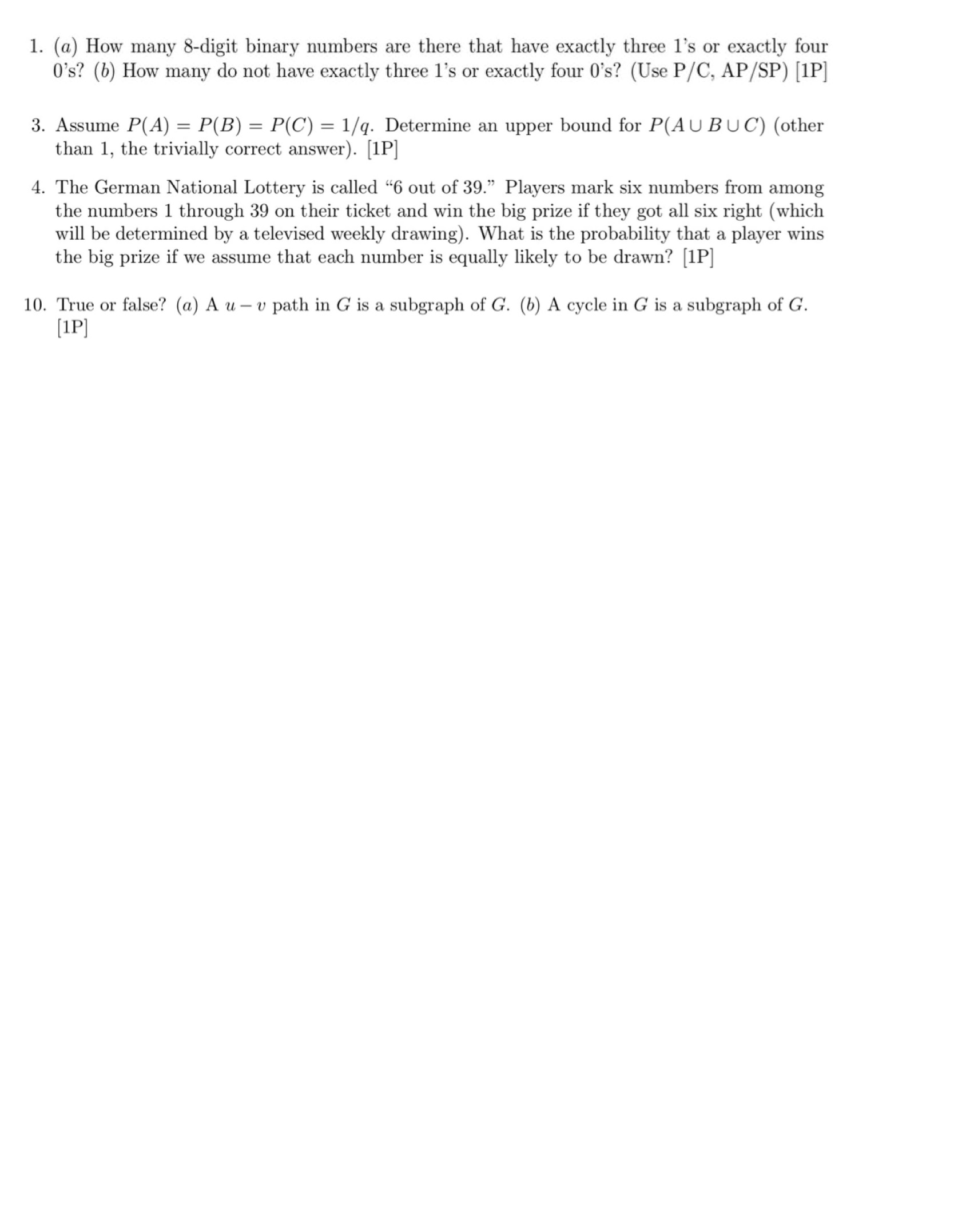
l. (a) How many 8-digit binary numbers are there that have exactly three 1's or exactly four 0's? (6) How many do not have exactly three 1's or exactly four 0's? (Use P/C, AP/SP) [1P] 3. Assume P(A) = P(B) = P(C) = l/q. Determine an upper bound for P(A U B U C) (other than 1, the trivially correct answer). [1P] 4. The German National Lottery is called \"6 out of 39.\" Players mark six numbers from among the numbers 1 through 39 on their ticket and win the big prize if they got all six right (which will be determined by a televised weekly drawing). What is the probability that a player wins the big prize if we assume that each number is equally likely to be drawn? [1P] 10. True or false? (a) A u v path in G is a subgraph of G. (b) A cycle in G is a subgraph of G. [1P]
Step by Step Solution
There are 3 Steps involved in it

Get step-by-step solutions from verified subject matter experts
 Study Help