







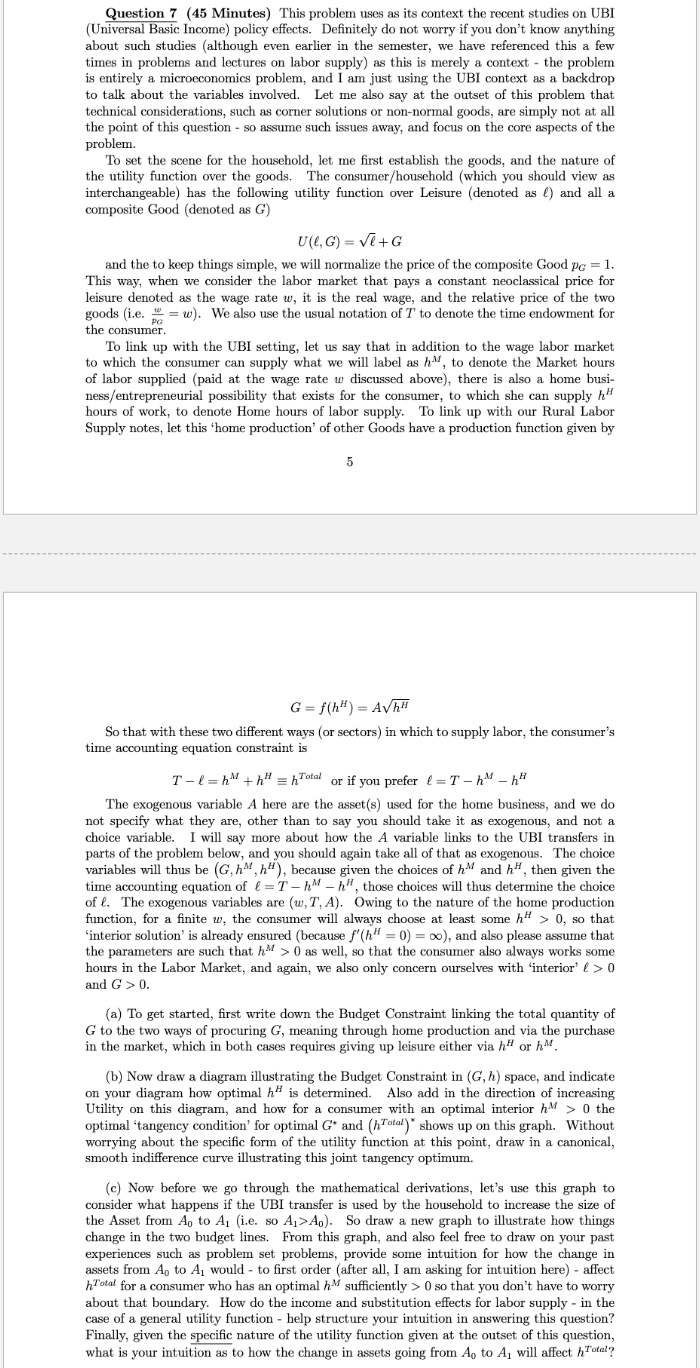
Question: l G U ( l , G ) = l 2 + G and the t o keep things simple, w e will normalize the
and the keep things simple, will normalize the price the composite Good
This way, when consider the labor market that pays a constant neoclassical price for
leisure denoted the wage rate denote the time endowment for
the consumer.
link with the UBI setting, let say that addition the wage labor market
which the consumer can supply what will label discussed
hours work, denote Home hours labor supply. link with our Rural Labor
Supply notes, let this 'home production' other Goods have a production function given
that with these two different ways which supply labor, the consumer's
time accounting equation constraint
you prefer
The exogenous variable A here are the asset used for the home business, and
not specify what they are, other than say you should take exogenous, and not
choice variable. I will say more about how the A variable links the UBI transfers
parts the problem below, and you should again take all that exogenous. The choice
variables will thus because given the choices and then given the
time accounting equation those choices will thus determine the choice
The exogenous variables are Owing the nature the home production
function, for a finite the consumer will always choose least some well, that the consumer also always works some
hours the Labor Market, and again, also only concern ourselves with 'interior'
and
get started, first write down the Budget Constraint linking the total quantity
the two ways procuring meaning through home production and via the purchase
the market, which both cases requires giving leisure either via determined. Also add the direction increasing
Utility this diagram, and how for a consumer with optimal interior the
optimal 'tangency condition' for optimal and shows this graph. Without
worrying about the specific form the utility function this point, draw a canonical,
smooth indifferen
Step by Step Solution
There are 3 Steps involved in it
1 Expert Approved Answer
Step: 1 Unlock

Question Has Been Solved by an Expert!
Get step-by-step solutions from verified subject matter experts
Step: 2 Unlock
Step: 3 Unlock
 Study Help