







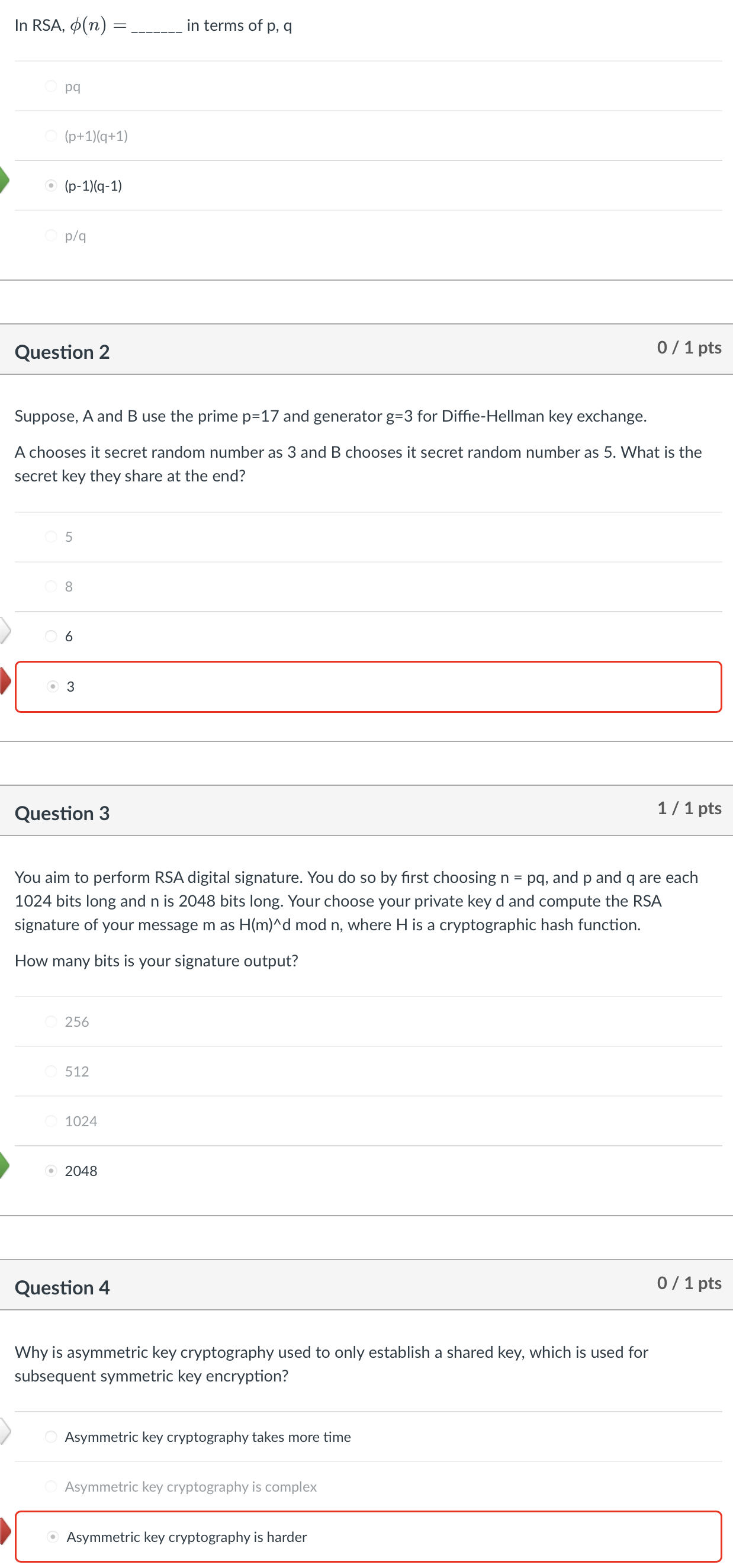
Question: l n R S A , ( n ) = in terms of p , q p q ( p + 1 ) ( q
in terms of
Question
Suppose, A and use the prime and generator for DiffieHellman key exchange.
A chooses it secret random number as and chooses it secret random number as What is the
secret key they share at the end?
Question
You aim to perform RSA digital signature. You do so by first choosing and and are each
bits long and is bits long. Your choose your private key and compute the RSA
signature of your message as mod where is a cryptographic hash function.
How many bits is your signature output?
Question
Why is asymmetric key cryptography used to only establish a shared key, which is used for
subsequent symmetric key encryption?
Asymmetric key cryptography takes more time
Asymmetric key cryptography is complex
Step by Step Solution
There are 3 Steps involved in it
1 Expert Approved Answer
Step: 1 Unlock

Question Has Been Solved by an Expert!
Get step-by-step solutions from verified subject matter experts
Step: 2 Unlock
Step: 3 Unlock
 Study Help