Question: L Problem 3. (20 points total) Consider the following game in Normal form: P.ee Le 3,4 1,5 2,6 Uk Me De Re 0,3 6,9 8,2
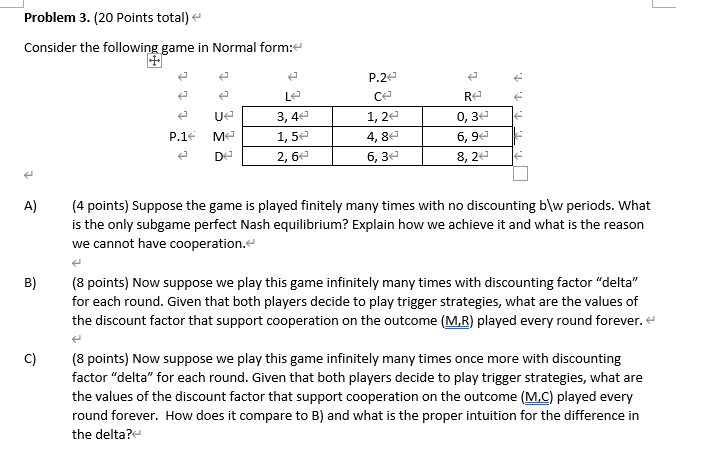
L Problem 3. (20 points total) Consider the following game in Normal form: P.ee Le 3,4 1,5 2,6 Uk Me De Re 0,3 6,9 8,2 1,2 4,82 6,32 P.14 OTT. 1. 1. A) (4 points) Suppose the game is played finitely many times with no discounting b\w periods. What is the only subgame perfect Nash equilibrium? Explain how we achieve it and what is the reason we cannot have cooperation. B) e C) (8 points) Now suppose we play this game infinitely many times with discounting factor "delta" for each round. Given that both players decide to play trigger strategies, what are the values of the discount factor that support cooperation on the outcome (M,R) played every round forever. (8 points) Now suppose we play this game infinitely many times once more with discounting factor "delta" for each round. Given that both players decide to play trigger strategies, what are the values of the discount factor that support cooperation on the outcome (M.C) played every round forever. How does it compare to B) and what is the proper intuition for the difference in the delta? L Problem 3. (20 points total) Consider the following game in Normal form: P.ee Le 3,4 1,5 2,6 Uk Me De Re 0,3 6,9 8,2 1,2 4,82 6,32 P.14 OTT. 1. 1. A) (4 points) Suppose the game is played finitely many times with no discounting b\w periods. What is the only subgame perfect Nash equilibrium? Explain how we achieve it and what is the reason we cannot have cooperation. B) e C) (8 points) Now suppose we play this game infinitely many times with discounting factor "delta" for each round. Given that both players decide to play trigger strategies, what are the values of the discount factor that support cooperation on the outcome (M,R) played every round forever. (8 points) Now suppose we play this game infinitely many times once more with discounting factor "delta" for each round. Given that both players decide to play trigger strategies, what are the values of the discount factor that support cooperation on the outcome (M.C) played every round forever. How does it compare to B) and what is the proper intuition for the difference in the delta









 Study Help