







Question: l r _ 3. (35 points) A rm has a production function given by f (1'1, $2) = 2:13 2:3, Where an and 1'2 are
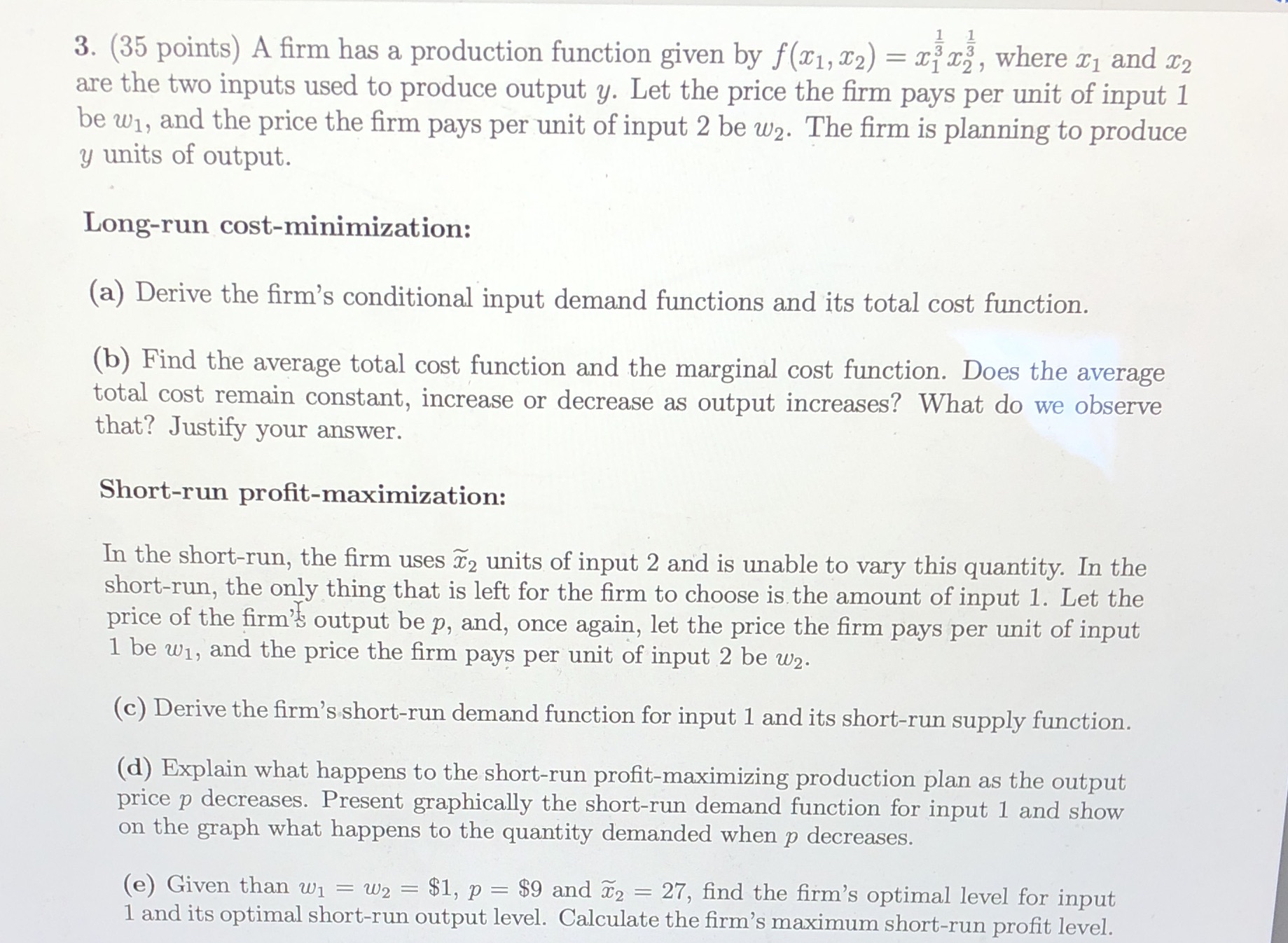
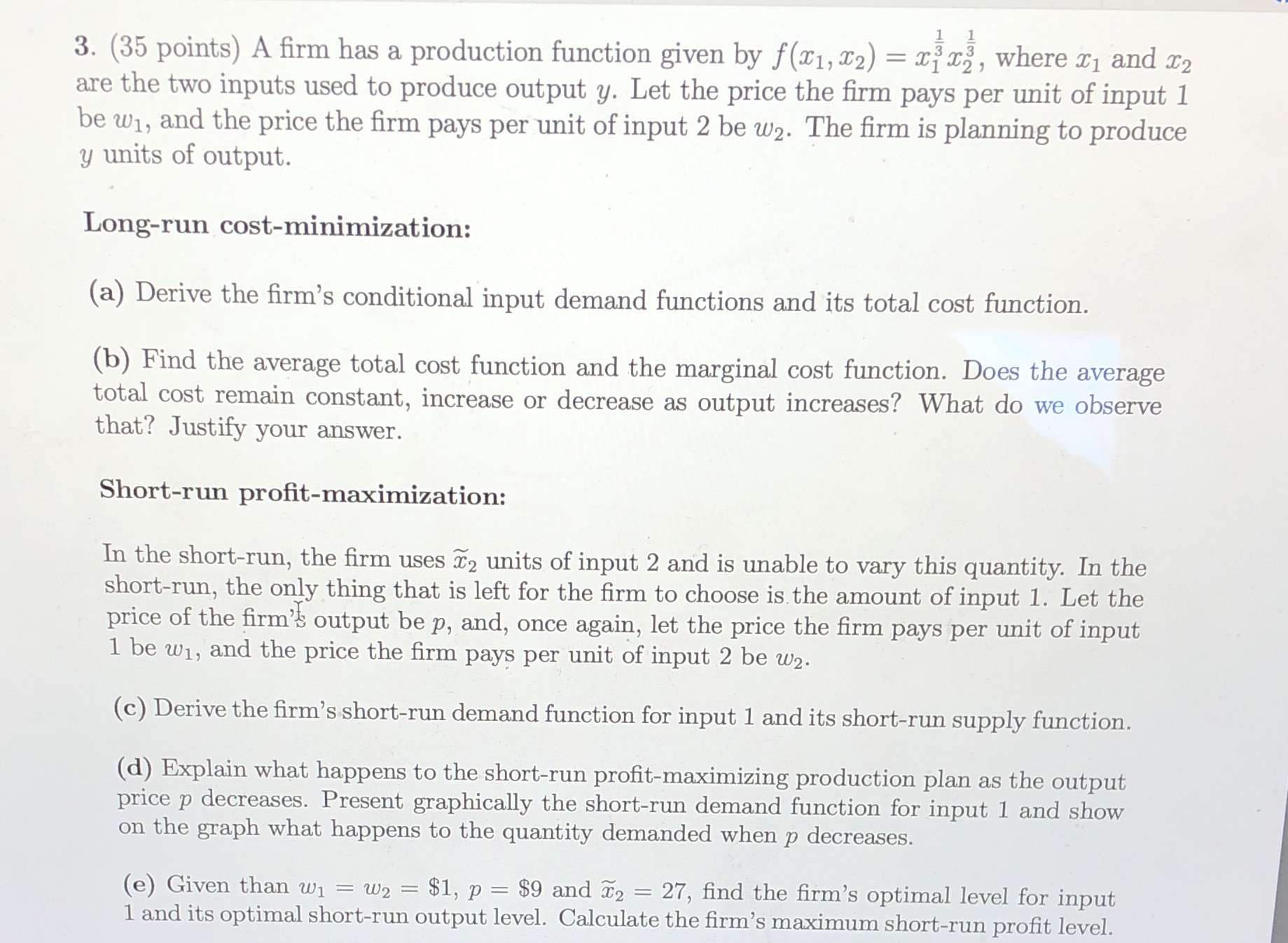
l r _ 3. (35 points) A rm has a production function given by f (1'1, $2) = 2:13 2:3, Where an and 1'2 are the two inputs used to produce output y. Let the price the rm pays per unit of input 1 be ml, and the price the rm pays per unit of input 2 be 102. The rm is planning to produce y units of output. Long-run cost-minimization: (a) Derive the rm's conditional input demand functions and its total cost function. (b) Find the average total cost function and the marginal cost function. Does the average total cost remain constant, increase or decrease as output increases? What do we observe that? Justify your answer. Shortrun prot-maximization: In the shortrun, the rm uses 52 units of input 2 and is unable to vary this quantity. In the short-run, the only thing that is left for the rm to choose isthe amount of input 1. Let the price of the rm's output be p, and, once again, let the price the rm pays per unit of input 1 be ml, and the price the rm pays per, unit of input .2 be wz. (c) Derive the rm'sshortrun demand function for input 1 and its short~run supply function. ((1) Explain what happens to the shortrun prot-maximizing production plan as the output price p decreases. Present graphically the shortrun demand function for input 1 and show on the graph what happens to the quantity demanded when p decreases. (e) Given than 101 = mg = $1, p = $9 and 52 = 27, nd the rm's optimal level for input 1 and its optimal short-run output level. Calculate the rm's maximum short-run prot level
Step by Step Solution
There are 3 Steps involved in it

Get step-by-step solutions from verified subject matter experts
 Study Help