







Question: L4P3 I could use some help with this code, in embedded c if you can. If not i can convert from c+. Thank you for
L4P3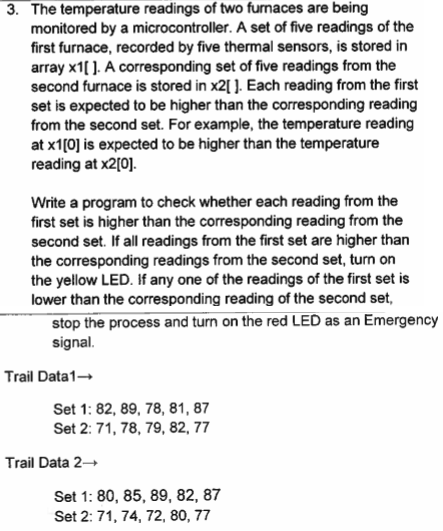
I could use some help with this code, in embedded c if you can. If not i can convert from c+. Thank you for your help! I share the link with my class to add more votes!
3. The temperature readings of two furnaces are being monitored by a microcontroller. A set of five readings of the first furnace, recorded by five thermal sensors, is stored in array x1( ). A corresponding set of five readings from the second furnace is stored in x2[ ]. Each reading from the first set is expected to be higher than the corresponding reading from the second set. For example, the temperature reading at x1[0] is expected to be higher than the temperature reading at x2[0]. Write a program to check whether each reading from the first set is higher than the corresponding reading from the second set. If all readings from the first set are higher than the corresponding readings from the second set, turn on the yellow LED. If any one of the readings of the first set is lower than the corresponding reading of the second set, stop the process and turn on the red LED as an Emergency signal Trail Data1 Set 1: 82, 89, 78, 81, 87 Set 2: 71, 78, 79, 82, 77 Trail Data 2 Set 1: 80, 85, 89, 82, 87 Set 2: 71, 74, 72, 80, 77 3. The temperature readings of two furnaces are being monitored by a microcontroller. A set of five readings of the first furnace, recorded by five thermal sensors, is stored in array x1( ). A corresponding set of five readings from the second furnace is stored in x2[ ]. Each reading from the first set is expected to be higher than the corresponding reading from the second set. For example, the temperature reading at x1[0] is expected to be higher than the temperature reading at x2[0]. Write a program to check whether each reading from the first set is higher than the corresponding reading from the second set. If all readings from the first set are higher than the corresponding readings from the second set, turn on the yellow LED. If any one of the readings of the first set is lower than the corresponding reading of the second set, stop the process and turn on the red LED as an Emergency signal Trail Data1 Set 1: 82, 89, 78, 81, 87 Set 2: 71, 78, 79, 82, 77 Trail Data 2 Set 1: 80, 85, 89, 82, 87 Set 2: 71, 74, 72, 80, 77
Step by Step Solution
There are 3 Steps involved in it

Get step-by-step solutions from verified subject matter experts
 Study Help