







Question: Lab 1 0 3 : Translational Static Equilibrium - - - Force Table / Vector Addition Objectives 1 . Explore Vector Nature of Force: Gain
Lab : Translational Static Equilibrium Force TableVector Addition
Objectives
Explore Vector Nature of Force: Gain practical experience with the vector nature of force, emphasizing the importance of both magnitude and direction in force analysis.
Develop Vector Manipulation Skills: Practice manipulating vectors adding subtracting, resolving to deepen understanding of their behavior and how they combine.
Verify the Equilibrium Condition: Experimentally confirm that for an object to be in static translational equilibrium, the vector sum of all forces acting on it must be zero.
Determine Unknown Forces and Directions: Utilize a system of strings connected to a central ring on the force table. Apply the principles of vector addition and equilibrium to determine the unknown forces magnitudes and directions of these strings required for a balanced state.
Enhance Graphical Representation Skills: Practice representing forces as vectors with arrows on a diagram and utilize these diagrams to analyze the forces acting on the object.
Introduction and Background
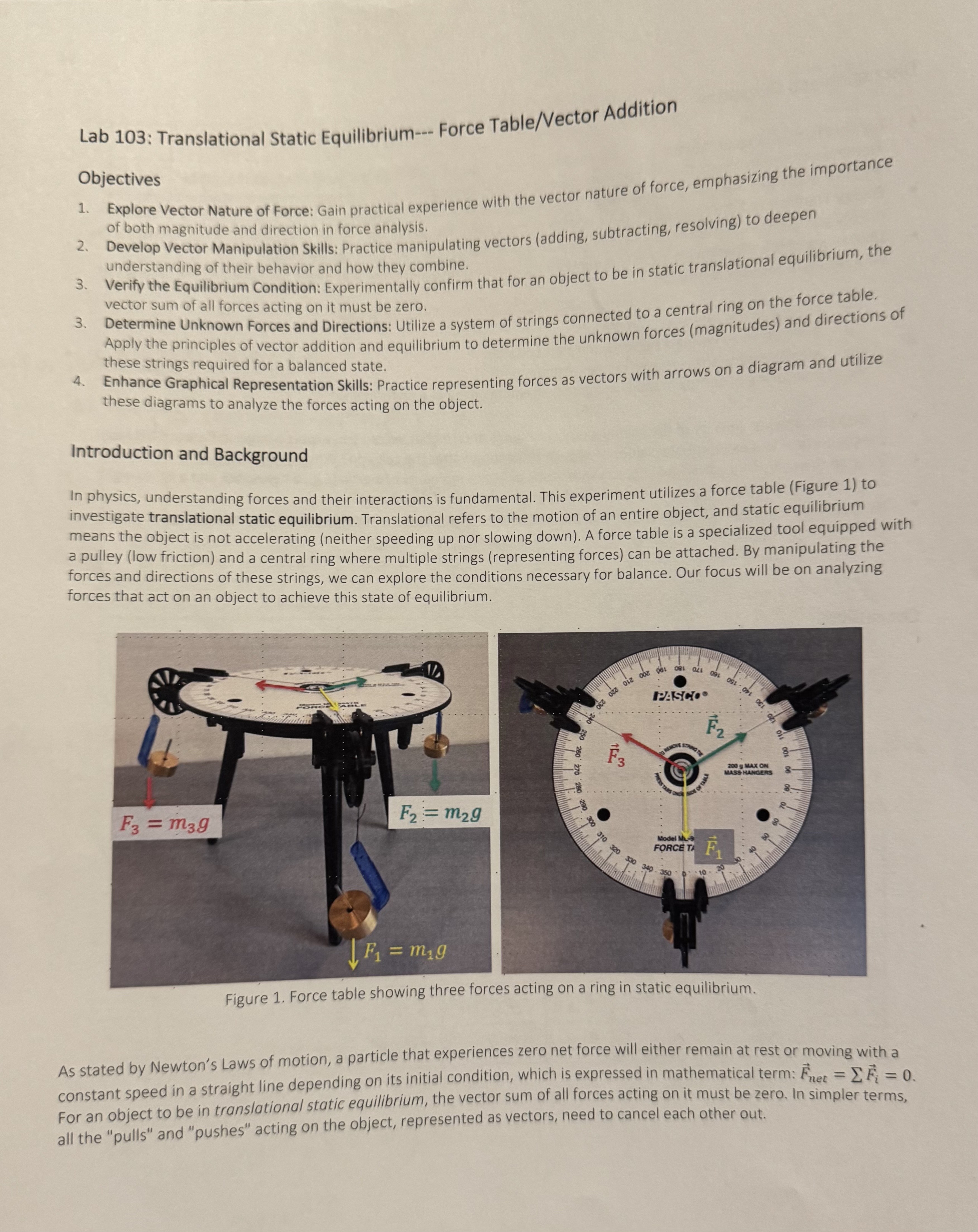
In physics, understanding forces and their interactions is fundamental. This experiment utilizes a force table Figure to investigate translational static equilibrium. Translational refers to the motion of an entire object, and static equilibrium means the object is not accelerating neither speeding up nor slowing down A force table is a specialized tool equipped with a pulley low friction and a central ring where multiple strings representing forces can be attached. By manipulating the forces and directions of these strings, we can explore the conditions necessary for balance. Our focus will be on analyzing forces that act on an object to achieve this state of equilibrium.
Figure force lavie siuvwio
As stated by Newton's Laws of motion, a particle that experiences zero net force will either remain at rest or moving with a constant speed in a straight line depending on its initial condition, which is expressed in mathematical term: vecFtext net sum vecFi For an object to be in translational static equilibrium, the vector sum of all forces acting on it must be zero. In simpler terms, all the "pulls" and "pushes" acting on the object, represented as vectors, need to cancel each other out. Lab : Translational Static Equilibrium Force TableVector Addition
Objectives
Explore Vector Nature of Force: Gain practical experience with the vector nature of force, emphasizing the importance of both magnitude and direction in force analysis.
Develop Vector Manipulation Skills: Practice manipulating vectors adding subtracting, resolving to deepen understanding of their behavior and how they combine.
Verify the Equilibrium Condition: Experimentally confirm that for an object to be in static translational equilibrium, the vector sum of all forces acting on it must be zero.
Determine Unknown Forces and Directions: Utilize a system of strings connected to a central ring on the force table. Apply the principles of vector addition and equilibrium to determine the unknown forces magnitudes and directions of these strings required for a balanced state.
Enhance Graphical Representation Skills: Practice representing forces as vectors with arrows on a diagram and utilize these diagrams to analyze the forces acting on the object.
Introduction and Background
In physics, understanding forces and their interactions is fundamental. This experiment utilizes a force table Figure to investigate translational static equilibrium. Translational refers to the motion of an entire object, and static equilibrium means the object is not accelerating neither speeding up nor slowing down A force table is a specialized tool equipped with a pulley low friction and a central ring where multiple strings representing forces can be attached. By manipulating the forces and directions of these strings, we can explore the conditions necessary for balance. Our focus will be on analyzing forces that act on an object to achieve this state of equilibrium.
Figure force lavie siuvwio
As stated by Newton's Laws of motion, a particle that experiences zero net force will either remain at rest or moving with a constant speed in a straight line depending on its initial condition, which is expressed in mathematical term: vecFtext net sum vecFi For an object to be in translational static equilibrium, the vector sum of all forces acting on it must be zero. In simpler terms, all the "pulls" and "pushes" acting on the object, represented as vectors, need to cancel each other out. :Ine given angle is reterenced on the turive tavic.
Table
Note: It is important to note that the vector arrows are not drawn to scale with respect to the forces they represent.
Discussion and Questions
Concepts:
Step by Step Solution
There are 3 Steps involved in it
1 Expert Approved Answer
Step: 1 Unlock

Question Has Been Solved by an Expert!
Get step-by-step solutions from verified subject matter experts
Step: 2 Unlock
Step: 3 Unlock
 Study Help