







Question: Lab 12 - Interference and diffraction lab fPhysics 2426 Questions 1. In your single-slit experiment, how did the width of the central maximum compare to
Lab 12 - Interference and diffraction lab
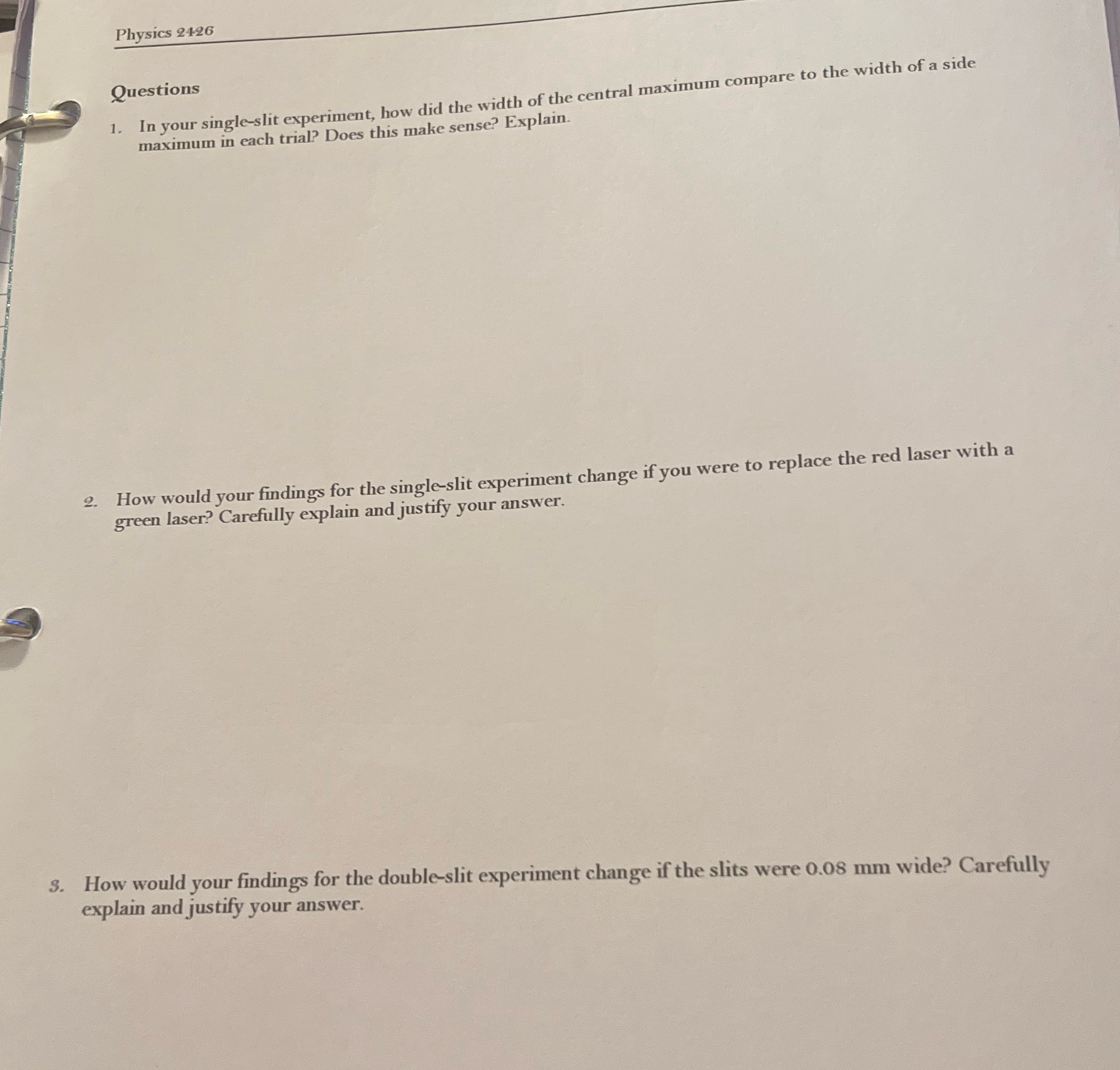
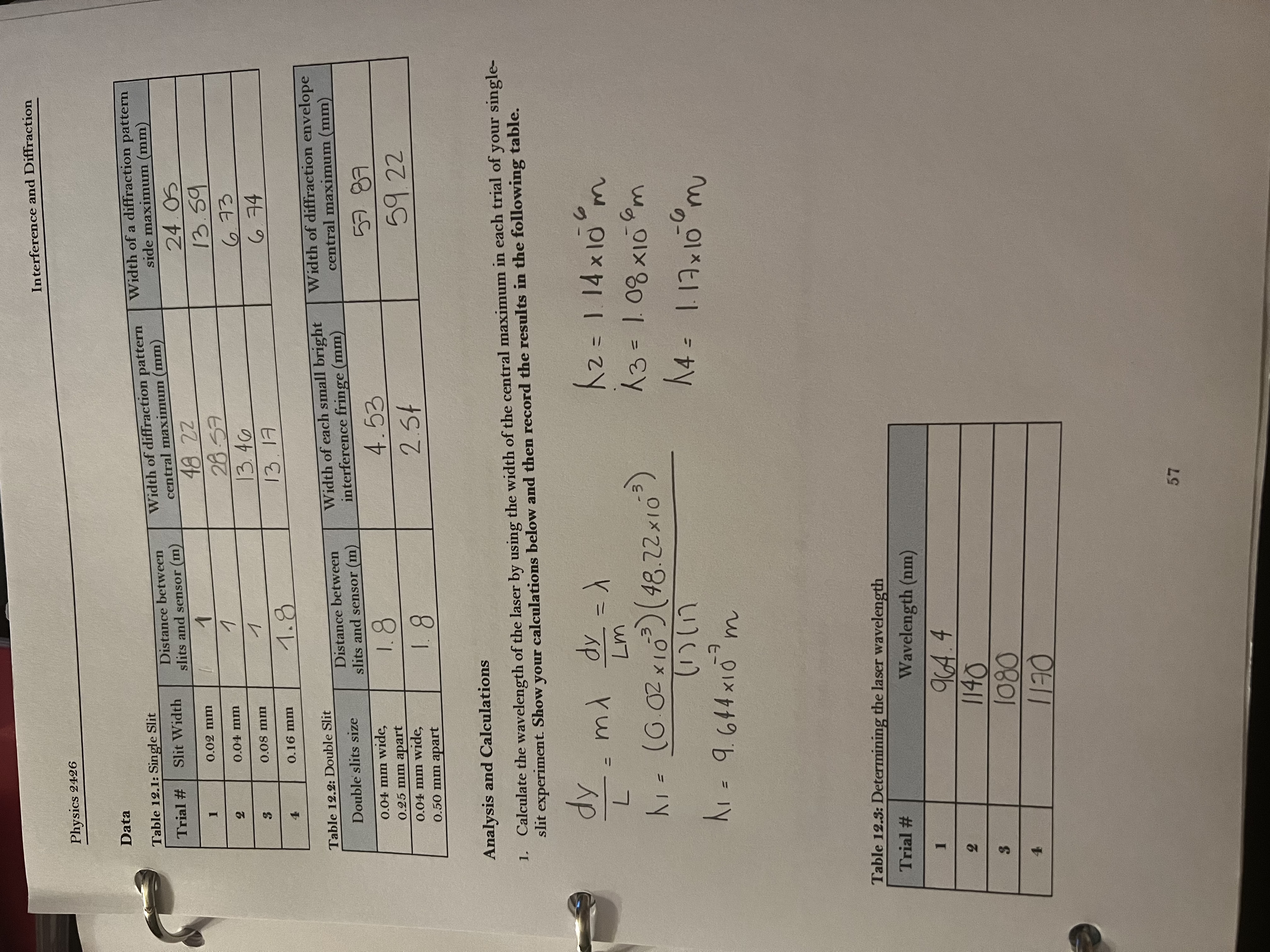
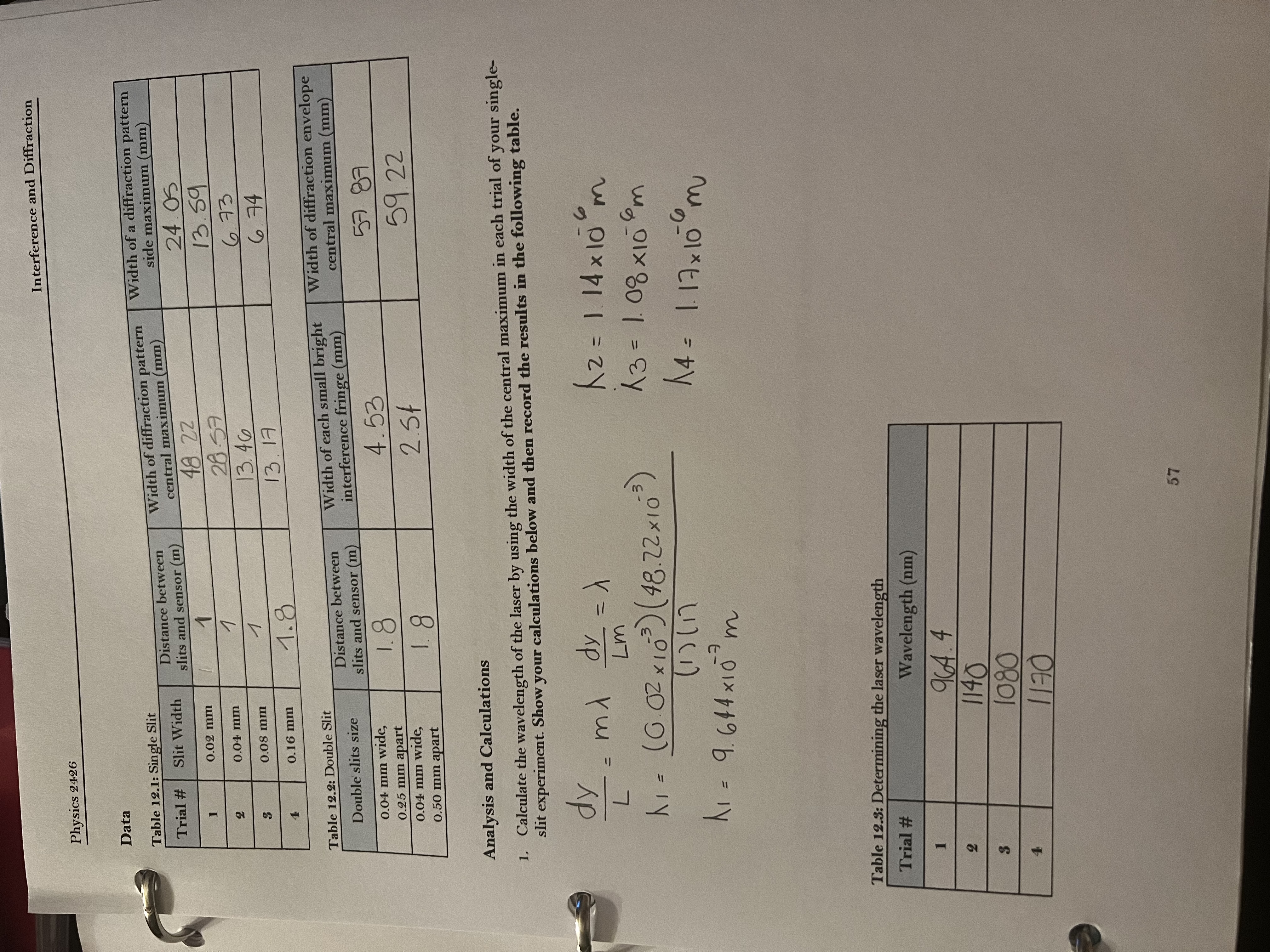
\fPhysics 2426 Questions 1. In your single-slit experiment, how did the width of the central maximum compare to the width of a side maximum in each trial? Does this make sense? Explain 2. How would your findings for the single-slit experiment change if you were to replace the red laser with a green laser? Carefully explain and justify your answer. 3. How would your findings for the double-slit experiment change if the slits were 0.08 mm wide? Carefully explain and justify your answer.Interference and Diffraction Physics 2426 Data Table 12.1: Single Slit Width of diffraction pattern Width of a diffraction pattern Slit Width Distance between Trial # central maximum (mm) side maximum (mm) slits and sensor (m) 24.05 0.02 mm 48 22 28 57 13.59 0.04 mm 0.08 mm 13. 46 6 73 0.16 mm 1.8 13 . 17 6.74 Table 12.2: Double Slit Distance between Width of each small bright Width of diffraction envelope Double slits size slits and sensor (m) interference fringe (mm) central maximum (mm) 0.04 mm wide, 57 87 0.25 mm apart 1.8 4. 53 0.04 mm wide, 0.50 mm apart 1 8 2. 5+ 59.22 Analysis and Calculations 1. Calculate the wavelength of the laser by using the width of the central maximum in each trial of your single- slit experiment. Show your calculations below and then record the results in the following table. dy = m d dy = > Lm ( 2 = 1 14 x10 m KI = (0.02 x 10³) (48.22 x10³) 13 = 108 x 10 # m KI = 9. 64 4 x 10 m 14 = 1.17 x 10 m Table 12.3: Determining the laser wavelength Trial # Wavelength (nm) 964.4 2 1140 1080 1170 57
Step by Step Solution
There are 3 Steps involved in it

Get step-by-step solutions from verified subject matter experts
 Study Help