







Question: LAB 2 Implement the parallel sum method as described by the text below. NOTE: Please, Use the C language. If you can write out the
LAB 2
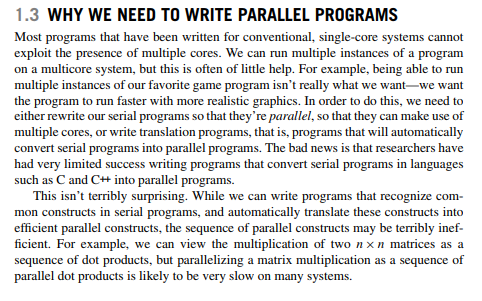
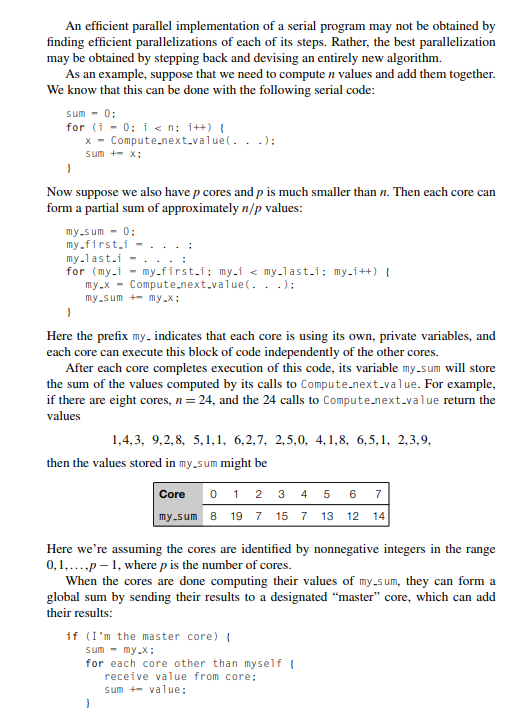
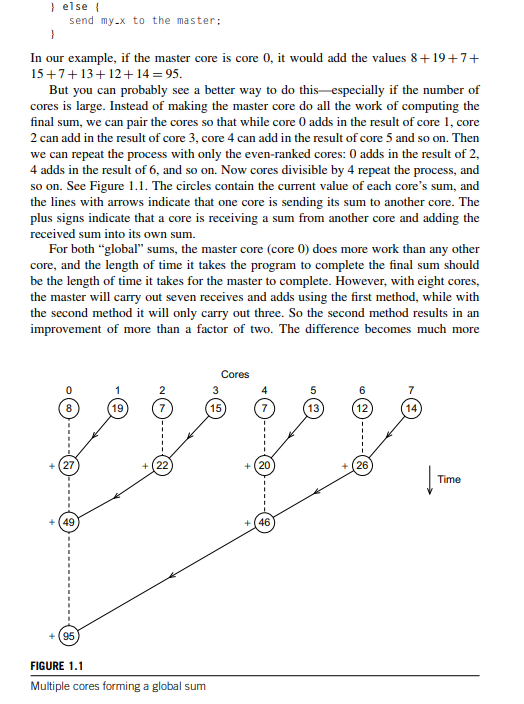
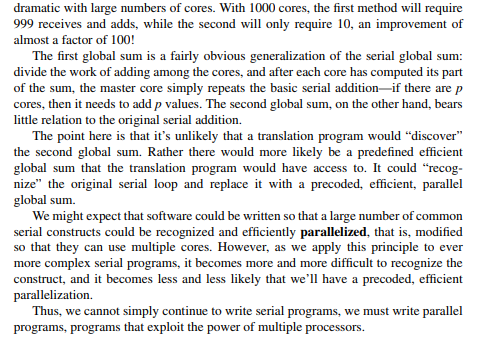
Implement the parallel sum method as described by the text below.
NOTE: Please, Use the C language. If you can write out the OpenMP program and paste it here, so that i can copy it and paste in my OpenMP . Thanks
1.3 WHY WE NEED TO WRITE PARALLEL PROGRAMS Most programs that have been written for conventional, single-core systems cannot exploit the presence of multiple cores. We can run multiple instances of a program on a multicore system, but this is often of little help. For example, being able to run multiple instances of our favorite game program isn't really what we want-we want the program to run faster with more realistic graphics. In order to do this, we need to either rewrite our serial programs so that they're parallel, so that they can make use of multiple cores, or write translation programs, that is, programs that will automatically convert serial programs into parallel programs. The bad news is that researchers have had very limited success such as C and C++into parallel programs. writing programs that convert serial programs in languages This isn't terribly surprising. While we can write programs that recognize com- mon constructs in serial programs, and automatically translate these constructs into efficient parallel constructs, the sequence of parallel constructs may be terribly inef ficient. For example, we can view the multiplication of two nx n matrices as a sequence of dot products, but parallelizing a matrix multiplication as a sequence of parallel dot products is likely to be very slow on many systems. 1.3 WHY WE NEED TO WRITE PARALLEL PROGRAMS Most programs that have been written for conventional, single-core systems cannot exploit the presence of multiple cores. We can run multiple instances of a program on a multicore system, but this is often of little help. For example, being able to run multiple instances of our favorite game program isn't really what we want-we want the program to run faster with more realistic graphics. In order to do this, we need to either rewrite our serial programs so that they're parallel, so that they can make use of multiple cores, or write translation programs, that is, programs that will automatically convert serial programs into parallel programs. The bad news is that researchers have had very limited success such as C and C++into parallel programs. writing programs that convert serial programs in languages This isn't terribly surprising. While we can write programs that recognize com- mon constructs in serial programs, and automatically translate these constructs into efficient parallel constructs, the sequence of parallel constructs may be terribly inef ficient. For example, we can view the multiplication of two nx n matrices as a sequence of dot products, but parallelizing a matrix multiplication as a sequence of parallel dot products is likely to be very slow on many systems
Step by Step Solution
There are 3 Steps involved in it

Get step-by-step solutions from verified subject matter experts
 Study Help