







Question: Lab 3: Normalization Assignment: Problem #7 from Chapter #6. (Be sure to note that this is PROBLEM and not REVIEW QUESTION). Normalize a set of
Lab 3: Normalization
Assignment: Problem #7 from Chapter #6.
(Be sure to note that this is PROBLEM and not REVIEW QUESTION).
Normalize a set of data to 1st, 2nd and 3rd normal form by creating relational schemas, dependency diagrams and an Entity Relationship Diagram (crows foot notation).
For this lab, complete problem #7 in Chapter 6. Be sure to complete each letter (a thru c) for the problem. The ERD for letter c must be completed with the use of Microsoft Visio.
Remember to include headers on all documents you submit to include a brief descriptive title, you name and a date.
Attach all files as a single submission to Canvas.
NOTES TO HELP YOU COMPLETE YOUR LAB
Relational schema is defined in section 4.1.b in chapter 4 of the textbook.Dependency diagram is defined in section 6.3 in chapter 6 of the textbook.An example of a crows foot ERD can be found in chapter 4, figure 4.35.
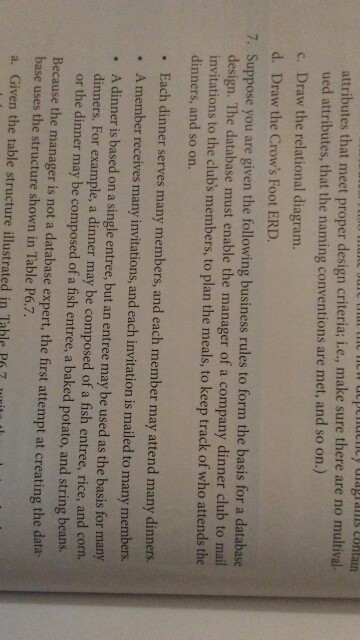
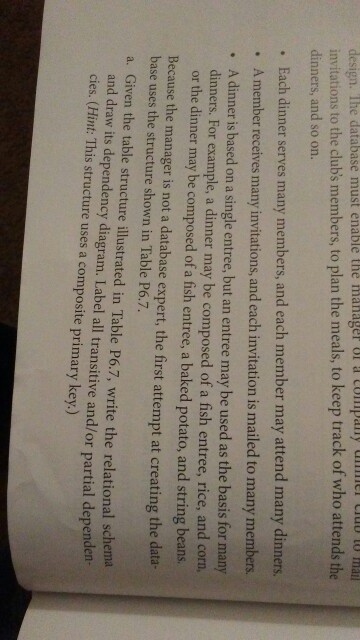
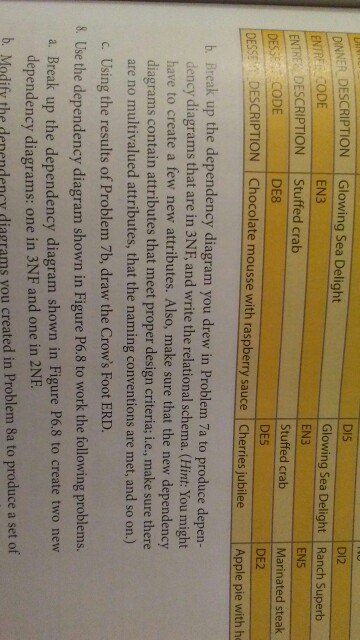
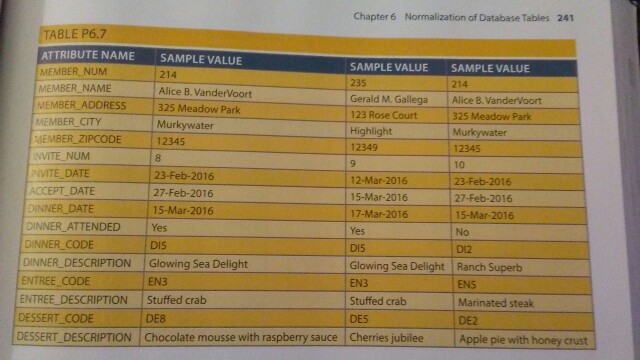
attributes that meet proper design criteria, i.e., make sure there are no multival. ued attributes, that the naming conventions are met, and so on.) c. Draw the relational diagram. d. Draw the Crow's Foot ERD 7. Suppose you are given the following business rules to form the basis for a database design. The database must enable the manager of a company dinner club to mail invitations to the club's members, to plan the meals, to keep track of who attends the dinners, and so on. Each dinner serves many members, and each member may attend many dinners A member receives many invitations, and each invitation is mailed to many members. . A dinner is based on a single entree, but an entree may be used as the basis for many dinners. For example, a dinner may be composed of a fish entree, rice, and corn, or the dinner may be composed of a fish entree, a baked potato, and string beans. Because the manager is not a database expert, the first attempt at creating the data- base uses the structure shown in Table P6.7. a. Given the table structure illustrated in Table P67 uit
Step by Step Solution
There are 3 Steps involved in it

Get step-by-step solutions from verified subject matter experts
 Study Help