Question: Lab 9: Fluids Purpose/objective: In this virtual lab activity you will explore about Archimedes' Principle, Describe Archimedes' Principle in terms of buoyancy and will predict
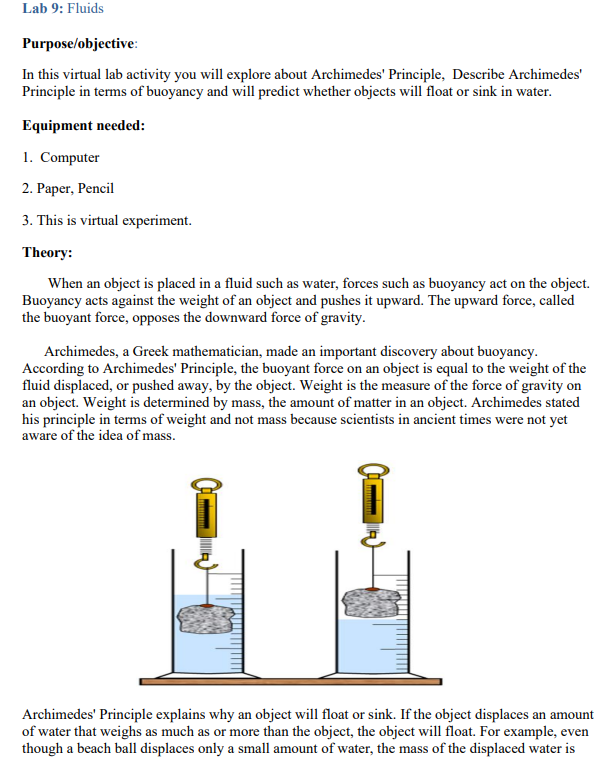
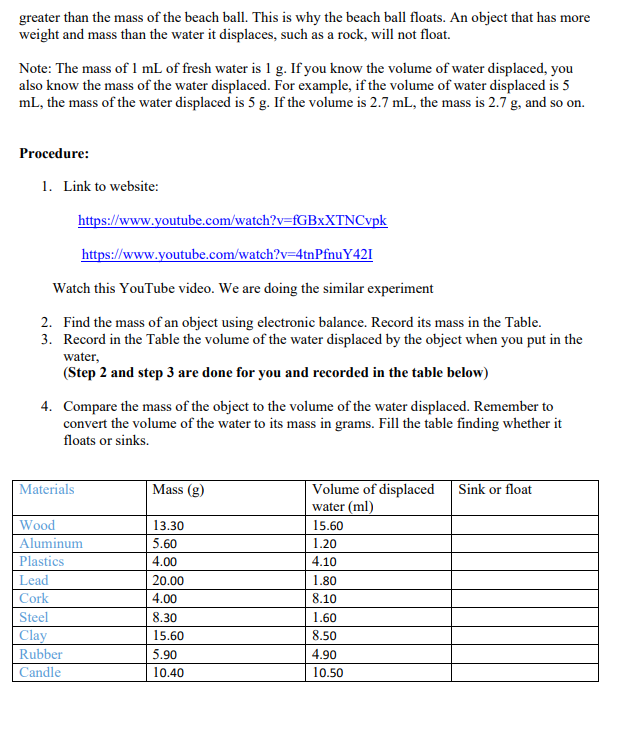
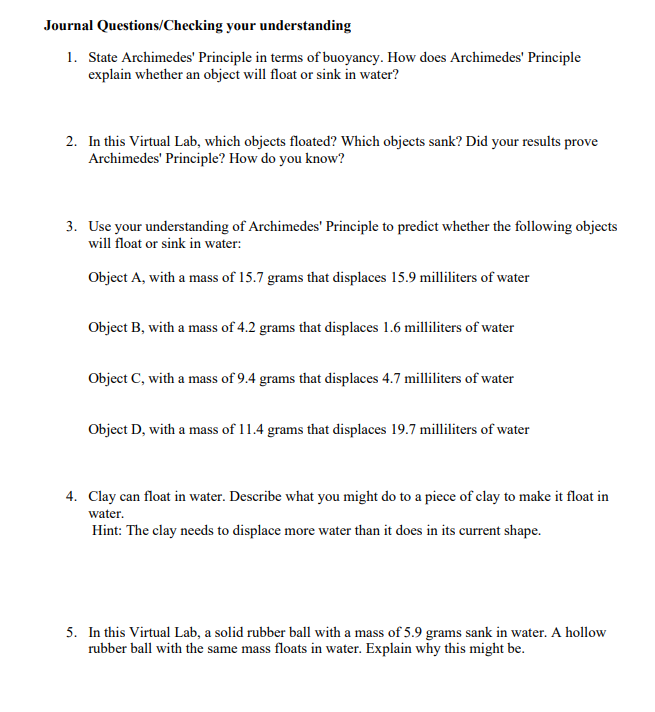
Lab 9: Fluids Purpose/objective: In this virtual lab activity you will explore about Archimedes' Principle, Describe Archimedes' Principle in terms of buoyancy and will predict whether objects will float or sink in water. Equipment needed: 1. Computer 2. Paper, Pencil 3. This is virtual experiment. Theory: When an object is placed in a fluid such as water, forces such as buoyancy act on the object. Buoyancy acts against the weight of an object and pushes it upward. The upward force, called the buoyant force, opposes the downward force of gravity. Archimedes, a Greek mathematician, made an important discovery about buoyancy. According to Archimedes' Principle, the buoyant force on an object is equal to the weight of the fluid displaced, or pushed away, by the object. Weight is the measure of the force of gravity on an object. Weight is determined by mass, the amount of matter in an object. Archimedes stated his principle in terms of weight and not mass because scientists in ancient times were not yet aware of the idea of mass. mm Archimedes' Principle explains why an object will float or sink. If the object displaces an amount of water that weighs as much as or more than the object, the object will float. For example, even though a beach ball displaces only a small amount of water, the mass of the displaced water isgreater than the mass of the beach ball. This is why the beach ball floats. An object that has more weight and mass than the water it displaces, such as a rock, will not float. Note: The mass of 1 mL of fresh water is 1 g. If you know the volume of water displaced, you also know the mass of the water displaced. For example, if the volume of water displaced is 5 mL, the mass of the water displaced is 5 g. If the volume is 2.7 mL, the mass is 2.7 g, and so on. Procedure: 1. Link to website: https://www.youtube.com/watch?v=fGBxXTNCvpk https://www.youtube.com/watch?v=4tnPfnu Y421 Watch this YouTube video. We are doing the similar experiment 2. Find the mass of an object using electronic balance. Record its mass in the Table. 3. Record in the Table the volume of the water displaced by the object when you put in the water, (Step 2 and step 3 are done for you and recorded in the table below) 4. Compare the mass of the object to the volume of the water displaced. Remember to convert the volume of the water to its mass in grams. Fill the table finding whether it floats or sinks. Materials Mass (g) Volume of displaced Sink or float water (ml) Wood 13.30 15.60 Aluminum 5.60 1.20 Plastics 4.00 4.10 Lead 20.00 1.80 Cork 4.00 8.10 Steel 8.30 1.60 Clay 15.60 8.50 Rubber 5.90 4.90 Candle 10.40 10.50Journal Questions/Checking your understanding 1. State Archimedes' Principle in terms of buoyancy. How does Archimedes' Principle explain whether an object will float or sink in water? 2. In this Virtual Lab, which objects floated? Which objects sank? Did your results prove Archimedes' Principle? How do you know? 3. Use your understanding of Archimedes' Principle to predict whether the following objects will float or sink in water: Object A, with a mass of 15.7 grams that displaces 15.9 milliliters of water Object B, with a mass of 4.2 grams that displaces 1.6 milliliters of water Object C, with a mass of 9.4 grams that displaces 4.7 milliliters of water Object D, with a mass of 11.4 grams that displaces 19.7 milliliters of water 4. Clay can float in water. Describe what you might do to a piece of clay to make it float in water. Hint: The clay needs to displace more water than it does in its current shape. 5. In this Virtual Lab, a solid rubber ball with a mass of 5.9 grams sank in water. A hollow rubber ball with the same mass floats in water. Explain why this might be
Step by Step Solution
There are 3 Steps involved in it
1 Expert Approved Answer
Step: 1 Unlock
Question Has Been Solved by an Expert!
Get step-by-step solutions from verified subject matter experts
Step: 2 Unlock
Step: 3 Unlock
Students Have Also Explored These Related Mathematics Questions!









 Study Help