







Question: Lab: Array - Backed Lists Overview For this assignment you will complete the implementation of the array - backed list data structure ( ArrayList )
Lab: ArrayBacked Lists
Overview
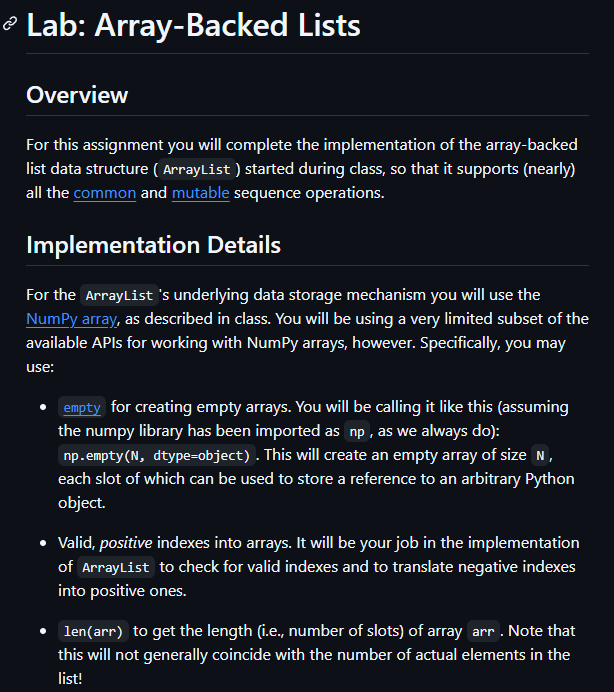
For this assignment you will complete the implementation of the arraybacked list data structure ArrayList started during class, so that it supports nearly all the common and mutable sequence operations.
Implementation Details
For the ArrayList s underlying data storage mechanism you will use the NumPy array, as described in class. You will be using a very limited subset of the available APIs for working with NumPy arrays, however. Specifically, you may use:
empty for creating empty arrays. You will be calling it like this assuming the numpy library has been imported as np as we always do: npempty N dtypeobject This will create an empty array of size N each slot of which can be used to store a reference to an arbitrary Python object.
Valid, positive indexes into arrays. It will be your job in the implementation of ArrayList to check for valid indexes and to translate negative indexes into positive ones.
lenarr to get the length ie number of slots of array arr. Note that this will not generally coincide with the number of actual elements in the list!
You should not use any other arrayrelated functions provided by NumPy! Notably, delete, insert, append, resize, and others, are off limits Using them to carry out list operations is generally speaking, less efficient than the manual approach outlined in class. Also, it's important that you learn how to implement them yourself. Breaking this rule will result in significant score reductions
ArrayList
And now for the task at hand. We've broken down the ArrayList methods you need to implement and the test cases that follow into seven categories:
Subscriptbased access points
Stringification points
Singleelement manipulation points
Predicates TrueFalse queries points
Queries points
Bulk operations points
All told, there are methods a couple of which we implemented together in class whose behavior are specified in their docstrings. Stubs for all the methods are found in
arraylist.py Note that we left out API support for
slices eg lststart:stop:step; you can read about how to support slices in the Python docs, but we just don't think it's worth the extra busywork.
Advice
We strongly advise that you start with the first category of functions and move down the list sequentially, pausing after each to run the corresponding tests. Keep in mind that while you're not permitted to make use of NumPy APIs beyond those listed above you can certainly make use of ArrayList methods you've already implemented.
For instance, your implementations of pop and remove can and should use the del operator on your own list to remove elements from the middle, and it probably makes sense to use extend in your
add and copy methods. When in doubt as to how a method should behave, consult the Python Docs for guidance.
Step by Step Solution
There are 3 Steps involved in it
1 Expert Approved Answer
Step: 1 Unlock

Question Has Been Solved by an Expert!
Get step-by-step solutions from verified subject matter experts
Step: 2 Unlock
Step: 3 Unlock
 Study Help