



Question: Lab - Chapter 8 1. In 2014 the National Fire Protection Association reported that 19% of all fireworks injuries affected the eyes. The administrator of
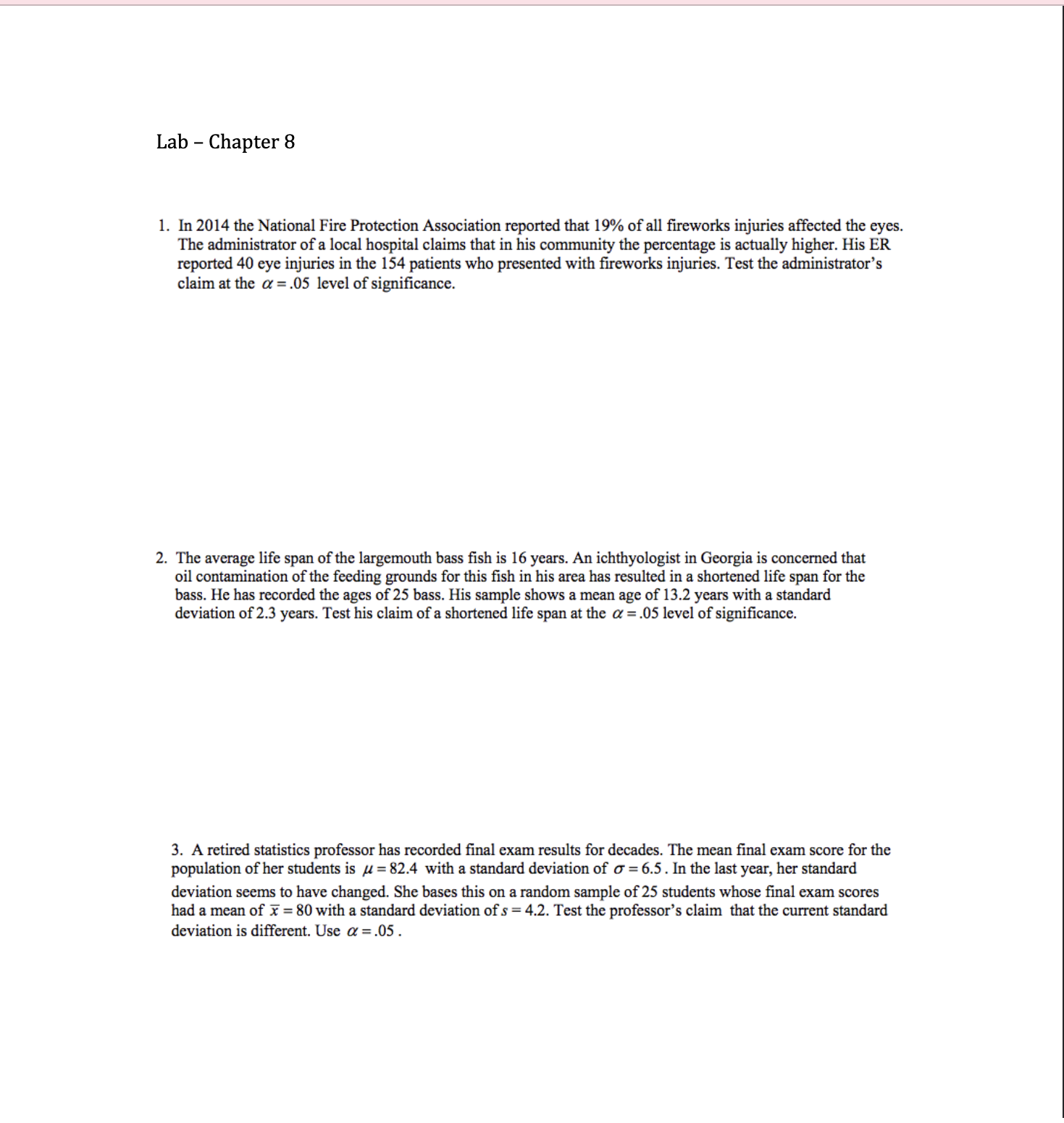
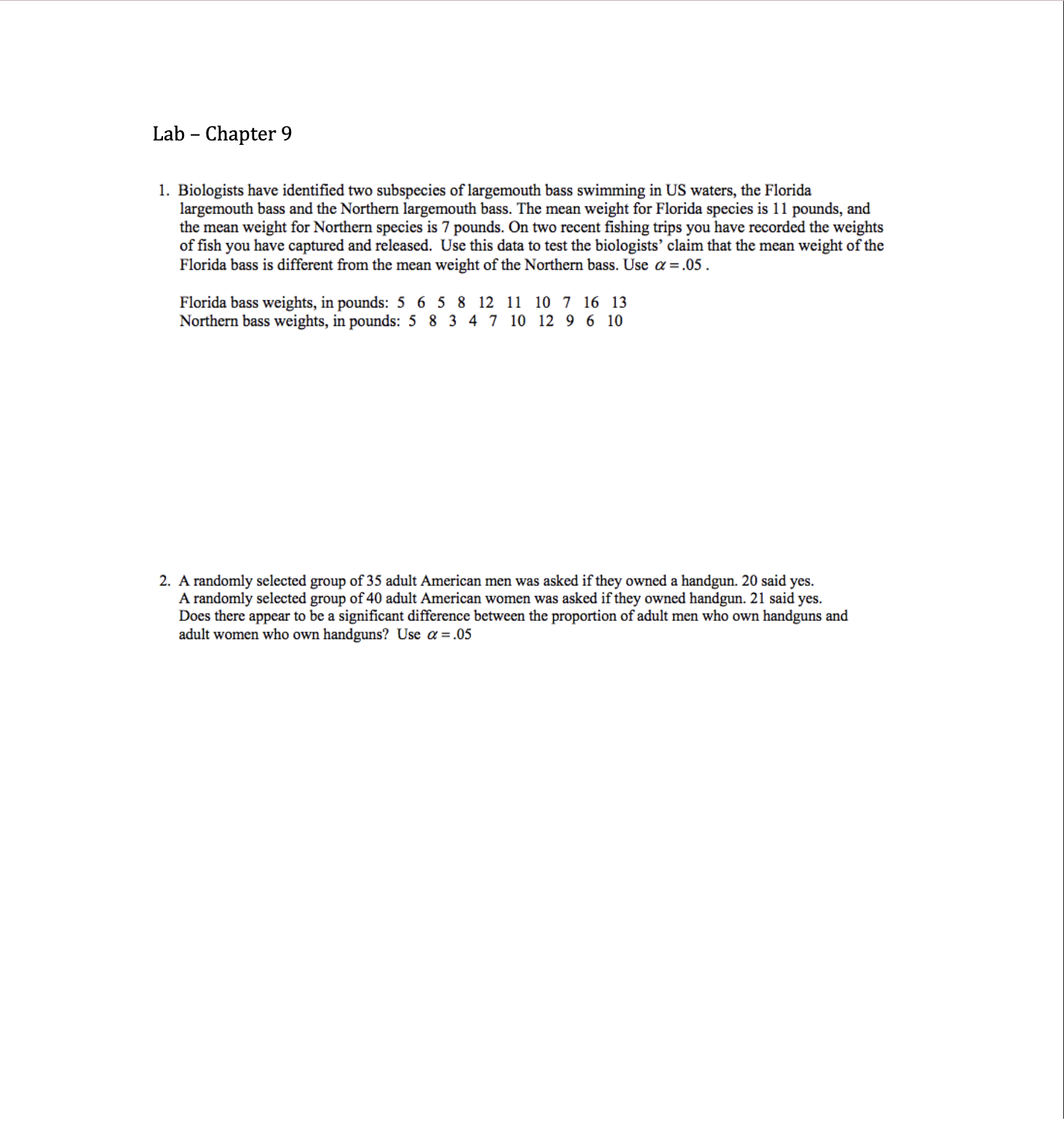
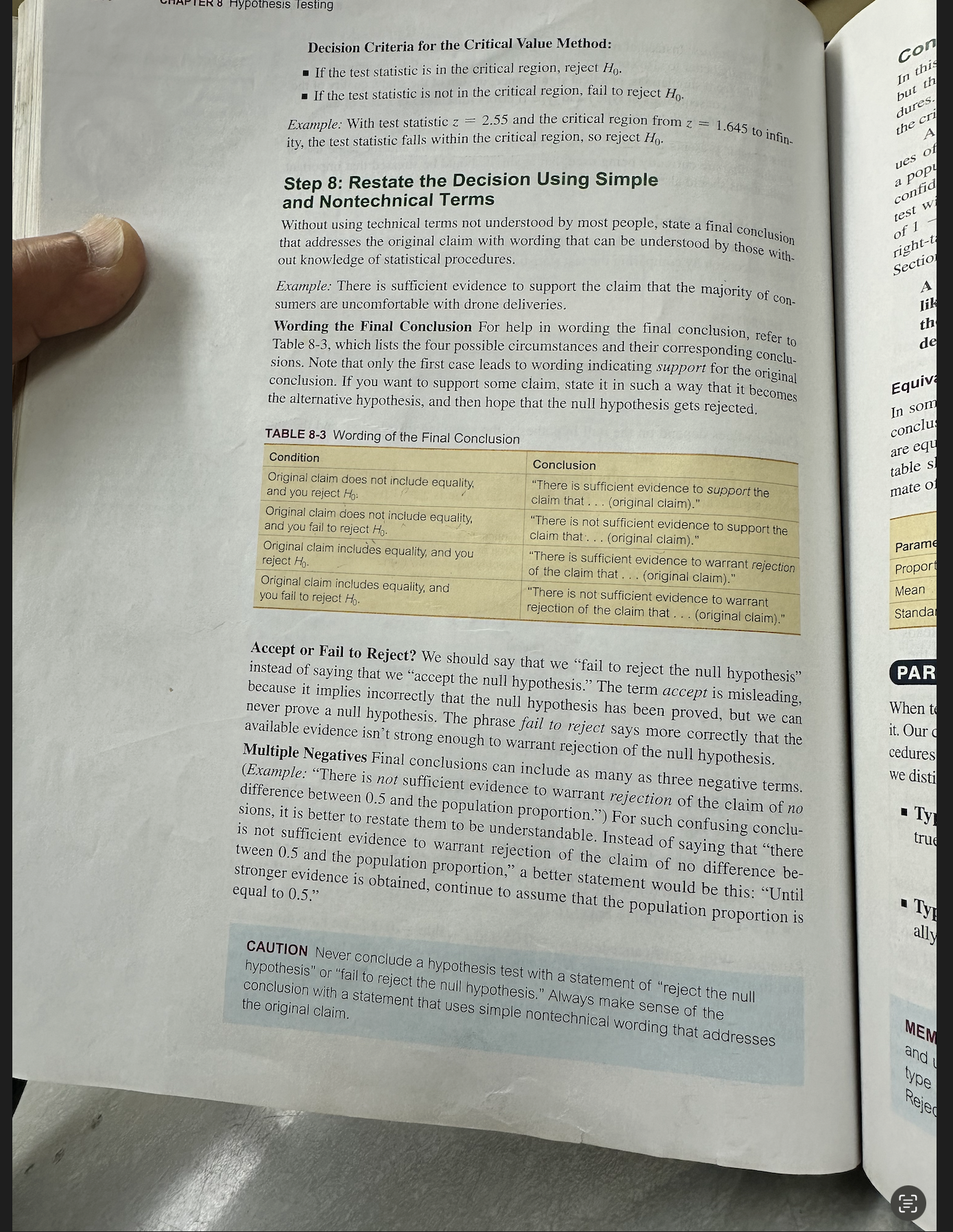
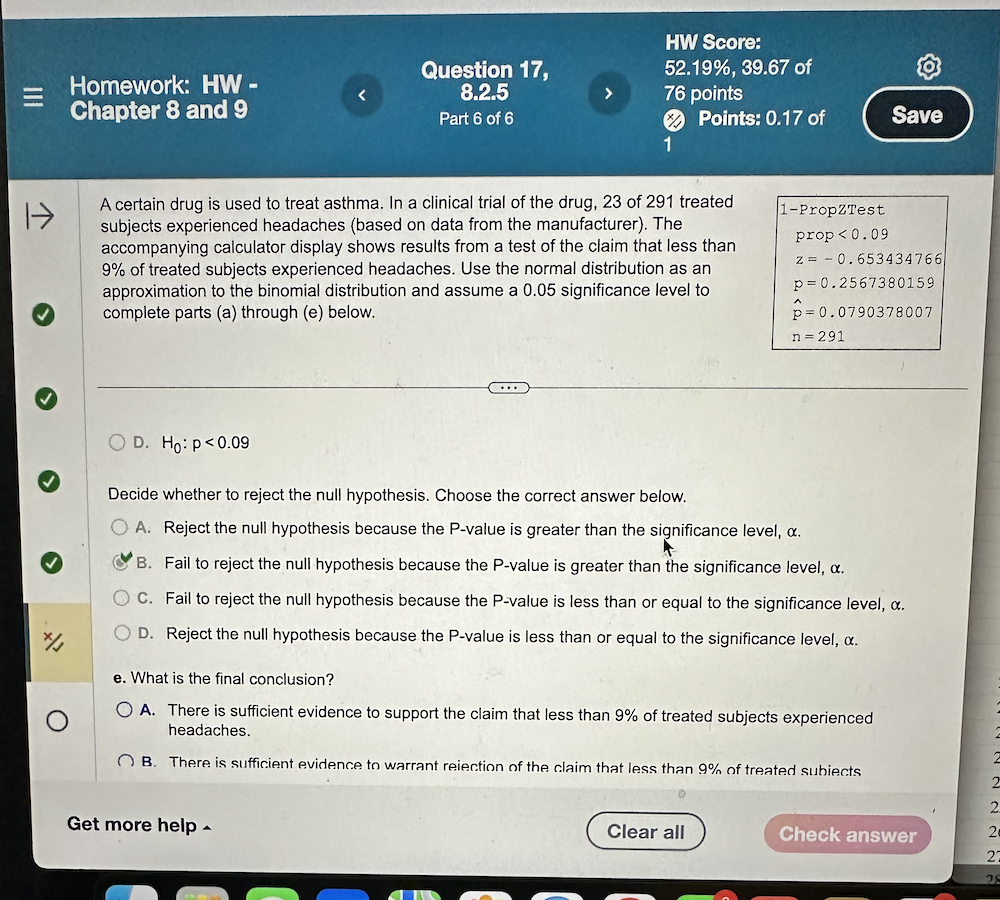
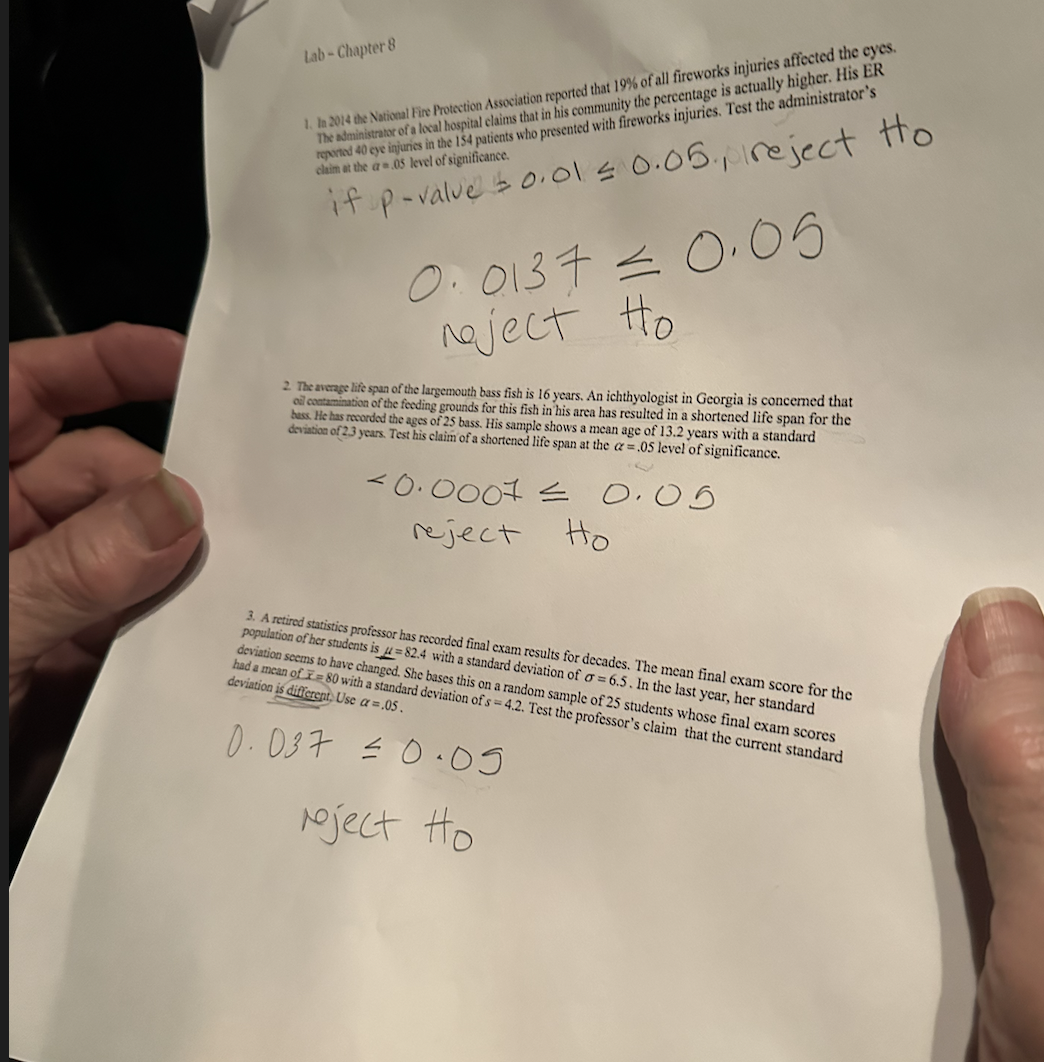
Lab - Chapter 8 1. In 2014 the National Fire Protection Association reported that 19% of all fireworks injuries affected the eyes. The administrator of a local hospital claims that in his community the percentage is actually higher. His ER reported 40 eye injuries in the 154 patients who presented with fireworks injuries. Test the administrator's claim at the &x =.05 level of significance. 2. The average life span of the largemouth bass fish is 16 years. An ichthyologist in Georgia is concerned that oil contamination of the feeding grounds for this fish in his area has resulted in a shortened life span for the bass. He has recorded the ages of 25 bass. His sample shows a mean age of 13.2 years with a standard deviation of 2.3 years. Test his claim of a shortened life span at the & =.05 level of significance. 3. A retired statistics professor has recorded final exam results for decades. The mean final exam score for the population of her students is u# =82.4 with a standard deviation of & =6.5. In the last year, her standard deviation seems to have changed. She bases this on a random sample of 25 students whose final exam scores had a mean of X = 80 with a standard deviation of s = 4.2. Test the professor's claim that the current standard deviation is different. Use & =.05. Lab - Chapter 9 1. Biologists have identified two subspecies of largemouth bass swimming in US waters, the Florida largemouth bass and the Northern largemouth bass. The mean weight for Florida species is 11 pounds, and the mean weight for Northern species is 7 pounds. On two recent fishing trips you have recorded the weights of fish you have captured and released. Use this data to test the biologists' claim that the mean weight of the Florida bass is different from the mean weight of the Northern bass. Use & =.05. Florida bass weights, inpounds: 5 6 5 8 12 11 10 7 16 13 Northern bass weights, inpounds: 5 8 3 4 7 10 12 9 6 10 2. A randomly selected group of 35 adult American men was asked if they owned a handgun. 20 said yes. A randomly selected group of 40 adult American women was asked if they owned handgun. 21 said yes. Does there appear to be a significant difference between the proportion of adult men who own handguns and adult women who own handguns? Use & =.05 Testing Decision Criteria for the Critical Value Method: Con In this If the test statistic is in the critical region, reject Ho. but th If the test statistic is not in the critical region, fail to reject Ho. dures. the cri Example: With test statistic z = 2.55 and the critical region from z = 1.645 to infin. A ity, the test statistic falls within the critical region, so reject Ho. ues of a pop Step 8: Restate the Decision Using Simple confid and Nontechnical Terms test w Without using technical terms not understood by most people, state a final conclusion of 1 that addresses the original claim with wording that can be understood by those with- right-t Section out knowledge of statistical procedures. Example: There is sufficient evidence to support the claim that the majority of con- like sumers are uncomfortable with drone deliveries. th Wording the Final Conclusion For help in wording the final conclusion, refer to de Table 8-3, which lists the four possible circumstances and their corresponding conclu sions. Note that only the first case leads to wording indicating support for the original Equiv conclusion. If you want to support some claim, state it in such a way that it becomes the alternative hypothesis, and then hope that the null hypothesis gets rejected. In son conclu TABLE 8-3 Wording of the Final Conclusion are equ Condition Conclusion table s Original claim does not include equality, "There is sufficient evidence to support the mate of and you reject Ho: claim that . . . (original claim)." Original claim does not include equality, "There is not sufficient evidence to support the and you fail to reject Ho. claim that. .. (original claim)." Parame Original claim includes equality, and you Propor reject Ho- 'There is sufficient evidence to warrant rejection of the claim that . . . (original claim)." Original claim includes equality, and Mean you fail to reject Ho. "There is not sufficient evidence to warrant rejection of the claim that . .. (original claim)." Standa Accept or Fail to Reject? We should say that we "fail to reject the null hypothesis" PAR instead of saying that we "accept the null hypothesis." The term accept is misleading, because it implies incorrectly that the null hypothesis has been proved, but we can When to never prove a null hypothesis. The phrase fail to reject says more correctly that the it. Our available evidence isn't strong enough to warrant rejection of the null hypothesis. cedures Multiple Negatives Final conclusions can include as many as three negative terms. we disti Example: "There is not sufficient evidence to warrant rejection of the claim of no difference between 0.5 and the population proportion.") For such confusing conclu Ty sions, it is better to restate them to be understandable. Instead of saying that "there true is not sufficient evidence to warrant rejection of the claim of no difference be- tween 0.5 and the population proportion," a better statement would be this: "Until equal to 0.5." stronger evidence is obtained, continue to assume that the population proportion is ally CAUTION Never conclude a hypothesis test with a statement of "reject the null hypothesis" or "fail to reject the null hypothesis." Always make sense of the conclusion with a statement that uses simple nontechnical wording that addresses the original claim. MEM and type Rejed1 Tl T Question 17, 52.19%, 39.67 of Homework: HW - PR R Chapter8and 9 LG @ Points: 0.17 of 1 A certain drug is used to treat asthma. In a clinical trial of the drug, 23 of 291 treated 1-PropZTest subjects experienced headaches (based on data from the manufacturer). The accompanying calculator display shows results from a test of the claim that less than 9% of treated subjects experienced headaches. Use the normal distribution as an approximation to the binomial distribution and assume a 0.05 significance level to = complete parts (a) through (e) below. p=0.0790378007 n=291 prop
Step by Step Solution
There are 3 Steps involved in it

Get step-by-step solutions from verified subject matter experts