







Question: Lab Description: A PLC will control a MANUAL washer machine with three temperature settings ( Cold , Med, Hot ) . Description of Sequence of
Lab Description:
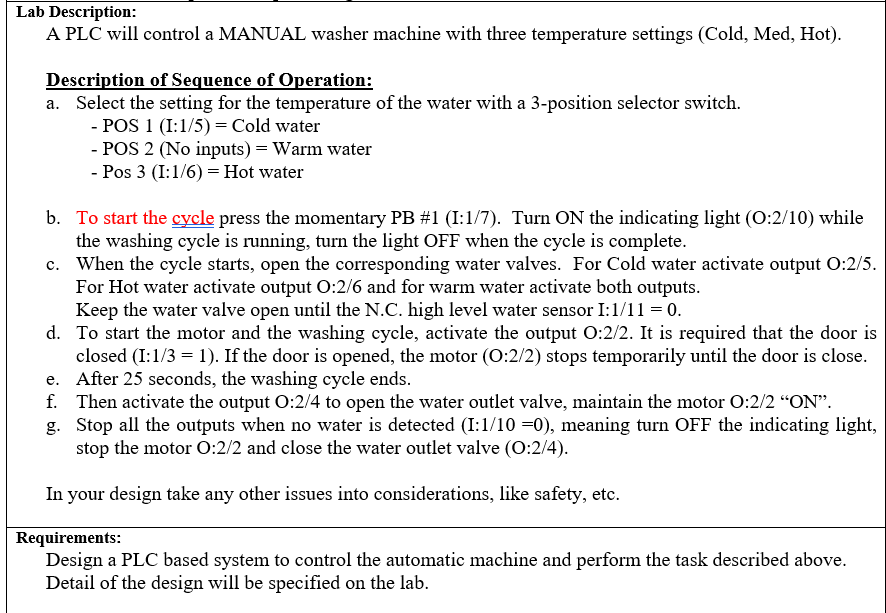
A PLC will control a MANUAL washer machine with three temperature settings Cold Med, Hot
Description of Sequence of Operation:
a Select the setting for the temperature of the water with a position selector switch.
POS I: Cold water
POS No inputs Warm water
Pos mathrmI: Hot water
b To start the cycle press the momentary PB #I: Turn ON the indicating light O: while the washing cycle is running, turn the light OFF when the cycle is complete.
c When the cycle starts, open the corresponding water valves. For Cold water activate output O: For Hot water activate output O: and for warm water activate both outputs.
Keep the water valve open until the NC high level water sensor I:
d To start the motor and the washing cycle, activate the output mathrmO: It is required that the door is closed mathrmI: If the door is opened, the motor mathrmO: stops temporarily until the door is close.
e After seconds, the washing cycle ends.
f Then activate the output O: to open the water outlet valve, maintain the motor O:ON
g Stop all the outputs when no water is detected mathrmI: meaning turn OFF the indicating light, stop the motor mathrmO: and close the water outlet valve O:
In your design take any other issues into considerations, like safety, etc.
Requirements:
Design a PLC based system to control the automatic machine and perform the task described above. Detail of the design will be specified on the lab.
Step by Step Solution
There are 3 Steps involved in it
1 Expert Approved Answer
Step: 1 Unlock

Question Has Been Solved by an Expert!
Get step-by-step solutions from verified subject matter experts
Step: 2 Unlock
Step: 3 Unlock
 Study Help