Question: Lab Exercise 2: Relative and / X a7 = Cc 25 canvas.uoregon.edu/courses/244405/assignments/1609309 Lab 2_Relative and Absolute Dating.doc Points: 60 Because types of sediment are recognizable
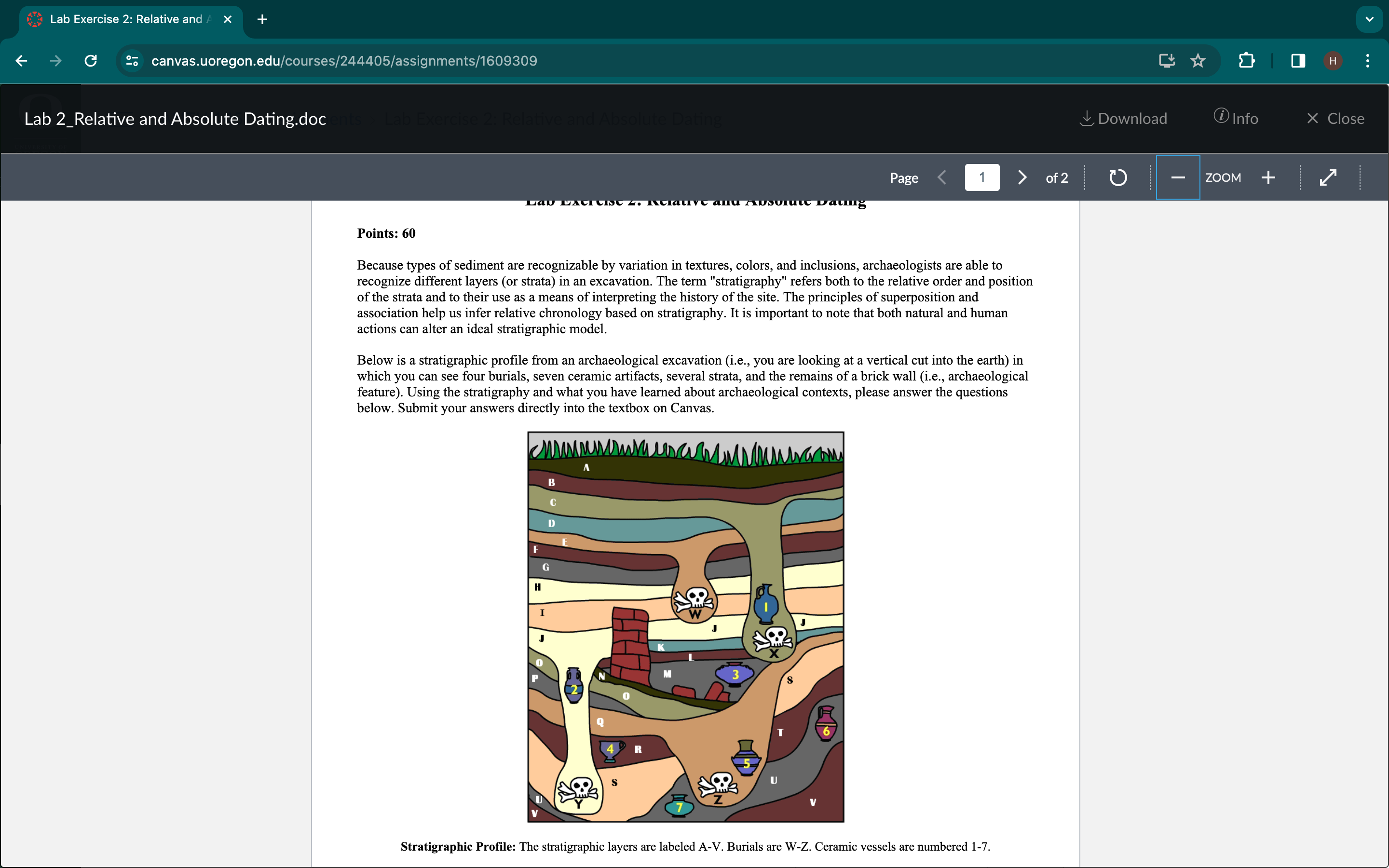
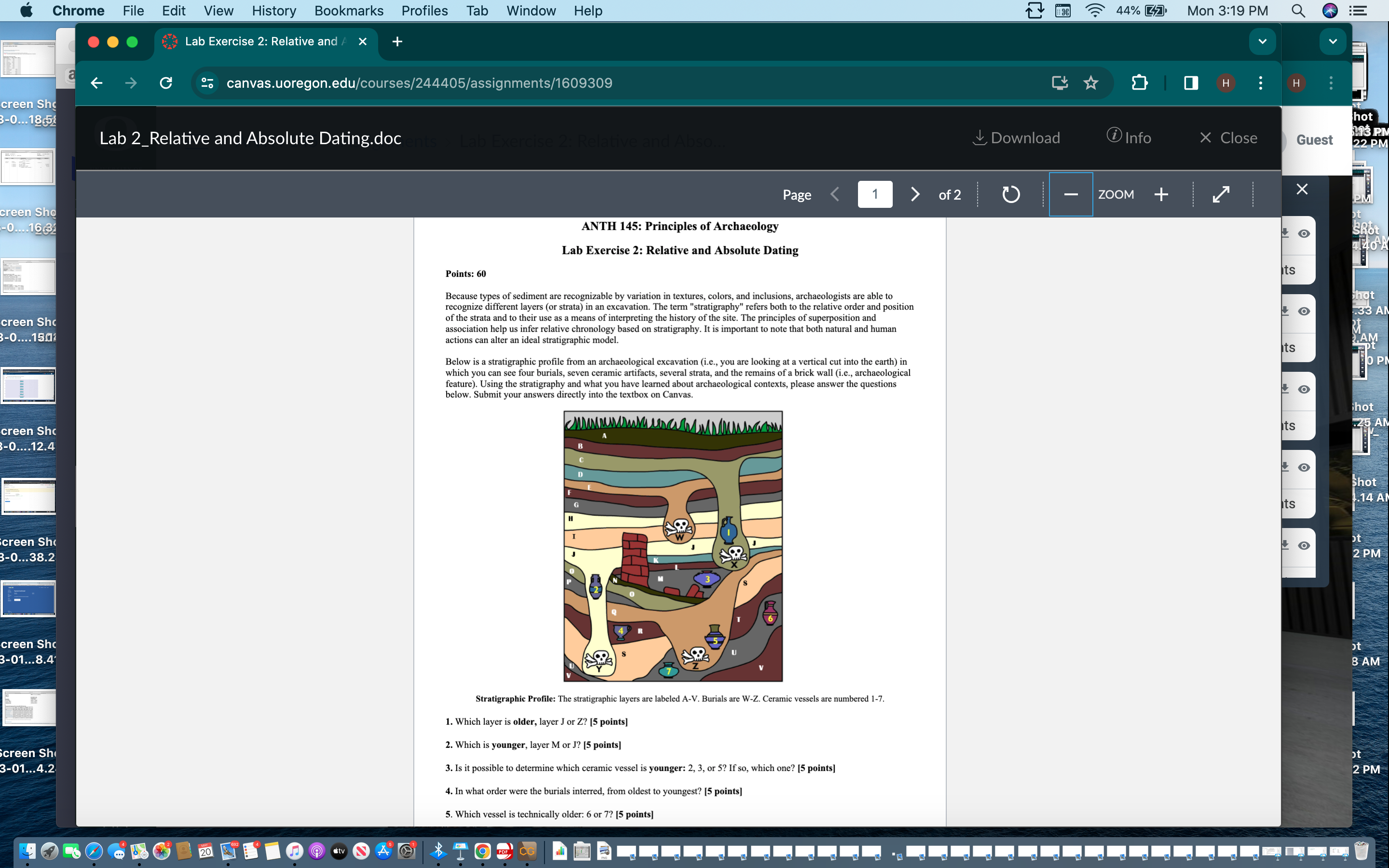
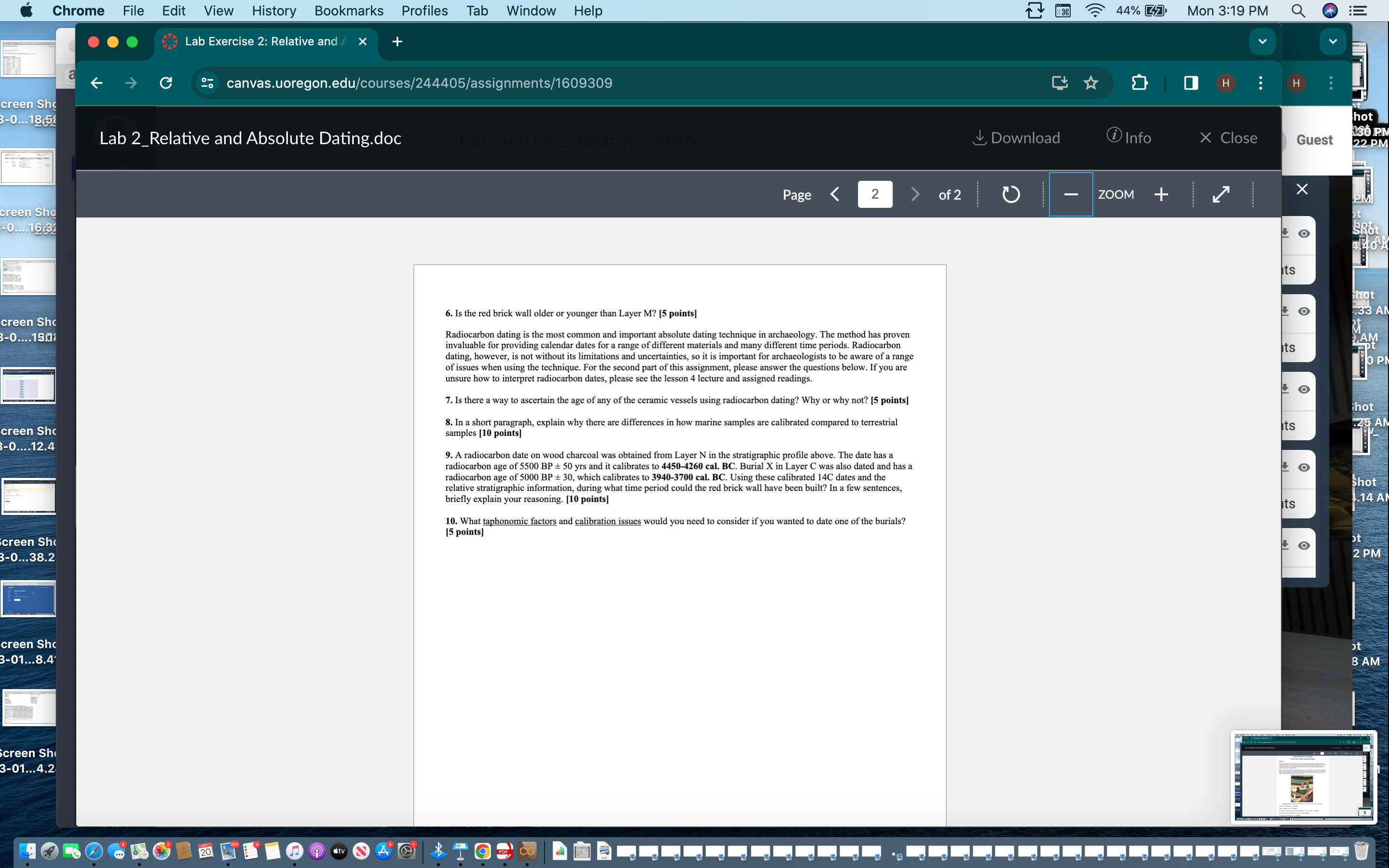
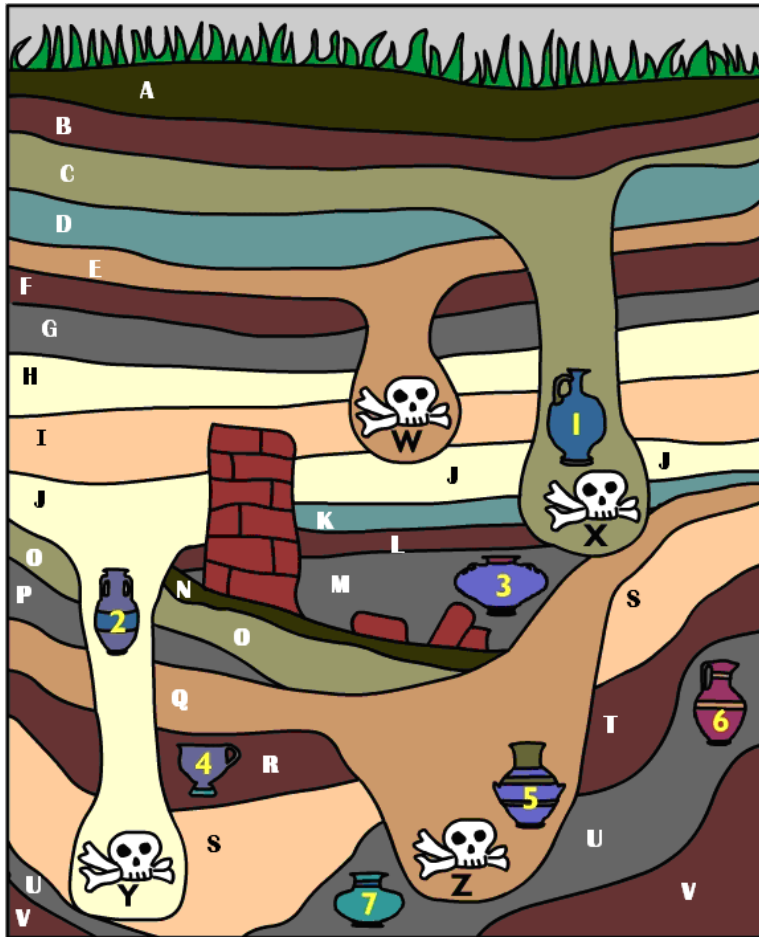
Lab Exercise 2: Relative and / X a7 = Cc 25 canvas.uoregon.edu/courses/244405/assignments/1609309 Lab 2_Relative and Absolute Dating.doc Points: 60 Because types of sediment are recognizable by variation in textures, colors, and inclusions, archaeologists are able to recognize different layers (or strata) in an excavation. The term "stratigraphy" refers both to the relative order and position of the strata and to their use as a means of interpreting the history of the site. The principles of superposition and association help us infer relative chronology based on stratigraphy. It is important to note that both natural and human actions can alter an ideal stratigraphic model. Below is a stratigraphic profile from an archaeological excavation (i.e., you are looking at a vertical cut into the earth) in which you can see four burials, seven ceramic artifacts, several strata, and the remains of a brick wall (i.e., archaeological feature). Using the stratigraphy and what you have learned about archaeological contexts, please answer the questions below. Submit your answers directly into the textbox on Canvas. Stratigraphic Profile: The stratigraphic layers are labeled A-V. Burials are W-Z. Ceramic vessels are numbered 1-7. @ Chrome File Edit View History Bookmarks Profiles Tab Window Help E = 4% @D Mon319PM Q @ Lab Exercise 2: Relative and /X ar (] 25 canvas.uoregon.edu/courses/244405/assignments/1609309 Lab 2_Relative and Absolute Dating.doc ANTH 145: Principles of Archaeology Lab Exercise 2: Relative and Absolute Dating Points: 60 Because types of sediment are recognizable by variation in textures, colors, and inclusions, archacologists are able to recognize different layers (or strata) in an excavation. The term "stratigraphy" refers both to the relative order and position of the strata and to their use as a means of interpreting the history of the site. The principles of superposition and association help us infer relative chronology based on stratigraphy. It is important to note that both natural and human actions can alter an ideal stratigraphic model. Below is a stratigraphic profile from an archacological excavation (i.c., you are looking at a vertical cut into the carth) in 'which you can see four burials, seven ceramic artifacts, several strata, and the remains of a brick wall (i.c., archacological feature). Using the stratigraphy and what you have leamed about archacological contexts, please answer the questions below. Submit your answers directly into the textbox on Canvas. Stratigraphic Profile: The stratigraphic layers are labeled A-V. Burials are W-Z. Ceramic vessels are numbered 1-7. 1. Which layer is older, layer J or Z? [5 points] 2. Which is younger, layer M or J? [5 points] 3.Isit possible to determine which ceramic vessel is younger: 2, 3, or 5 If so, which one? [5 points] 4. In what order were the burials interred, from oldest to youngest? [S points] 5. Which vessel is technically older: 6 or 77 [S points] GROTaiANO0 02 3 LU DD DL LD L DL LD DD L L] @ Chrome File Edit View History Bookmarks Profiles Tab Window Help Lab Exercise 2: Relative and /X ar canvas.uoregon.edu/courses/244405/assignments/1609309 Lab 2_Relative and Absolute Dating.doc MORO RO EEEROO - OF 6. Is the red brick wall older or younger than Layer M? [5 points] Radiocarbon dating is the most common and important absolute dating technique in archacology. The method has proven invaluable for providing calendar dates for a range of different materials and many different time periods. Radiocarbon dating, however, is not without ts limitations and uncertainties, so it is important for archaeologists to be aware of a range of issues when using the technique. For the second part of this assignment, please answer the questions below. If you are unsure how to interpret radiocarbon dates, please see the lesson 4 lecture and assigned readings. 7.Is there a way to ascertain the age of any of the ceramic vesscls using radiocarbon dating? Why or why not? [S points] 8.1n a short paragraph, explain why there are differences in how marine samples are calibrated compared to terrestrial samples [10 points] 9. A radiocarbon date on wood charcoal was obtained from Layer N in the stratigraphic profile above. The date has a radiocarbon age of 5500 BP + 50 yrs and it calibrates to 44504260 cal. BC. Burial X in Layer C was also dated and has a radiocarbon age of 5000 BP + 30, which calibrates to 3940-3700 cal. BC. Using these calibrated 14C dates and the relative stratigraphic information, during what time period could the red brick wall have been built? In a few sentences, briefly explain your reasoning. [10 points] 10. What taphonomic factors and calibration issues would you need to consider if you wanted to date one of the burials? I5 points] o E 44% B3 Mon 3:19PM Q @ i \f
Step by Step Solution
There are 3 Steps involved in it
1 Expert Approved Answer
Step: 1 Unlock
Question Has Been Solved by an Expert!
Get step-by-step solutions from verified subject matter experts
Step: 2 Unlock
Step: 3 Unlock
Students Have Also Explored These Related Law Questions!









 Study Help