







Question: lab procedure steps part i need help with based off of the procedure Extraction of Caffeine 1. Obtain 2 uncoated alertness aid tablets and measure
 part i need help with based off of the procedure
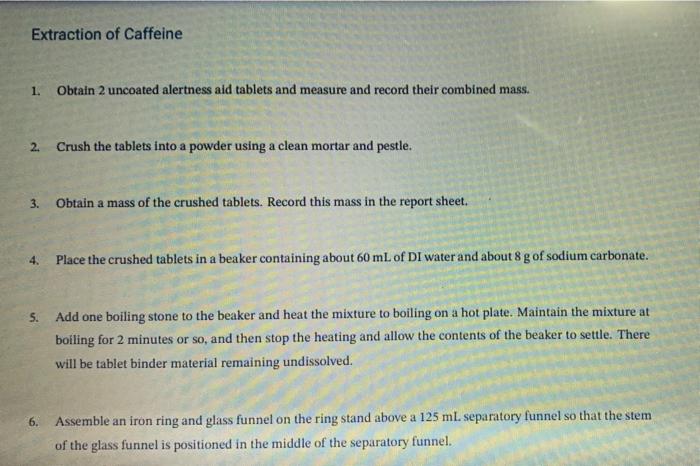
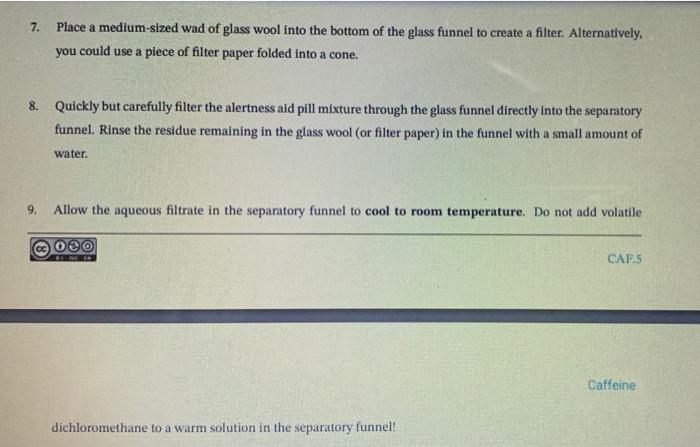
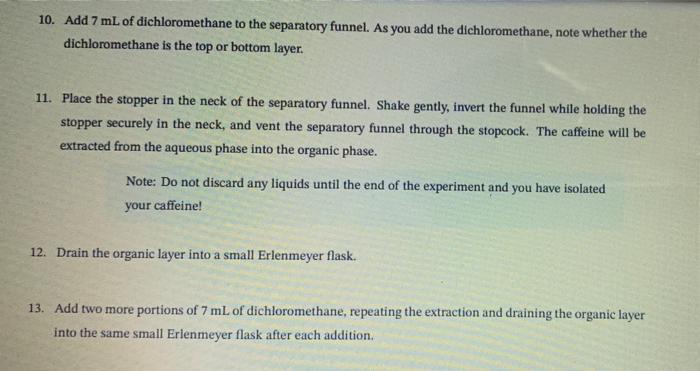
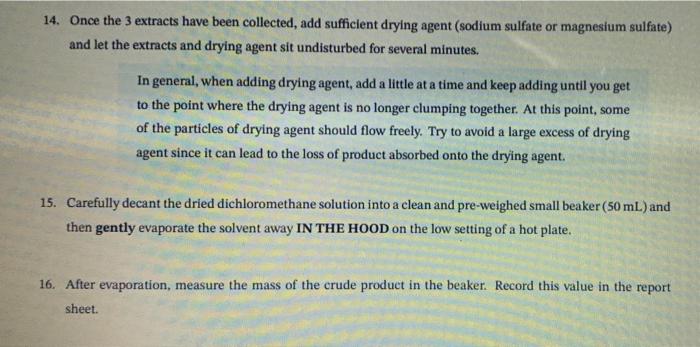
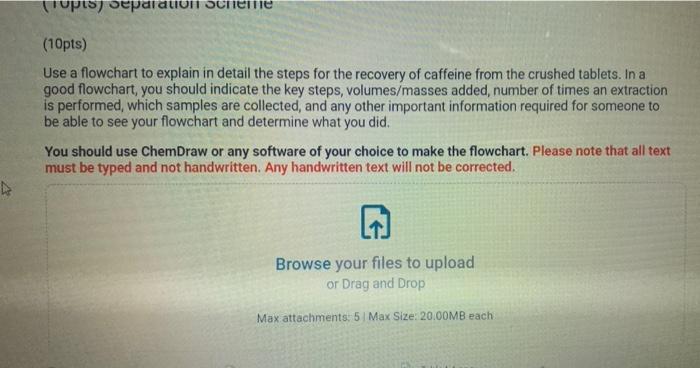
Extraction of Caffeine 1. Obtain 2 uncoated alertness aid tablets and measure and record their combined mass. 2 Crush the tablets into a powder using a clean mortar and pestle. 3. Obtain a mass of the crushed tablets. Record this mass in the report sheet. 4. Place the crushed tablets in a beaker containing about 60 mL of DI water and about 8 g of sodium carbonate. 5. Add one boiling stone to the beaker and heat the mixture to boiling on a hot plate. Maintain the mixture at boiling for 2 minutes or so, and then stop the heating and allow the contents of the beaker to settle. There will be tablet binder material remaining undissolved. 6. Assemble an iron ring and glass funnel on the ring stand above a 125 ml separatory funnel so that the stem of the glass furnel is positioned in the middle of the separatory funnel. 7. Place a medium-sized wad of glass wool into the bottom of the glass funnel to create a filter. Alternatively, you could use a piece of filter paper folded into a cone. 8. Quickly but carefully filter the alertness aid pill mixture through the glass funnel directly into the separatory funnel. Rinse the residue remaining in the glass wool (or filter paper) in the funnel with a small amount of water. 9. Allow the aqueous filtrate in the separatory funnel to cool to room temperature. Do not add volatile CAF.5 Caffeine dichloromethane to a warm solution in the separatory funnel! 10. Add 7 mL of dichloromethane to the separatory funnel. As you add the dichloromethane, note whether the dichloromethane is the top or bottom layer. 11. Place the stopper in the neck of the separatory funnel. Shake gently, invert the funnel while holding the stopper securely in the neck, and vent the separatory funnel through the stopcock. The caffeine will be extracted from the aqueous phase into the organic phase. Note: Do not discard any liquids until the end of the experiment and you have isolated your caffeine! 12. Drain the organic layer into a small Erlenmeyer flask. 13. Add two more portions of 7 mL of dichloromethane, repeating the extraction and draining the organic layer into the same small Erlenmeyer flask after each addition, 14. Once the 3 extracts have been collected, add sufficient drying agent (sodium sulfate or magnesium sulfate) and let the extracts and drying agent sit undisturbed for several minutes. In general, when adding drying agent, add a little at a time and keep adding until you get to the point where the drying agent is no longer clumping together. At this point, some of the particles of drying agent should flow freely. Try to avoid a large excess of drying agent since it can lead to the loss of product absorbed onto the drying agent. 15. Carefully decant the dried dichloromethane solution into a clean and pre-weighed small beaker (50 mL) and then gently evaporate the solvent away IN THE HOOD on the low setting of a hot plate. 16. After evaporation, measure the mass of the crude product in the beaker. Record this value in the report sheet. upis) Deparauon (10pts) Use a flowchart to explain in detail the steps for the recovery of caffeine from the crushed tablets. In a good flowchart, you should indicate the key steps, volumes/masses added, number of times an extraction is performed, which samples are collected, and any other important information required for someone to be able to see your flowchart and determine what you did. You should use ChemDraw or any software of your choice to make the flowchart. Please note that all text must be typed and not handwritten. Any handwritten text will not be corrected Browse your files to upload or Drag and Drop Max attachments: 5 Max Size: 20.00MB each
Step by Step Solution
There are 3 Steps involved in it

Get step-by-step solutions from verified subject matter experts
 Study Help