Question: LAB05ex2.m clear all; % clear all variables m = 1; % mass [kg] k = 16; % spring constant [N/m] c = 2; % friction
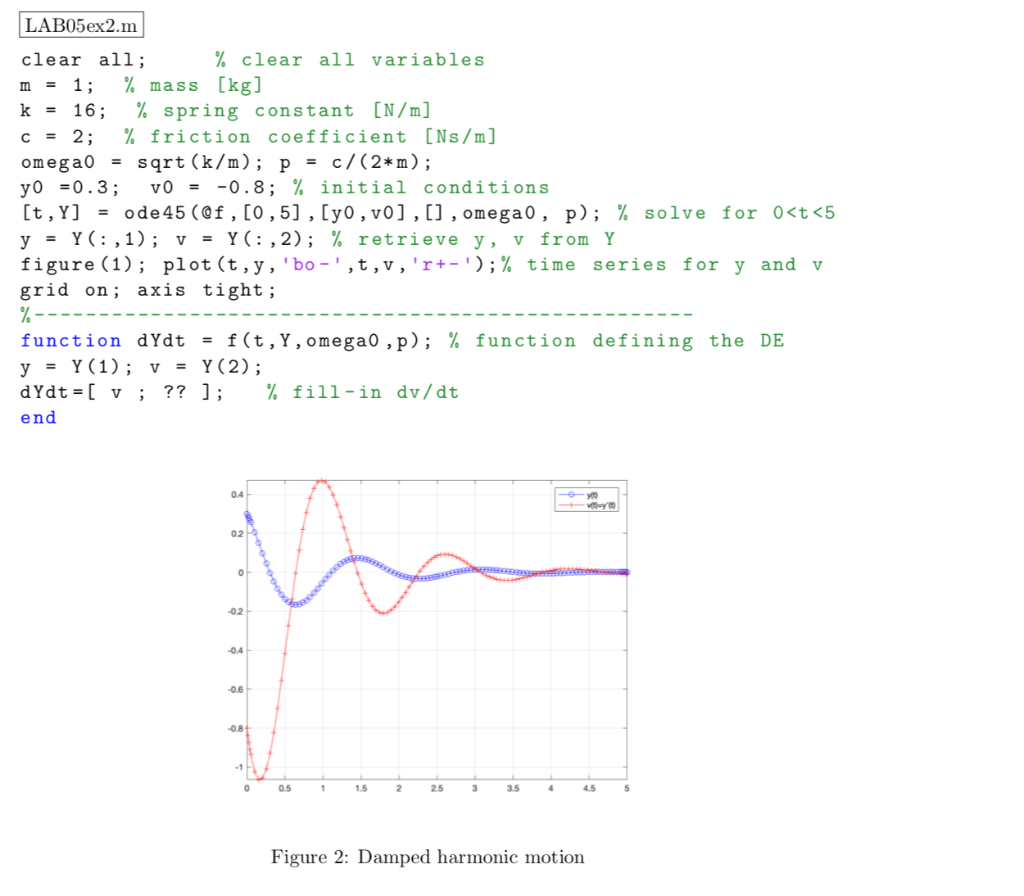
![mass [kg] k = 16; % spring constant [N/m] c = 2;](https://dsd5zvtm8ll6.cloudfront.net/si.experts.images/questions/2024/09/66e2cb34efb1c_18866e2cb346feff.jpg)
LAB05ex2.m clear all; % clear all variables m = 1; % mass [kg] k = 16; % spring constant [N/m] c = 2; % friction coefficient [Ns/m] omega0 = sqrt (k/m); p = c/(2*m); yo =0.3; v0 = -0.8; % initial conditions [t,Y] = ode45 (@f, [0,5] , [y0, v0],[], omegal, p); % solve for 0t? You can answer the question either by magnifying the MATLAB figure using the magnify button , or use the following MATLAB commands (explain): THIS CONTENT IS PROTECTED AND MAY NOT BE SHARED, UPLOADED, SOLD OR DISTRIBUTED 2019 v2 Copyright School of Mathematical and Statistical Sciences, Arizona State University for i=1:length (y) M(i)=max(abs (y (i:end))); end i = find (M ti with ' num2str(t (i-1)) 's ti s' num2str(t(i))]) (b) What is the largest in magnitude) velocity attained by the mass, and when is it attained? Answer by using the magnify button. (c) How does the size of c affect the motion? To support your answer, run the file LABO5ex2.m for c = 4, c = 8, and c = 20. Include the corresponding graphs with a title indicating the value of c used. (d) Determine analytically the smallest critical) value of e such that no oscillation ap- pears in the solution. 4. (a) Modify LABO5ex2.m to compute and plot the quantity E = {mv2+kky? as a function of time. What do you observe? Is the energy conserved in this case? Include the plot. (b) Show analytically that 0 while a > 0 for c t? You can answer the question either by magnifying the MATLAB figure using the magnify button , or use the following MATLAB commands (explain): THIS CONTENT IS PROTECTED AND MAY NOT BE SHARED, UPLOADED, SOLD OR DISTRIBUTED 2019 v2 Copyright School of Mathematical and Statistical Sciences, Arizona State University for i=1:length (y) M(i)=max(abs (y (i:end))); end i = find (M ti with ' num2str(t (i-1)) 's ti s' num2str(t(i))]) (b) What is the largest in magnitude) velocity attained by the mass, and when is it attained? Answer by using the magnify button. (c) How does the size of c affect the motion? To support your answer, run the file LABO5ex2.m for c = 4, c = 8, and c = 20. Include the corresponding graphs with a title indicating the value of c used. (d) Determine analytically the smallest critical) value of e such that no oscillation ap- pears in the solution. 4. (a) Modify LABO5ex2.m to compute and plot the quantity E = {mv2+kky? as a function of time. What do you observe? Is the energy conserved in this case? Include the plot. (b) Show analytically that 0 while a > 0 for c









 Study Help