Question: Lab3 Moisture and lapse rates Objective: To learn how to measure moisture in the atmosphere and its impact on lapse rates. To understand the difference
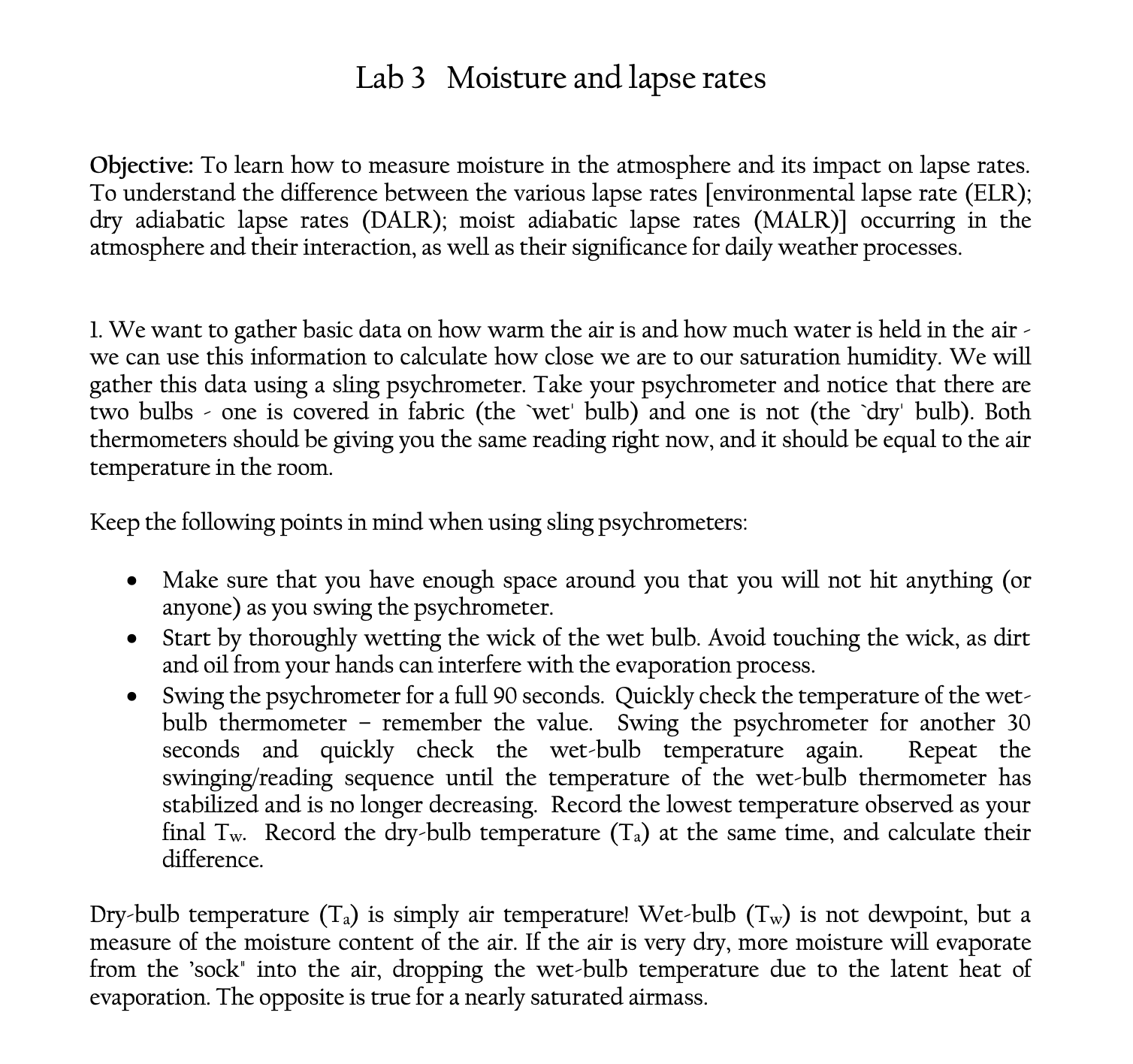
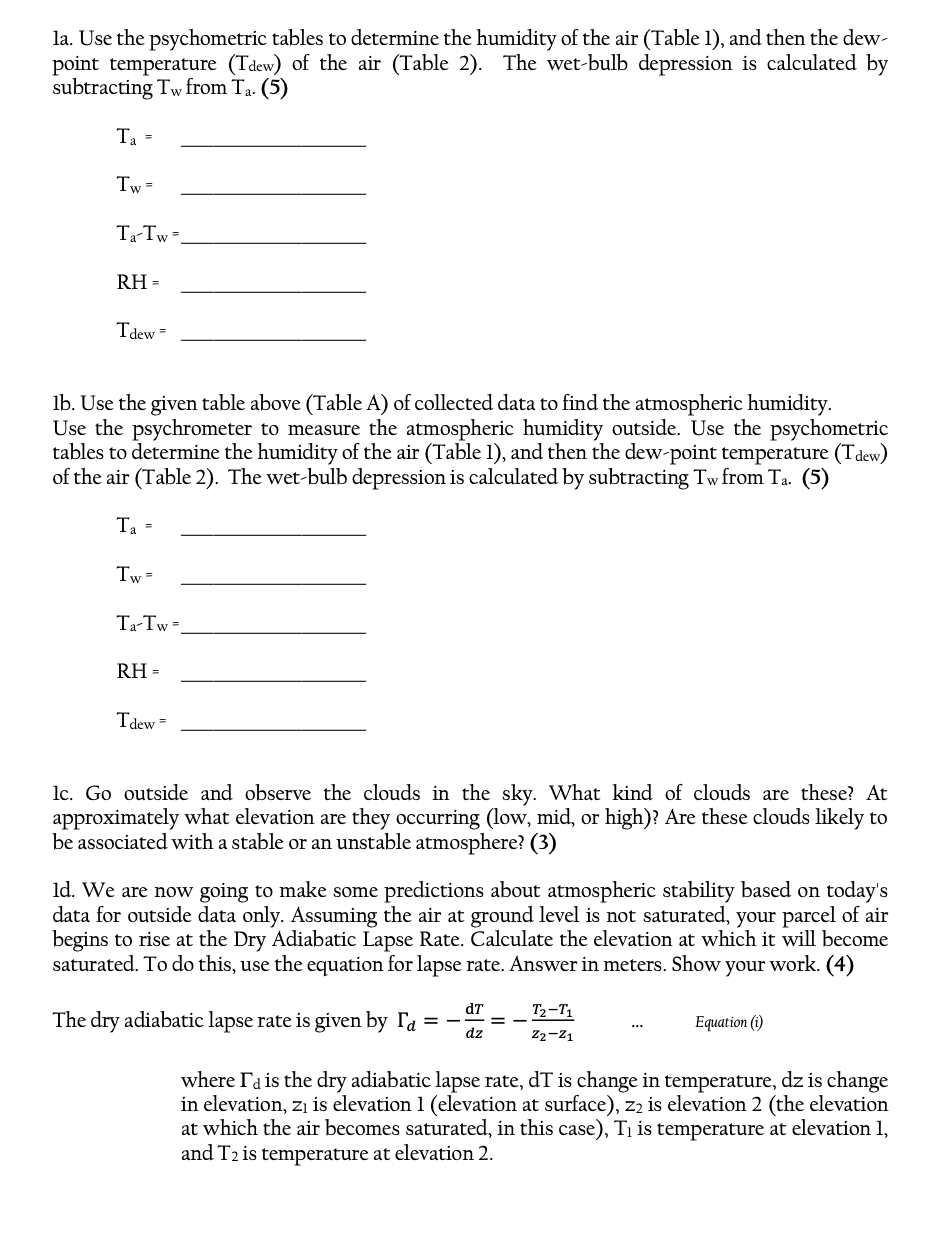
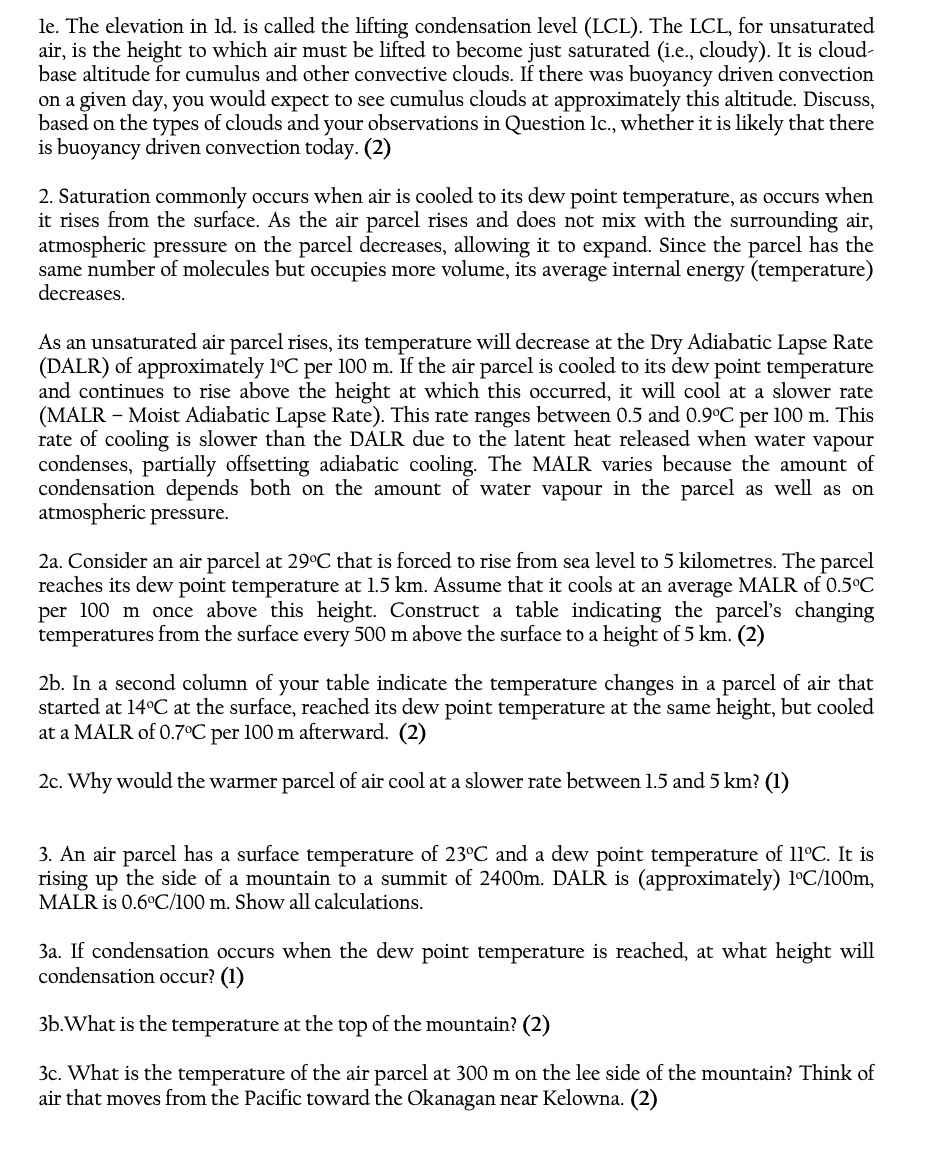
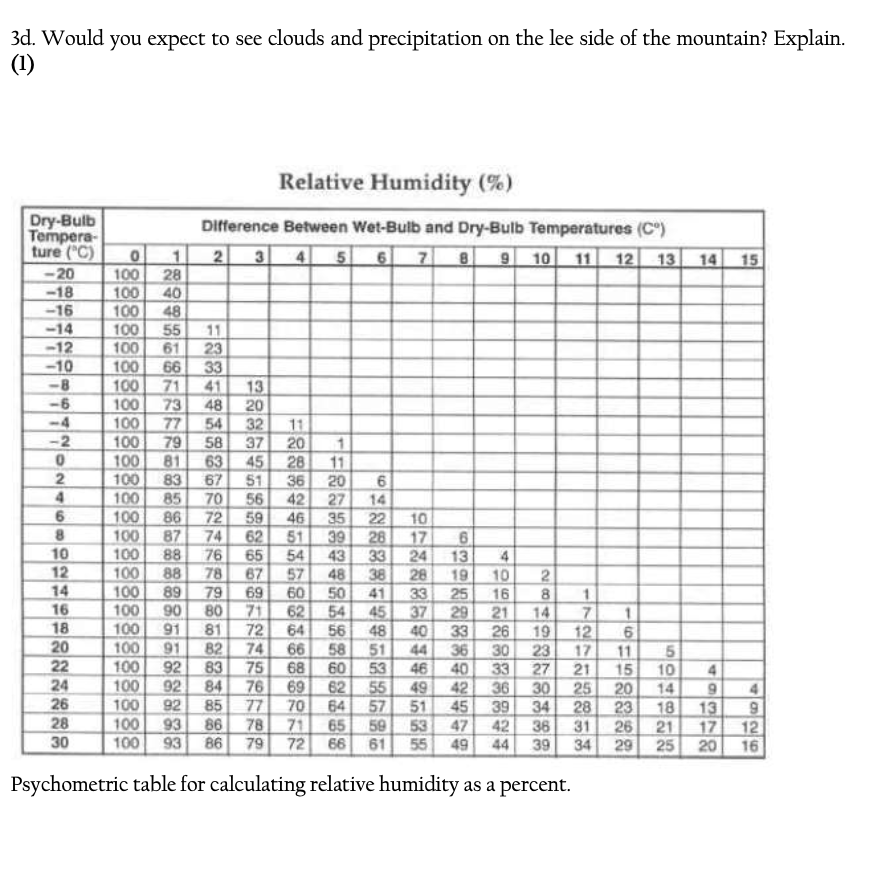
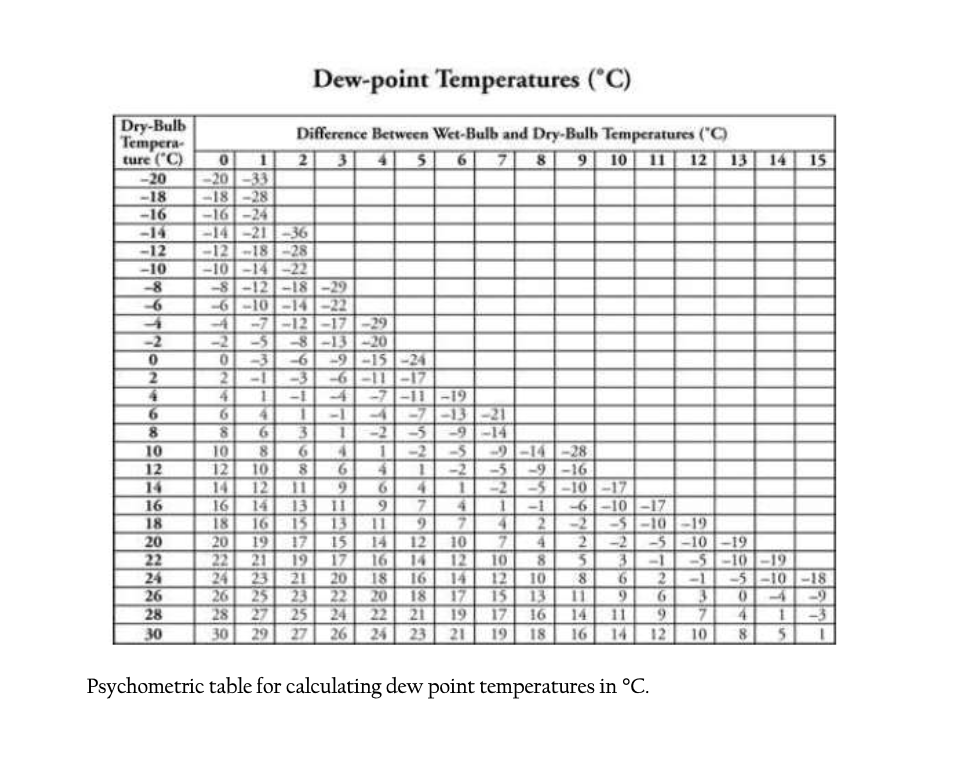
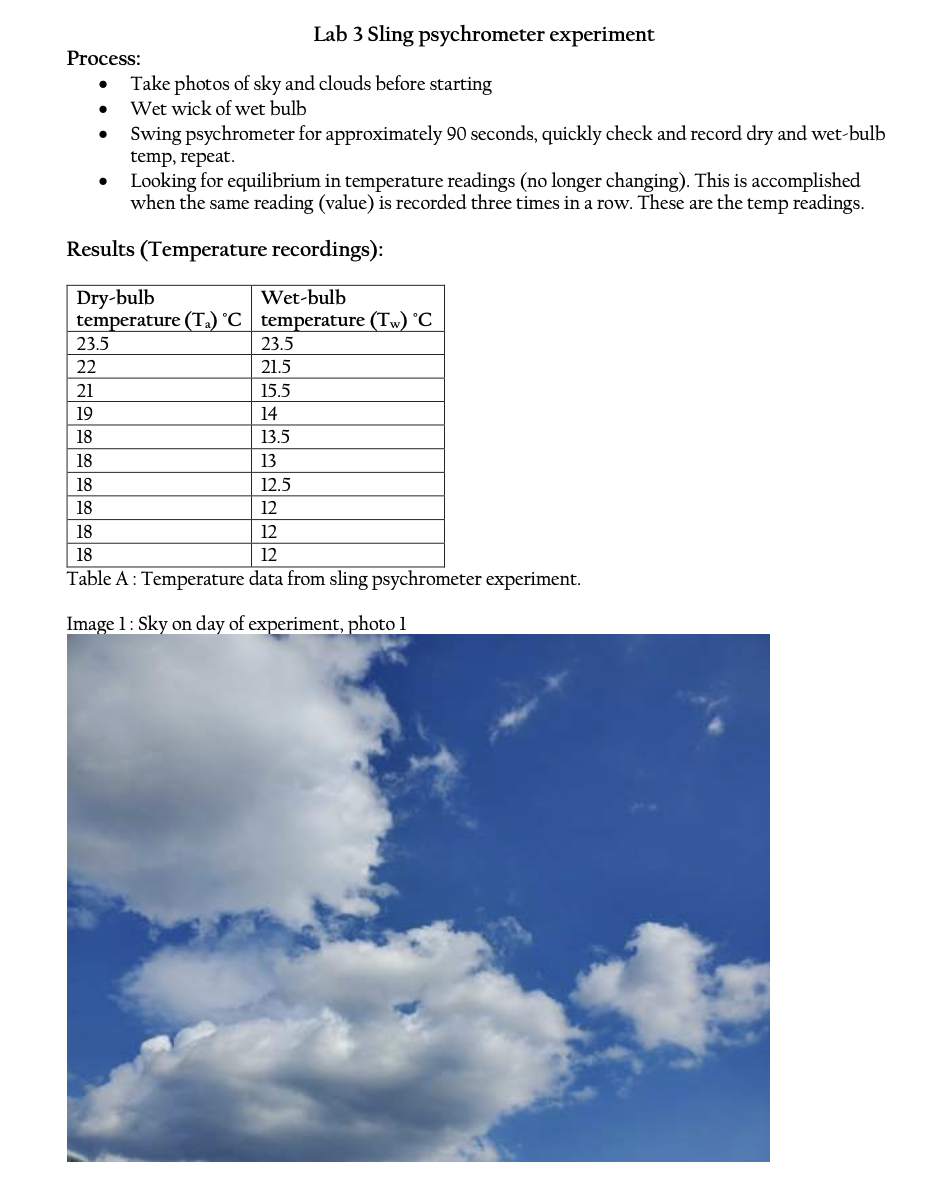
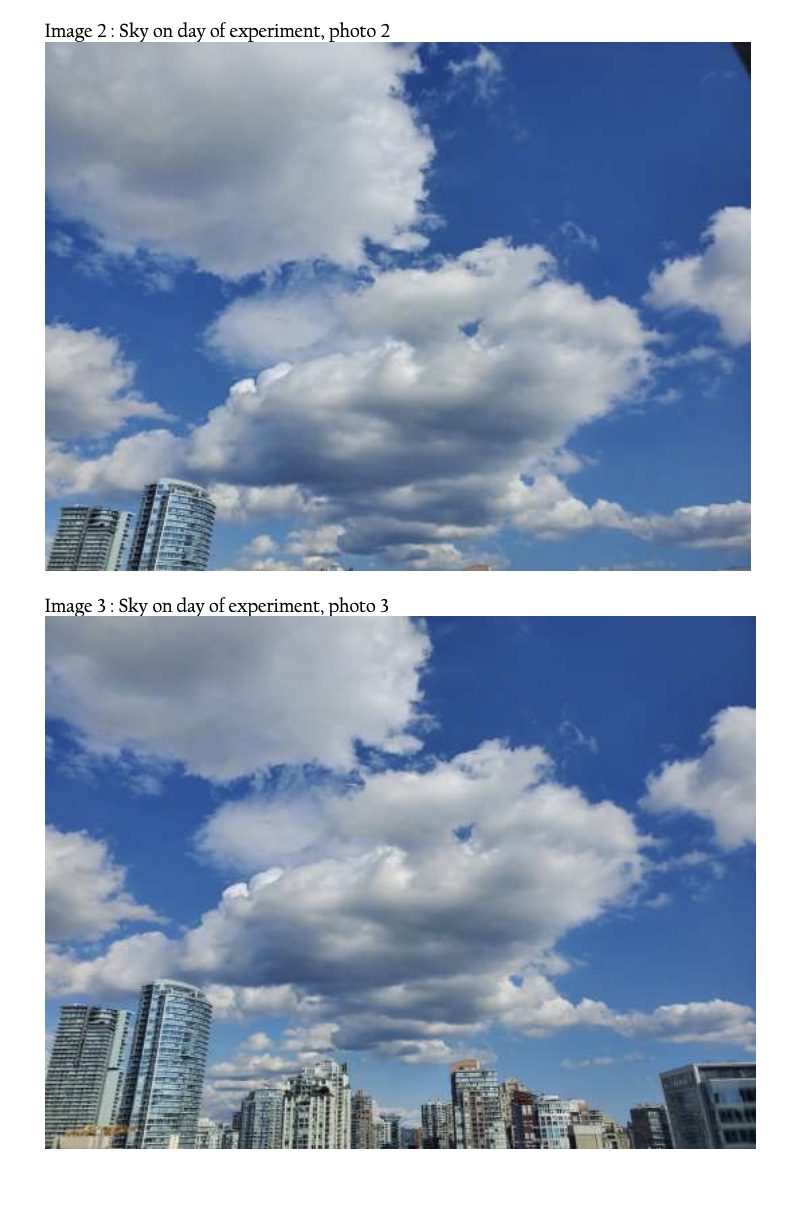
Lab3 Moisture and lapse rates Objective: To learn how to measure moisture in the atmosphere and its impact on lapse rates. To understand the difference between the various lapse rates [environmental lapse rate (ELR); dry adiabatic lapse rates (DALR); moist adiabatic lapse rates (MALR)] occurring in the atmosphere and their interaction, as well as their significance for daily weather processes. 1. We want to gather basic data on how warm the air is and how much water is held in the air - we can use this information to calculate how close we are to our saturation humidity. We will gather this data using a sling psychrometer. Take your psychrometer and notice that there are two bulbs - one is covered in fabric (the 'wet' bulb) and one is not (the 'dry' bulb). Both thermometers should be giving you the same reading right now, and it should be equal to the air temperature in the room. Keep the following points in mind when using sling psychrometers: Make sure that you have enough space around you that you will not hit anything (or anyone) as you swing the psychrometer. Start by thoroughly wetting the wick of the wet bulb. Avoid touching the wick, as dirt and oil from your hands can interfere with the evaporation process. Swing the psychrometer for a full 90 seconds. Quickly check the temperature of the wet- bulb thermometer - remember the value. Swing the psychrometer for another 30 seconds and quickly check the wet-bulb temperature again. Repeat the swinging/reading sequence until the temperature of the wet-bulb thermometer has stabilized and is no longer decreasing. Record the lowest temperature observed as your final Tw. Record the dry-bulb temperature (T.) at the same time, and calculate their difference. Dry-bulb temperature (Ta) is simply air temperature! Wet-bulb (Tw) is not dewpoint, but a measure of the moisture content of the air. If the air is very dry, more moisture will evaporate from the 'sock" into the air, dropping the wet-bulb temperature due to the latent heat of evaporation. The opposite is true for a nearly saturated airmass. la. Use the psychometric tables to determine the humidity of the air (Table 1), and then the dew- point temperature (Tdew) of the air (Table 2). The wet-bulb depression is calculated by subtracting Tw from T. (5) Taew = lb. Use the given table above (Table A) of collected data to find the atmospheric humidity. Use the psychrometer to measure the atmospheric humidity outside. Use the psychometric tables to determine the humidity of the air (Table 1), and then the dew-point temperature (Tdew) of the air (Table 2). The wet-bulb depression is calculated by subtracting Tw from Ta. (5) Ta = Ta-Tw = RH = Tuew = lc. Go outside and observe the clouds in the sky. What kind of clouds are these? At approximately what elevation are they occurring (low, mid, or high)? Are these clouds likely to be associated with a stable or an unstable atmosphere? (3) ld. We are now going to make some predictions about atmospheric stability based on today's data for outside data only. Assuming the air at ground level is not saturated, your parcel of air begins to rise at the Dry Adiabatic Lapse Rate. Calculate the elevation at which it will become saturated. To do this, use the equation for lapse rate. Answer in meters. Show your work. (4) dr Ty The dry adiabatic lapse rate is given by Tg = - = vs Equation (i) dz Zo-21 where [yg is the dry adiabatic lapse rate, dT is change in temperature, dz is change in elevation, z) is elevation 1 (elevation at surface), z2 is elevation 2 (the elevation at which the air becomes saturated, in this case), T) is temperature at elevation 1, and T2 is temperature at elevation 2. le. The elevation in ld. is called the lifting condensation level (LCL). The LCL, for unsaturated air, is the height to which air must be lifted to become just saturated (ie., cloudy). It is cloud- base altitude for cumulus and other convective clouds. If there was buoyancy driven convection on a given day, you would expect to see cumulus clouds at approximately this altitude. Discuss, based on the types of clouds and your observations in Question lc., whether it is likely that there is buoyancy driven convection today. (2) 2. Saturation commonly occurs when air is cooled to its dew point temperature, as occurs when it rises from the surface. As the air parcel rises and does not mix with the surrounding air, atmospheric pressure on the parcel decreases, allowing it to expand. Since the parcel has the same number of molecules but occupies more volume, its average internal energy (temperature) decreases. As an unsaturated air parcel rises, its temperature will decrease at the Dry Adiabatic Lapse Rate (DALR) of approximately 1C per 100 m. If the air parcel is cooled to its dew point temperature and continues to rise above the height at which this occurred, it will cool at a slower rate (MALR - Moist Adiabatic Lapse Rate). This rate ranges between 0.5 and 0.9C per 100 m. This rate of cooling is slower than the DALR due to the latent heat released when water vapour condenses, partially offsetting adiabatic cooling. The MALR varies because the amount of condensation depends both on the amount of water vapour in the parcel as well as on atmospheric pressure. 2a. Consider an air parcel at 29C that is forced to rise from sea level to 5 kilometres. The parcel reaches its dew point temperature at 1.5 km. Assume that it cools at an average MALR of 0.5C per 100 m once above this height. Construct a table indicating the parcel's changing temperatures from the surface every 500 m above the surface to a height of 5 km. (2) 2b. In a second column of your table indicate the temperature changes in a parcel of air that started at 14C at the surface, reached its dew point temperature at the same height, but cooled at a MALR of 0.7C per 100 m afterward. (2) 2c. Why would the warmer parcel of air cool at a slower rate between 1.5 and 5 km? (1) 3. An air parcel has a surface temperature of 23C and a dew point temperature of 11C. It is rising up the side of a mountain to a summit of 2400m. DALR is (approximately) 1C/100m, MALR is 0.6C/100 m. Show all calculations. 3a. If condensation occurs when the dew point temperature is reached, at what height will condensation occur? (1) 3b.What is the temperature at the top of the mountain? (2) 3c. What is the temperature of the air parcel at 300 m on the lee side of the mountain? Think of air that moves from the Pacific toward the Okanagan near Kelowna. (2) 3d. Would you expect to see clouds and precipitation on the lee side of the mountain? Explain. (1) Relative Humidity (%) Difference Between Wet-Bulb and Dry-Bulb Temperatures (C") Dry-Bulb Tempera- 10 11 12 13 14 15 ture (C) 0 1 2 3 -20 100 28 -18 100 40 -16 100 48 -14 100 55 11 -12 100 61 -10 100 66 -8 71 -6 -4 38 8 8 8 838 3838 8 8 18 81 72 20 91 82 74 22 100 92 83 100 92 84 69 28 13 24 100 92 85 42 26 17 12 26 31 16 28 100 93 86 49 44 39 34 29 25 20 30 93 86 66 100 79 Psychometric table for calculating relative humidity as a percent.Dew-point Temperatures ("C) Dry-Bulb Difference Between Wet-Bulb and Dry-Bulb Temperatures ("C) Tempera- ture ('C) 0 1 10 11 12 13 14 15 -20 20 -18 -16 -14 -14 -21 -12 -12 -10 -10 -14 -12 24 -14 -28 -9 -17 -10 -17 -10 1-19 -10 -19 -10 -18 0 18 16 12 10 8 Psychometric table for calculating dew point temperatures in C.Lab 3 Sling psychrometer experiment Process: e Take photos of sky and clouds before starting = Wet wick of wet bulb e Swing psychrometer for approximately 90 seconds, quickly check and record dry and wet-bulb temp, repeat. e Looking for equilibrium in temperature readings (no longer changing). This is accomplished when the same reading (value) is recorded three times in a row. These are the temp readings. Results (Temperature recordings): Dry-bulb Wet-bulb temperature (T,) \"C | temperature (Tw) C 23.5 23.5 22 2S 21 15.5 19 14 18 13.5 18 3 18 12.5 18 ]2 18 ]2 18 12 Table A: Temperature data from sling psychrometer experiment. Image 1: Sky on periment, photo 1 - day ofe Image 2 : Sky on day of experiment, photo 2 Image 3 : Sky on day of experiment, photo 3
Step by Step Solution
There are 3 Steps involved in it
1 Expert Approved Answer
Step: 1 Unlock
Question Has Been Solved by an Expert!
Get step-by-step solutions from verified subject matter experts
Step: 2 Unlock
Step: 3 Unlock
Students Have Also Explored These Related Accounting Questions!