







Question: Language is C++ (10) If we list all permutations for n = 4 as below. (1,2,3,4) (1,2,4,3) (1,3,2,4) (1,3,4,2) (4,3,2,1) What can be said about
Language is C++
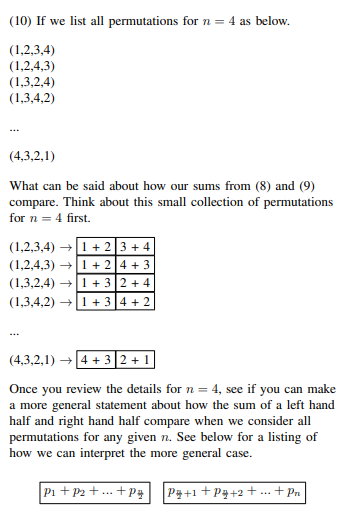
(10) If we list all permutations for n = 4 as below. (1,2,3,4) (1,2,4,3) (1,3,2,4) (1,3,4,2) (4,3,2,1) What can be said about how our sums from (8) and (9) compare. Think about this small collection of permutations for n = 4 first. (1,2,3,4) +1 +213 + 4 (1,2,4,3)+1 +2 4 + 3 (1,3,2,4) +1 + 32 + 4 (1,3,4,2) +1+34 + 2 (4,3,2,1) + 4 + 32 + 1 Once you review the details for n = 4, see if you can make a more general statement about how the sum of a left hand half and right hand half compare when we consider all permutations for any given n. See below for a listing of how we can interpret the more general case. P1 + P2 + ... +P4 Py+1 + P4+2 + + Pn (10) If we list all permutations for n = 4 as below. (1,2,3,4) (1,2,4,3) (1,3,2,4) (1,3,4,2) (4,3,2,1) What can be said about how our sums from (8) and (9) compare. Think about this small collection of permutations for n = 4 first. (1,2,3,4) +1 +213 + 4 (1,2,4,3)+1 +2 4 + 3 (1,3,2,4) +1 + 32 + 4 (1,3,4,2) +1+34 + 2 (4,3,2,1) + 4 + 32 + 1 Once you review the details for n = 4, see if you can make a more general statement about how the sum of a left hand half and right hand half compare when we consider all permutations for any given n. See below for a listing of how we can interpret the more general case. P1 + P2 + ... +P4 Py+1 + P4+2 + + Pn
Step by Step Solution
There are 3 Steps involved in it

Get step-by-step solutions from verified subject matter experts
 Study Help