







Question: Language, Proof, and Logic exercise 10.10 and 10.12 help? 470 (290 of 100% Du Each of the following arguments is valid. Some of the conclusions
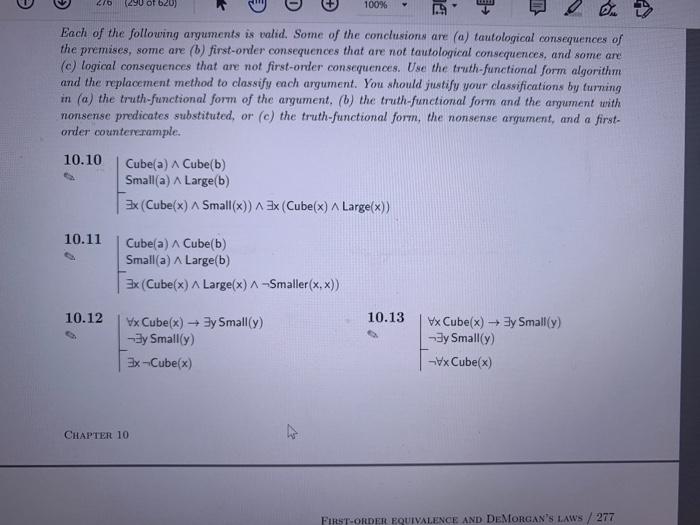
470 (290 of 100% Du Each of the following arguments is valid. Some of the conclusions are (a) tautological consequences of the premises, some are (b) first-order consequences that are not tautological consequences, and some are (c) logical consequences that are not first-order consequences. Use the truth-functional form algorithm and the replacement method to classify each argument. You should justify your classifications by turning in (a) the truth-functional form of the argument. (b) the truth-functional form and the argument with nonsense predicates substituted, or (c) the truth-functional form, the nonsense argument, and a first- order counterexample. 10.10 Cube(a) Cube(b) Small(a) A Large(b) x (Cube(x) A Small(x)) A 3x (Cube(x) A Large(x)) 10.11 Cube(a) Cubelb) Small(a) A Large(b) 3x (Cube(x) A Large(x) A-Smaller(x,x)) 10.12 10.13 Vx Cube(x) + 3y Small(y) By Small(y) Ex-Cube(x) Vx Cube(x) + 3y Small(y) By Small(y) -VxCube(x) CHAPTER 10 FIRST-ORDER EQUIVALENCE AND DEMORGAN'S LAWS / 277 470 (290 of 100% Du Each of the following arguments is valid. Some of the conclusions are (a) tautological consequences of the premises, some are (b) first-order consequences that are not tautological consequences, and some are (c) logical consequences that are not first-order consequences. Use the truth-functional form algorithm and the replacement method to classify each argument. You should justify your classifications by turning in (a) the truth-functional form of the argument. (b) the truth-functional form and the argument with nonsense predicates substituted, or (c) the truth-functional form, the nonsense argument, and a first- order counterexample. 10.10 Cube(a) Cube(b) Small(a) A Large(b) x (Cube(x) A Small(x)) A 3x (Cube(x) A Large(x)) 10.11 Cube(a) Cubelb) Small(a) A Large(b) 3x (Cube(x) A Large(x) A-Smaller(x,x)) 10.12 10.13 Vx Cube(x) + 3y Small(y) By Small(y) Ex-Cube(x) Vx Cube(x) + 3y Small(y) By Small(y) -VxCube(x) CHAPTER 10 FIRST-ORDER EQUIVALENCE AND DEMORGAN'S LAWS / 277
Step by Step Solution
There are 3 Steps involved in it

Get step-by-step solutions from verified subject matter experts
 Study Help