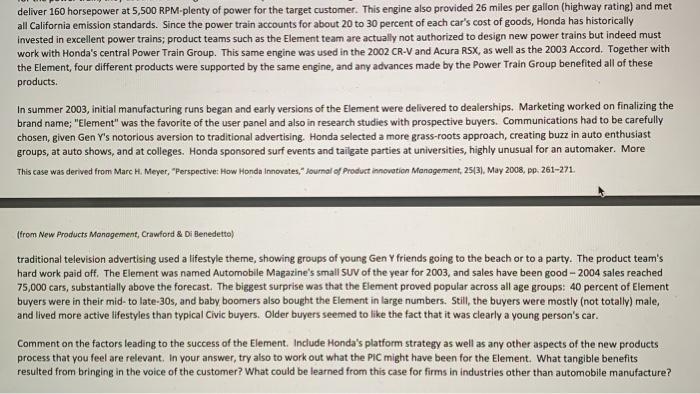
lasse. M2.3 - The Honda Element Your task in this exercise is to read "The Honda Element" case on pages 83-86 of your text, and then address the following prompts: Discuss the underlying strategic basis/objective of Honda's decision to develop "a ne kind of light truck." In other words, what strategic role(s) would the resulting product play? Clearly Honda leveraged a dual-drive strategy. Restate the market opportunity that Honda identified, and then discuss the technology/corporate strengths Honda leveraged to address it. What role did "VOC" (voice of customer) play in shaping the development initiative? In other words, how did VOC help narrow the scope of the product team's efforts and contribute to value creation? Share your thoughts about the relevancyecessity of a product innovation charter (or some similar framework) for this development initiative. List the five phases of the NP process, and then Identify the "real-world" details of the case that characterize the types of activity/tasks that constitute each phase. What are some key takeaways of the case that have relevancy in all industries? Submissions & Scoring: File format(s) MS Word file . Note that submissions of blank or "wrong" files, corrupted/unreadable/illegible files, or incorrect file types = 0 points. It is your responsibility to check that your files "work." You are allowed two submission attempts. I will grade the last attempt only. Due date: Sunday, 10/25, by 11:59pm via Blackboard. Late work: Late submissions allowed; 10% per day penalty Assignment Value 10 points Weak Okay Strong Criteria (0-5 pts) (6-8 pts) (9-10 pts) Content & Thinking Mastery/integration of concepts pls pls Evidence of thorough thought/analysis Communication Organization, structure, clarity ("flow") of ideas Language (sentences, wording) & Mechanics Qpts O pts (spelling, grammar, punctuation) Authenticity (writing reflects original thought/voice) Average level of Performance Your points earned for each criteria will be averaged together to determine a "level" of performance; your grade for the assignment will then be determined as follows: Level 5 100% of the assignment value Level 4 90% of the assignment value Level 3 80% of the assignment value Level 2 70% of the assignment value Level 0/1 No credit Case: The Honda Element Honda, like most automakers, is an expert in the use of product platforms. This case takes you through all new products process phases, highlighting how Honda applied its expertise in product platforms to develop a cost-efficient new light truck, the Element that was highly appealing to the targeted market segment The development of the Element began in 1998 with an idea for a new kind of light truck. At the time, Honda was already producing several lines of light trucks and sport utility vehicles (SUVs), including the CR-V, Pilot SUV, and Odyssey minivan. At that time, a new cross-functional team was charged with developing a new light truck to add to this line, targeting a different customer segment and usage situation. In particular, the target was Generation Y males (aged 19-29) about to buy their first car. Gen y was a potentially lucrative market: It was a sizeable segment, almost as large as the "baby boom (individuals born between 1946 and 1964). Also, 52 percent of first-time car buyers were in this demographic in the original business model, Element sales were fore-casted to reach about 50,000 units in the first year. This number was based on comparison against CR-V sales, which reached about 100,000 per year in North America, Senior salespeople at Honda recognited that several of their cars and light trucks were popular with young women or with families, but nothing appealed to young men. Honda also knew that several competitors had suvs in the $20,000 price range that appealed to this segment. Getting loyalty at an early age has always been a strategy of automakers, as they expect that customers will trade up to more expensive or luxurious cars in the line as they become more affluent. For example, an Element buyer might trade up to an Accord, then an Odyssey, through time. Honda was clearly using demographics as a segmentation base and identifying a segment with very high growth potential. The original charge of the product team was to develop a compelling new design that target users would respond to, while keeping the retail price affordable. Therefore, the first task was to try to understand the core values and beliefs of this unfamiliar segment. Ethnographic "fly-on-the-wall research was conducted at the X-Games, featuring competitions in extreme events such as hot-dog skling, snowboarding, and dirt-course motorcycle racing. Researchers with camcorders watched X-Games participants and spectators before, during, and after competitions. Later analysis of the videos provided a clear picture of the young males in the target market: They exhibit strong cohort identification, support social and environmental causes, are well educated, tend to be less career driven than older segments. These observations provided clues to Honda designers on what features would need to be built in to appeal to this target. For example, typical users of this age group would need a vehicle that provided flexibility: it should be able to easily carry sporting equipment, dorm room furniture, or plenty of friends, and could even serve as sleeping quarters for weekend trips. Product planners recognized that the light trucks currently in the line each had a clear positioning statement. The CR-V was for single, active individuals or small families; the Pilot was for larger families, and the Odyssey appealed to more settled families. The Element could fill a gap in the positioning map: the light truck for the single individual with an unconventional lifestyle Designers realized they would have to build flexibility into the Element's design. It would need a unique appearance and would also have to provide a fun driving experience. In all, four design themes were identified for the Element: adaptability/modularity, authenticity, functionality, and attitude/expression. These were added to the three design themes that drive development of all Honda cars - performance, safety, and value - to get the seven design themes that guided designers and engineers working on the Element Several different activities were then conducted simultaneously. Designers sketched several new versions of a bold new exterior appearance. Meanwhile, engineers worked on building in adaptability, focusing on fold-away seats that provided plenty of cargo or sleeping space when folded. This case was derived from Marc H. Meyer, "Perspective: How Honda innovate," soumol of Product innovation Management, 2s(3), May 2008, 20, 261-271. from New Products Management, Crawford & Di Benedetto) Side doors were attached in such a way as to permit easier entry and exit, and the tailgate was also redesigned in a "clamshell" shape to improve access. A removable moon roof would allow the user to carry a tall piece of furniture vertically, with the top part sticking out. Armed with sketches of their progress so far, team members (both engineers and marketers) visited several universities and met with male students at frat houses. After obtaining feedback, they made adjustments and were able to achieve many "quick turn" improvements. To get top management support for the Element, the product team invited Honda executives to San Onofre Surfing Beach in California, together with several Gen Y university students, for a weekend camping trip. The group discussed Gen Y lifestyle as well as car issues. The team felt that top management would support the project if they lived the life of the target user. It worked. The top executives were convinced of the value of the Element to the Honda car line, and the project got approval. A launch date of late 2003 was chosen. Once the project was approved, stylists updated their sketches, quarter-size clay models were built, and eventually full-size prototypes were created and submitted to top executives for approval. At the same time, a user group was selected of 30 men in the target age group, all living near Honda's Design Center in Torrance, California. They also reviewed sketches and prototypes, and gradually a design that this group found really interesting was finalized Here is where Honda's platform experience was put to use. New car product development is usually broken down into subsystems. In the case of the Element, four sub-systems were used: exterior, interior, suspension, and power train. For each, a design strategy was created, and work progressed Here is where nongas patrormexperience was put to use. wew car product Development is usually broken down into subsystems in the case of the Element, four sub-systems were used: exterior, interior, suspension, and power train. For each, a design strategy was created, and work progressed with periodic review by top management. The exterior subsystem consists of frame, bumpers, windshield, sunroof, tailgate, and so forth. Many of these components were specifically designed for the Element target segment, such as the unique side doors and the clamshell tailgate. The exterior panels were also designed with extra durability. In short, the Element's exterior was different enough from other Honda autos that it had to be designed uniquely, from the ground up. Similarly, the interior was a unique design. The driving principle behind the Element's interior design was the flexibility in cargo storage. The seats could be easily reconfigured into many different positions, or removed entirely. It was also expected that sand or mud would likely find its way into the storage area, so easy cleaning would be required. The flooring was urethane-coated, and electronics were located above the floor or put into waterproof barriers. Even waterproof seat fabric was used. There was little need to develop a totally unique suspension for the Element, however. The ride needed to be maneuverable, sporty, and fun, and the current CR-V suspension would not have delivered the desired benefits. Honda engineers solved the problem by combining the basic CR-V chassis with the power steering gearbox used in the CR-V, MDX, and Pilot, making the Element wider and lower to the ground, and adding wider tires. Finally, for the power train, they used the existing 2.4 liter VTEC (variable valve timing and emissions control) engine, specifically adapted for the Element to deliver 160 horsepower at 5,500 RPM-plenty of power for the target customer. This engine also provided 26 miles per gallon (highway rating) and met all California emission standards. Since the power train accounts for about 20 to 30 percent of each car's cost of goods, Honda has historically invested in excellent power trains; product teams such as the Element team are actually not authorized to design new power trains but indeed must work with Honda's central Power Train Group. This same engine was used in the 2002 CR-V and Acura RSX, as well as the 2003 Accord. Together with the Element, four different products were supported by the same engine, and any advances made by the Power Train Group benefited all of these products In summer 2003, initial manufacturing runs began and early versions of the Element were delivered to dealerships. Marketing worked on finalizing the brand name: "Element" was the favorite of the user panel and also in research studies with prospective buyers. Communications had to be carefully chosen, given Gen Y's notorious aversion to traditional advertising. Honda selected a more grass-roots approach, creating buzz in auto enthusiast groups, at auto shows, and at colleges. Honda sponsored surf events and tailgate parties at universities, highly unusual for an automaker. More This case was derived from Marc H. Mayer, "Perspective: How Honda Innovates," Journal of Product innovation Management, 25(3) May 2008, pp. 261-271 deliver 160 horsepower at 5,500 RPM.plenty of power for the target customer. This engine also provided 26 miles per gallon (highway rating) and met all California emission standards. Since the power train accounts for about 20 to 30 percent of each car's cost of goods, Honda has historically invested in excellent power trains; product teams such as the Element team are actually not authorized to design new power trains but indeed must work with Honda's central Power Train Group. This same engine was used in the 2002 CR-V and Acura RSX, as well as the 2003 Accord. Together with the Element, four different products were supported by the same engine, and any advances made by the Power Train Group benefited all of these products. In summer 2003, initial manufacturing runs began and early versions of the Element were delivered to dealerships. Marketing worked on finalizing the brand name; "Element" was the favorite of the user panel and also in research studies with prospective buyers. Communications had to be carefully chosen, given Gen Y's notorious aversion to traditional advertising. Honda selected a more grass-roots approach, creating buzz in auto enthusiast groups, at auto shows, and at colleges. Honda sponsored surf events and tailgate parties at universities, highly unusual for an automaker. More This case was derived from Marc H. Meyer, "Perspective: How Honda Innovates," fournal of Product innovation Management, 25(3). May 2008, pp. 261-271 (from New Products Management, Crawford & Di Benedetto) traditional television advertising used a lifestyle theme, showing groups of young Gen Y friends going to the beach or to a party. The product team's hard work paid off. The Element was named Automobile Magazine's small SUV of the year for 2003, and sales have been good -2004 sales reached 75,000 cars, substantially above the forecast. The biggest surprise was that the Element proved popular across all age groups: 40 percent of Element buyers were in their mid- to late-30s, and baby boomers also bought the Element in large numbers. Still, the buyers were mostly (not totally) male, and lived more active lifestyles than typical Civic buyers. Older buyers seemed to like the fact that it was clearly a young person's car. Comment on the factors leading to the success of the Element. Include Honda's platform strategy as well as any other aspects of the new products process that you feel are relevant. In your answer, try also to work out what the PIC might have been for the Element. What tangible benefits resulted from bringing in the voice of the customer? What could be learned from this case for firms in industries other than automobile manufacture