







Question: Last Name, First Name SID Extra points question ( + 2 points ) . In eukaryotes, the electron transport chain ( ETC ) is susceptible
Last Name, First Name
SID
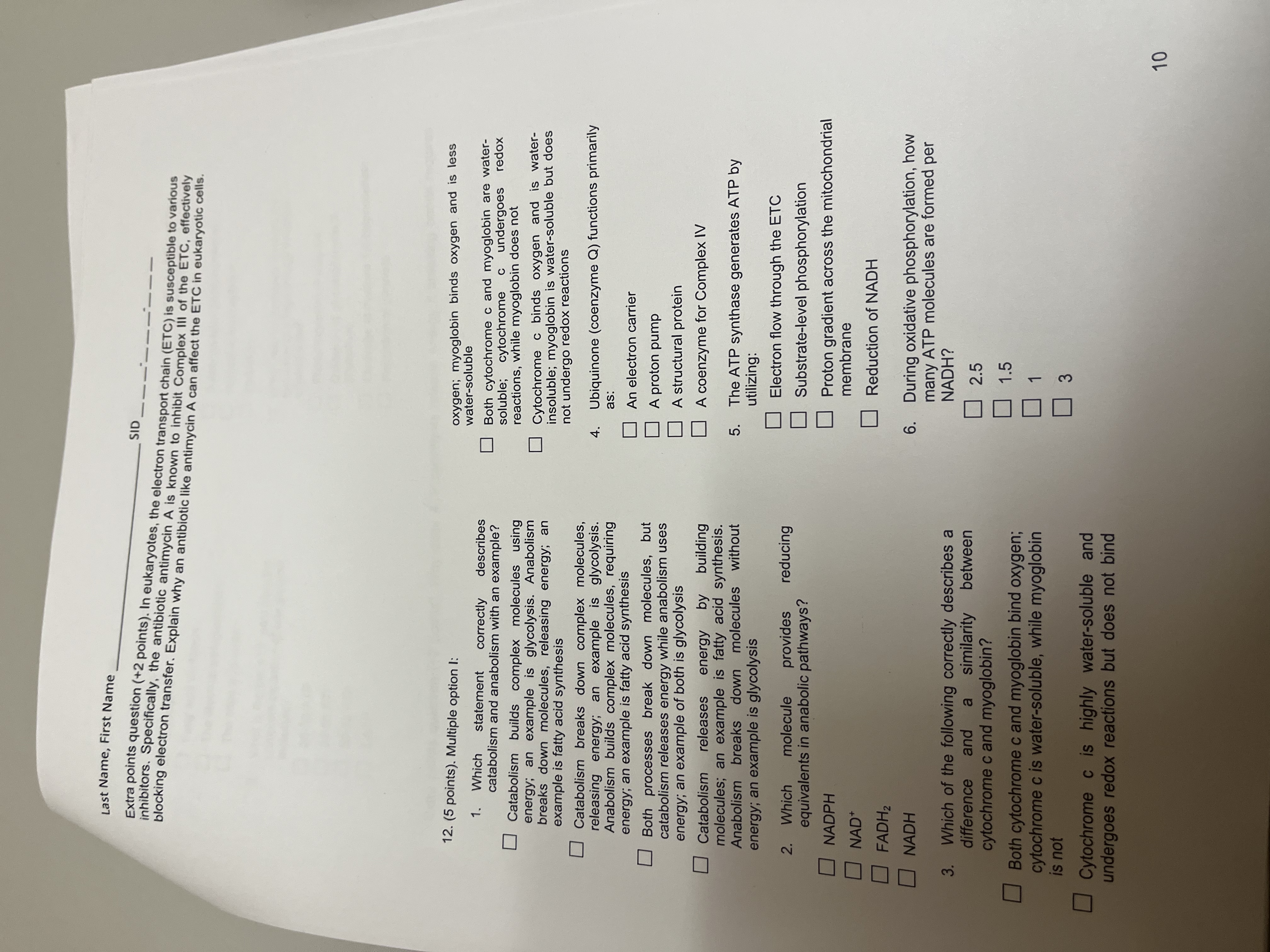
Extra points question points In eukaryotes, the electron transport chain ETC is susceptible to various inhibitors. Specifically, the antibiotic antimycin is known to inhibit Complex III of the ETC, effectively blocking electron transfer. Explain why an antibiotic like antimycin A can affect the ETC in eukaryotic cells.
points Multiple option I:
Which statement correctly describes catabolism and anabolism with an example?
Catabolism builds complex molecules using energy; an example is glycolysis. Anabolism breaks down molecules, releasing energy; an example is fatty acid synthesis
Catabolism breaks down complex molecules, releasing energy; an example is glycolysis. Anabolism builds complex molecules, requiring energy; an example is fatty acid synthesis
Both processes break down molecules, but catabolism releases energy while anabolism uses energy; an example of both is glycolysis
Catabolism releases energy by building molecules; an example is fatty acid synthesis. Anabolism breaks down molecules without energy; an example is glycolysis
Which molecule provides reducing equivalents in anabolic pathways?
NADPH
NADH
Which of the following correctly describes a difference and a similarity between cytochrome c and myoglobin?
Both cytochrome c and myoglobin bind oxygen; cytochrome c is watersoluble, while myoglobin is not
Cytochrome is highly watersoluble and undergoes redox reactions but does not bind
oxygen; myoglobin binds oxygen and is less watersoluble
Both cytochrome c and myoglobin are watersoluble; cytochrome c undergoes redox reactions, while myoglobin does not
Cytochrome c binds oxygen and is waterinsoluble; myoglobin is watersoluble but does not undergo redox reactions
Ubiquinone coenzyme Q functions primarily as:
An electron carrier
A proton pump
A structural protein
A coenzyme for Complex IV
The ATP synthase generates ATP by utilizing:
Electron flow through the ETC
Substratelevel phosphorylation
Proton gradient across the mitochondrial membrane
Reduction of NADH
During oxidative phosphorylation, how many ATP molecules are formed per NADH?
Step by Step Solution
There are 3 Steps involved in it
1 Expert Approved Answer
Step: 1 Unlock

Question Has Been Solved by an Expert!
Get step-by-step solutions from verified subject matter experts
Step: 2 Unlock
Step: 3 Unlock
 Study Help