







Question: Last part E is a yes or no question it's a little cut off A psychologist wants to test whether there is any difference in
Last part E is a yes or no question it's a little cut off
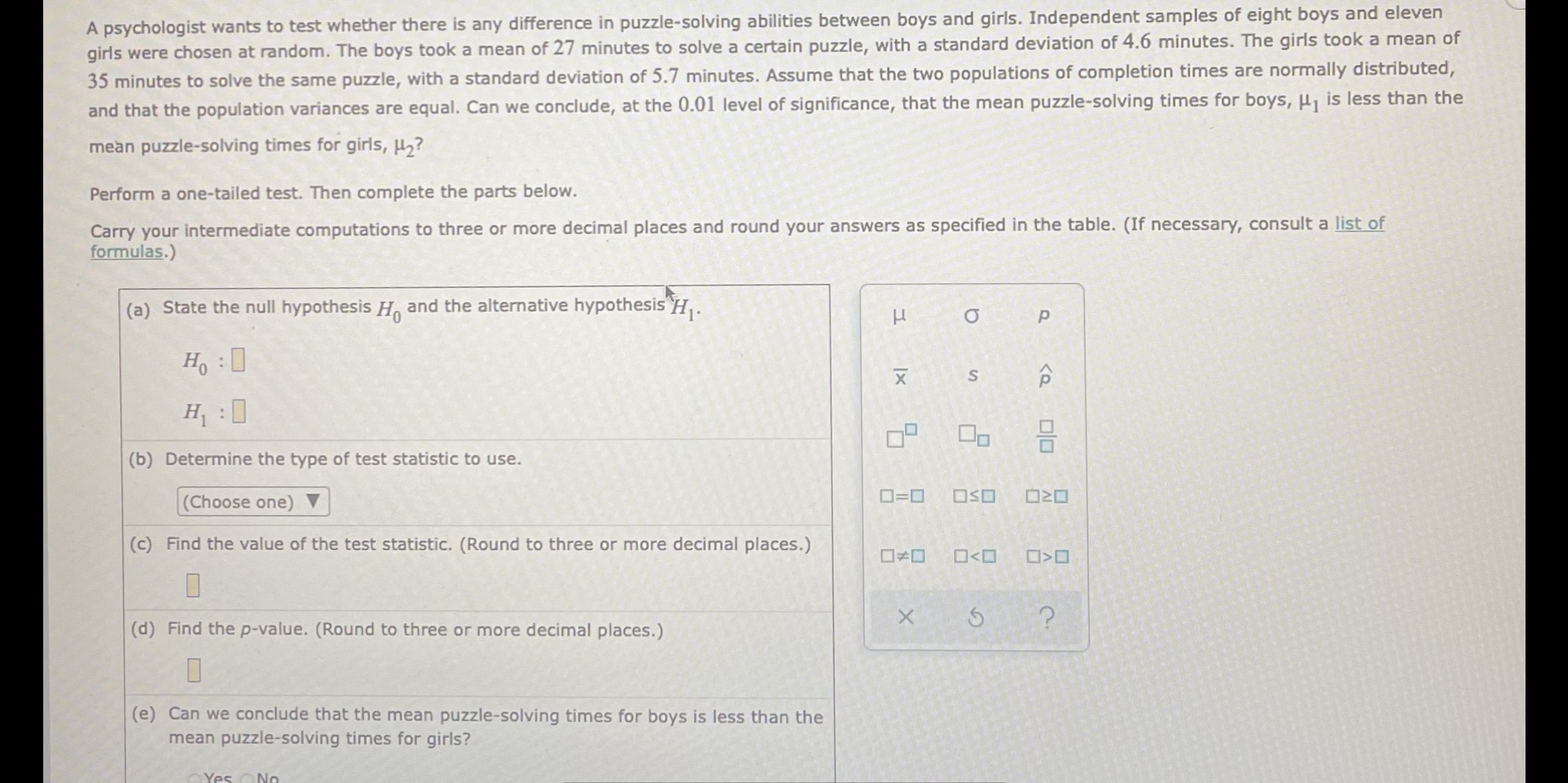
A psychologist wants to test whether there is any difference in puzzle-solving abilities between boys and girls. Independent samples of eight boys and eleven girls were chosen at random. The boys took a mean of 27 minutes to solve a certain puzzle, with a standard deviation of 4.6 minutes. The girls took a mean of 35 minutes to solve the same puzzle, with a standard deviation of 5.7 minutes. Assume that the two populations of completion times are normally distributed, and that the population variances are equal. Can we conclude, at the 0.01 level of significance, that the mean puzzle-solving times for boys, ] is less than the mean puzzle-solving times for girls, H2? Perform a one-tailed test. Then complete the parts below. Carry your intermediate computations to three or more decimal places and round your answers as specified in the table. (If necessary, consult a list of formulas.) (a) State the null hypothesis H and the alternative hypothesis H. H O P Ho : X S H : I (b) Determine the type of test statistic to use. (Choose one) 0=0 030 020 (c) Find the value of the test statistic. (Round to three or more decimal places.) 10 00 (d) Find the p-value. (Round to three or more decimal places.) X ? (e) Can we conclude that the mean puzzle-solving times for boys is less than the mean puzzle-solving times for girls
Step by Step Solution
There are 3 Steps involved in it

Get step-by-step solutions from verified subject matter experts
 Study Help