







Question: Last two images are starter code Module 4 Lab: Linked List Write a linked list that supports O(1) add_first, add_last, and remove_first operations. Your starter
Last two images are starter code
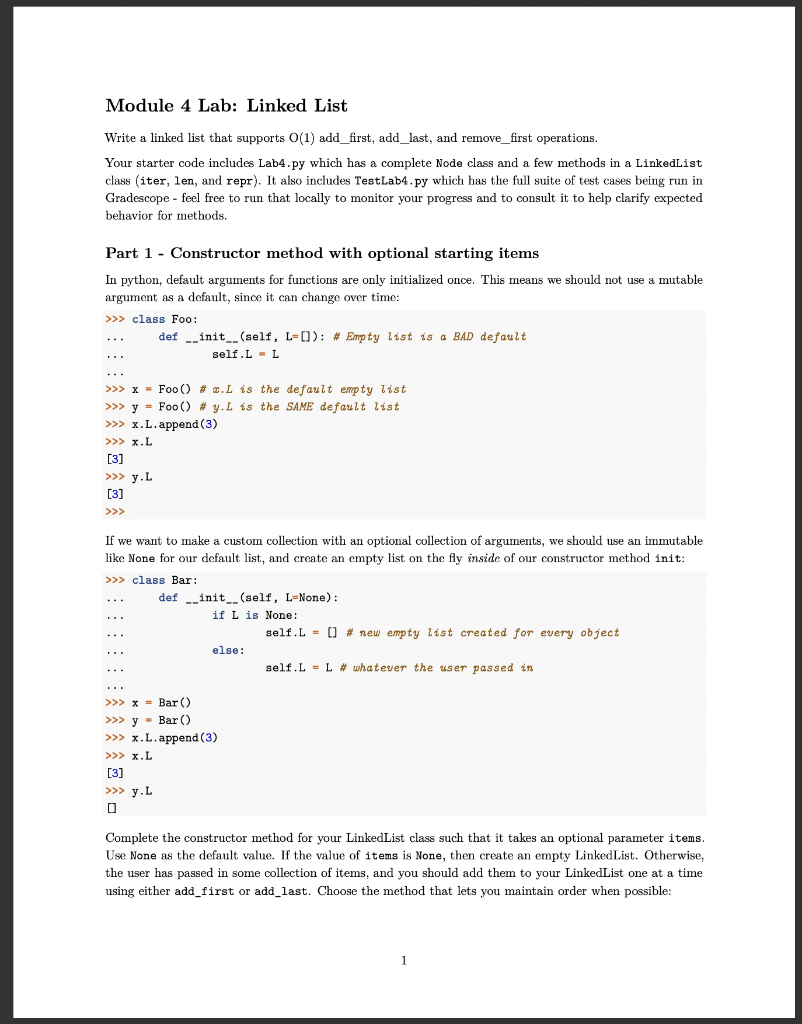
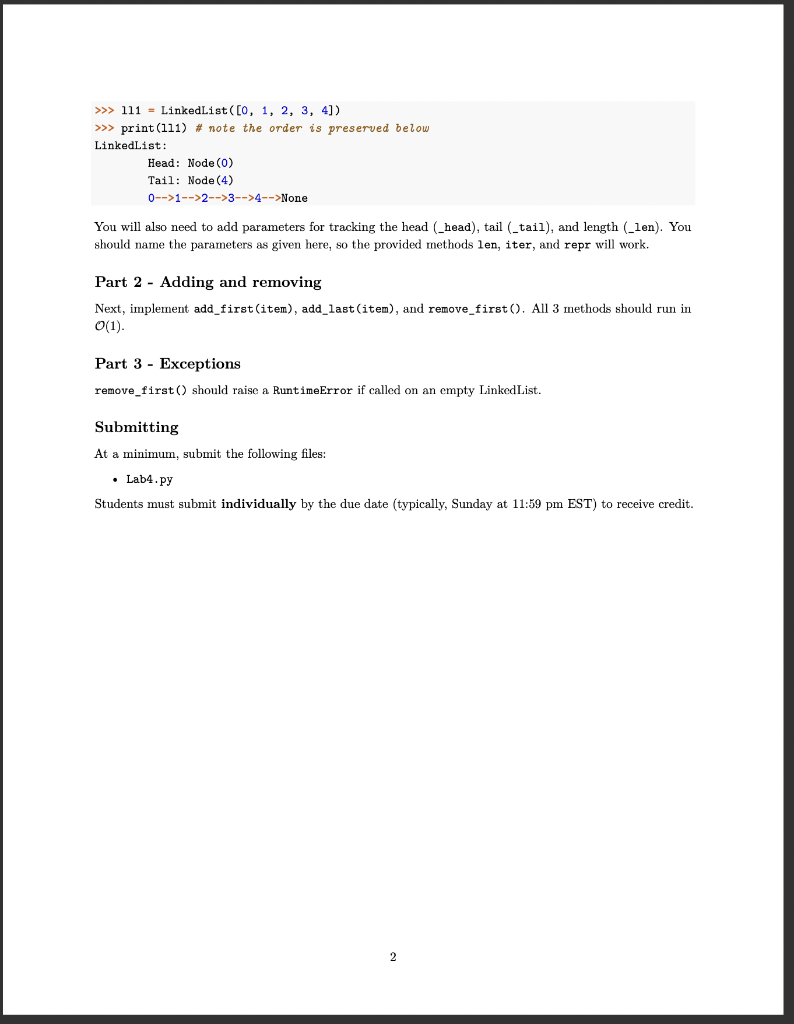
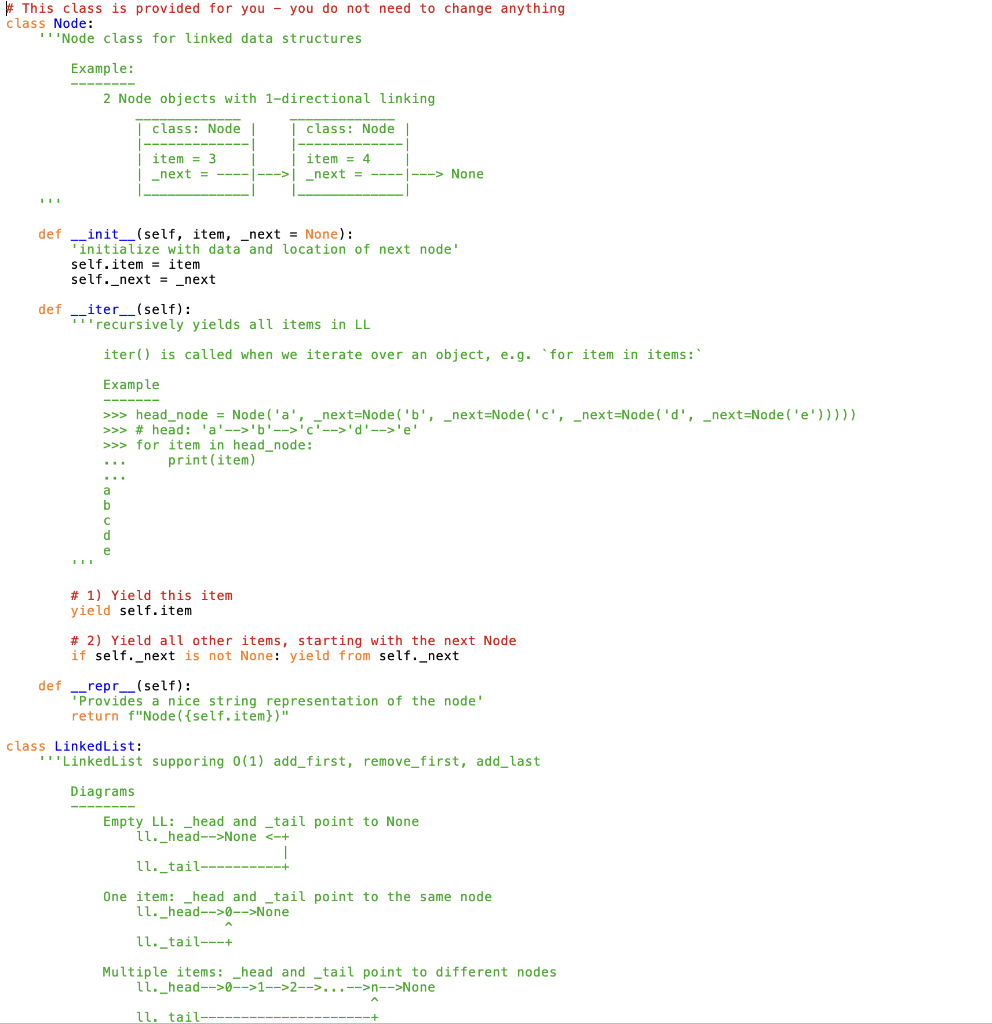
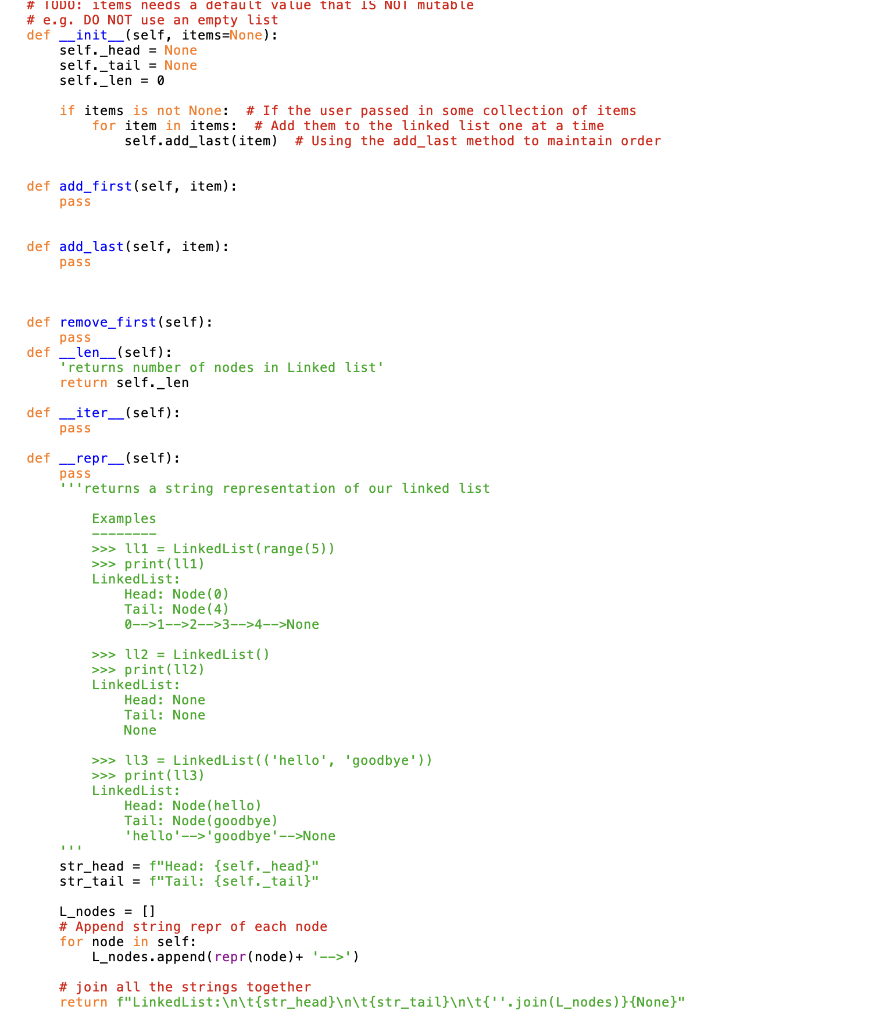
Module 4 Lab: Linked List Write a linked list that supports O(1) add_first, add_last, and remove_first operations. Your starter code includes Lab4.py which has a complete Node class and a few methods in a LinkedList class (iter, len, and repr). It also includes TestLab4.py which has the full suite of test cases being run in Gradescope - feel free to run that locally to monitor your progress and to consult it to help clarify expected behavior for methods. Part 1 - Constructor method with optional starting items In python, default arguments for functions are only initialized once. This means we should not use a mutable argument as a default, since it can change over time: class Foo: ... def _-_init_(self, L=[]): \# Empty list is a BAD default ... self. L=L *. x=Foo()#x.L is the default empty list y=Foo()#yL is the SAME default list >x.L. append (3) xL [3] yL [3] > If we want to make a custom collection with an optional collection of arguments, we should use an immutable like None for our default list, and create an empty list on the fly inside of our constructor method init: class Bar: ... def _init_(self, L=None): ... if L is None: self.L =[] \# new empty list created for every object ... else: ... self.L = L \# whatever the user passed in W. x=Bar() >=Bar() x.L. append (3) xL [3] yL Complete the constructor method for your LinkedList class such that it takes an optional parameter items. Use None as the default value. If the value of items is None, then create an empty LinkedList. Otherwise, the user has passed in some collection of items, and you should add them to your LinkedList one at a time using either add_first or add_last. Choose the method that lets you maintain order when possible: 1 111= LinkedList ([0,1,2,3,4]) print(111) \# note the order is preserved below LinkedList: Head: Node (0) Tail: Node (4) 0>1>2>3>4>None You will also need to add parameters for tracking the head (_head), tail (_tail), and length (_len). You should name the parameters as given here, so the provided methods len, iter, and repr will work. Part 2 - Adding and removing Next, implement add_first(item), add_last(item), and remove_first(). All 3 methods should run in O(1). Part 3 - Exceptions remove_first() should raise a RuntimeError if called on an empty LinkedList. Submitting At a minimum, submit the following files: - Lab4.py Students must submit individually by the due date (typically, Sunday at 11:59 pm EST) to receive credit
Step by Step Solution
There are 3 Steps involved in it

Get step-by-step solutions from verified subject matter experts
 Study Help