



Question: LC-3 Programming in assembly 1. Assume a sequence of positive numbers is stored in consecutive memory locations, starting at memory address x3000. The sequence terminates
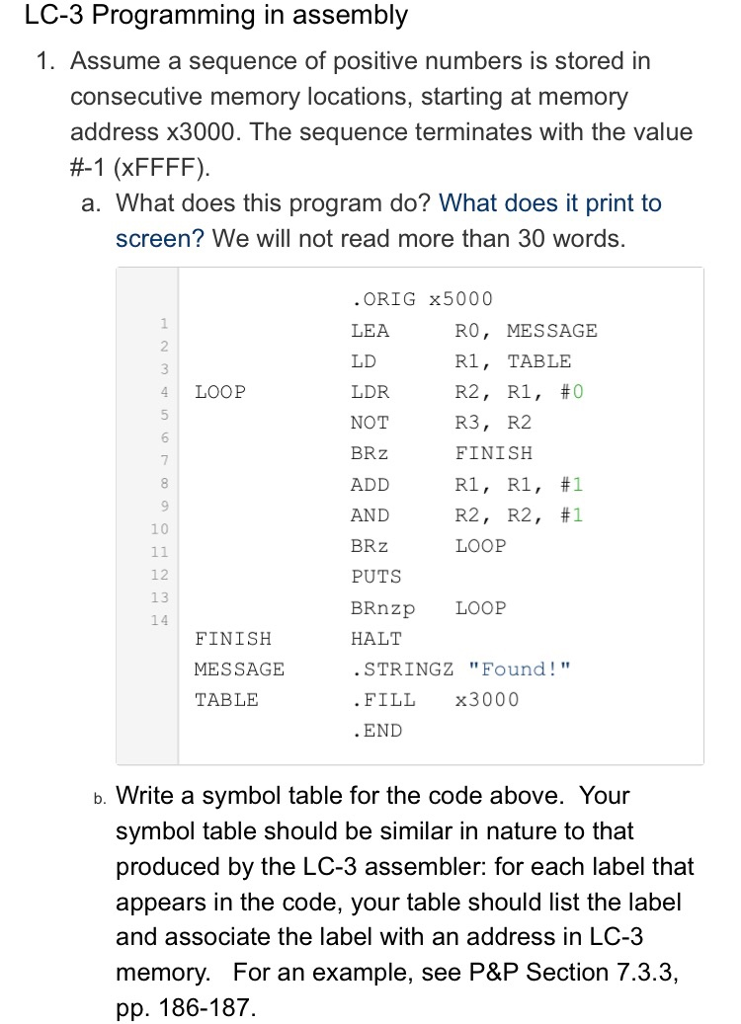
LC-3 Programming in assembly 1. Assume a sequence of positive numbers is stored in consecutive memory locations, starting at memory address x3000. The sequence terminates with the value #-1 (xFFFF) a. What does this program do? What does it print to screen? We will not read more than 30 words ORIG x5000 LEA LD LDR NOT BRz ADD AND BRz PUTS BRnzp LOOP HALT RO, MESSAGE R1, TABLE R2 , R1 , #0 R3, R2 FINISH R1, R1, #1 R2 , R2 , #1 LOOP 4 LOOP 10 12 13 14 FINISH MESSAGE TABLE STRINGZ "Found! " FILL x3000 END b. Write a symbol table for the code above. Your symbol table should be similar in nature to that produced by the LC-3 assembler: for each label that appears in the code, your table should list the label and associate the label with an address in LC-3 memory. For an example, see P&P Section 7.3.3, pp. 186-187. LC-3 Programming in assembly 1. Assume a sequence of positive numbers is stored in consecutive memory locations, starting at memory address x3000. The sequence terminates with the value #-1 (xFFFF) a. What does this program do? What does it print to screen? We will not read more than 30 words ORIG x5000 LEA LD LDR NOT BRz ADD AND BRz PUTS BRnzp LOOP HALT RO, MESSAGE R1, TABLE R2 , R1 , #0 R3, R2 FINISH R1, R1, #1 R2 , R2 , #1 LOOP 4 LOOP 10 12 13 14 FINISH MESSAGE TABLE STRINGZ "Found! " FILL x3000 END b. Write a symbol table for the code above. Your symbol table should be similar in nature to that produced by the LC-3 assembler: for each label that appears in the code, your table should list the label and associate the label with an address in LC-3 memory. For an example, see P&P Section 7.3.3, pp. 186-187
Step by Step Solution
There are 3 Steps involved in it

Get step-by-step solutions from verified subject matter experts