







Question: Leal 1. Pla Plan P26-31A Using payback, ARR, NPV, IRR, and profitability index to make capital investment decisions Hill Company operates a chain of sandwich
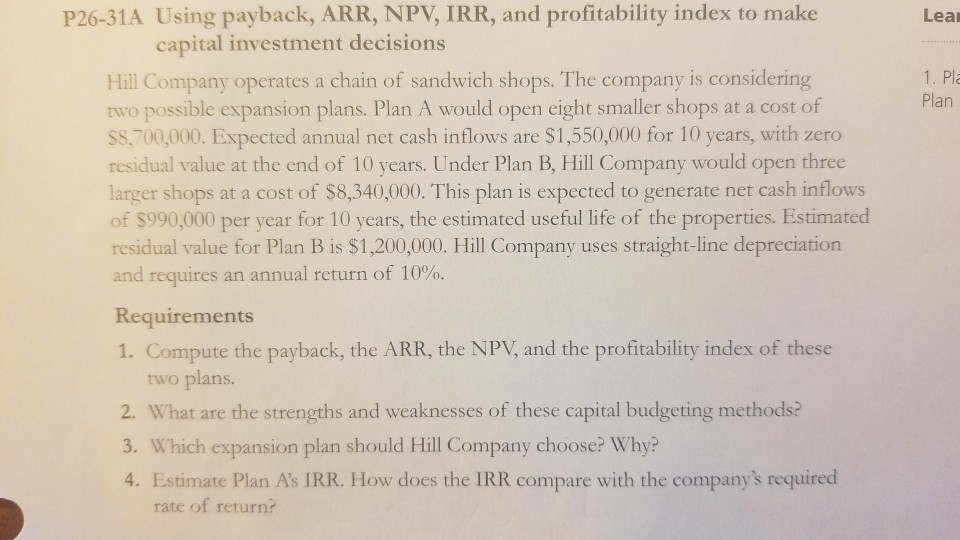
Leal 1. Pla Plan P26-31A Using payback, ARR, NPV, IRR, and profitability index to make capital investment decisions Hill Company operates a chain of sandwich shops. The company is considering two possible expansion plans. Plan A would open eight smaller shops at a cost of $8,700,000. Expected annual net cash inflows are $1,550,000 for 10 years, with zero residual value at the end of 10 years. Under Plan B, Hill Company would open three larger shops at a cost of $8,340,000. This plan is expected to generate net cash inflows of $990,000 per year for 10 years, the estimated useful life of the properties. Estimated residual value for Plan B is $1,200,000. Hill Company uses straight-line depreciation and requires an annual return of 10%. Requirements 1. Compute the payback, the ARR, the NPV, and the profitability index of these two plans. 2. What are the strengths and weaknesses of these capital budgeting methods? 3. Which expansion plan should Hill Company choose? Why? 4. Estimate Plan A's IRR. How does the IRR compare with the company's required rate of return
Step by Step Solution
There are 3 Steps involved in it

Get step-by-step solutions from verified subject matter experts
 Study Help