



Question: Learn It: Chapter 05 Organizing and Drafting Business Messages In Section 5-5, we will cover methods for emphasizing ideas, using active and passive voice, developing
Learn It: Chapter 05 Organizing and Drafting Business Messages
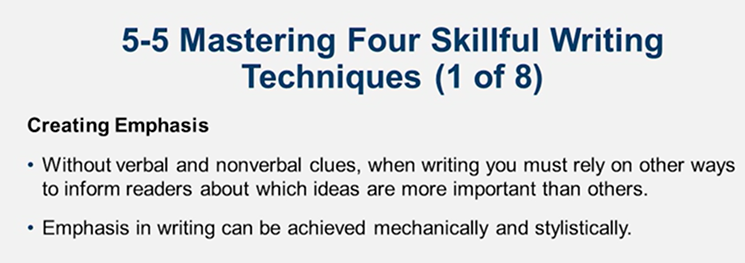
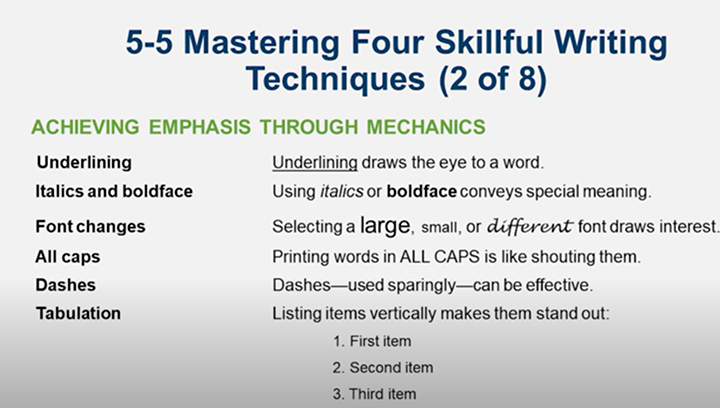
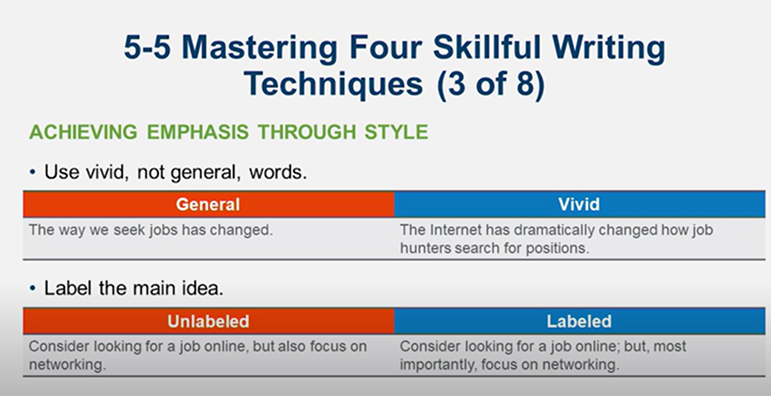
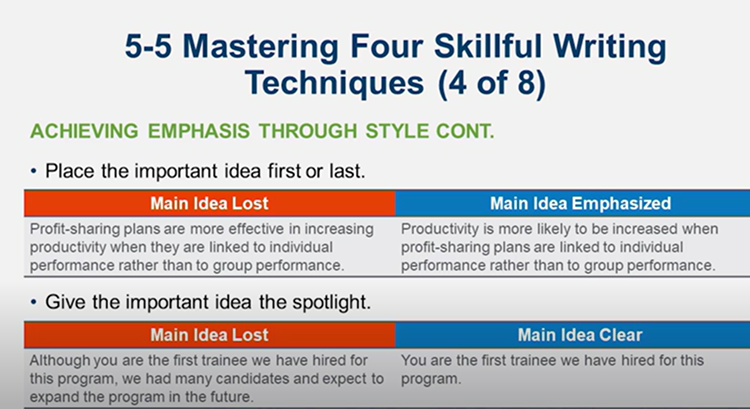
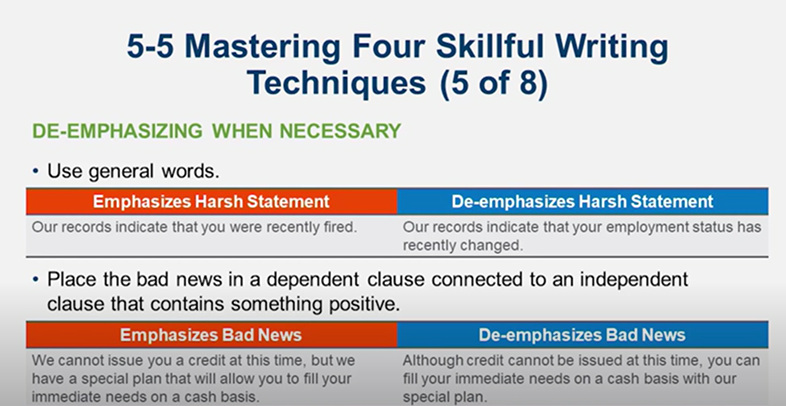
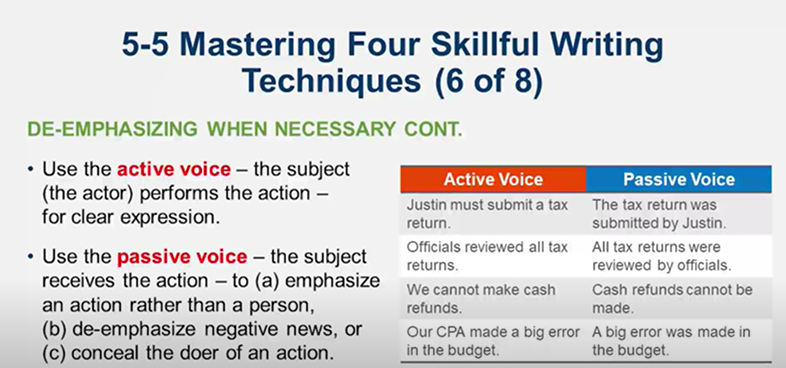
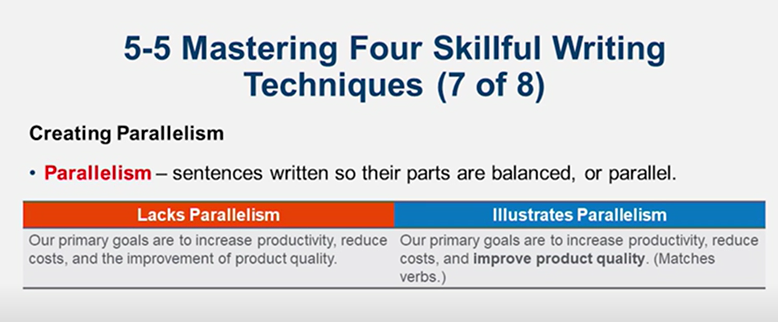
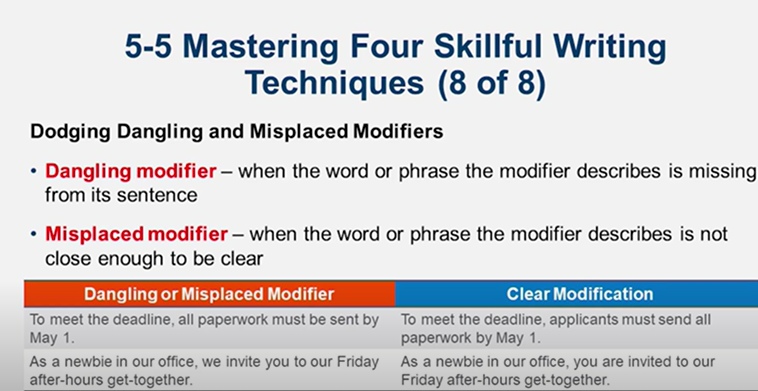
In Section 5-5, we will cover methods for emphasizing ideas, using active and passive voice, developing parallelism, and placing modifiers correctly. Without verbal and nonverbal clues, when writing you must rely on other ways to inform readers about which ideas are more important than others. Emphasis in writing can be achieved mechanically and stylistically. To emphasize a printed idea, writers often use devices such as underlining, which draws the eye to a word. Italics or boldface can be used to convey special meaning. Font changes such as selecting a large, small, or different font draws interest. Keep in mind that printing words in all caps is like shouting them. Used sparingly, dashes can be effective and using tabulation makes items stand out. Other means of achieving mechanical emphasis include the arrangement of space, color, lines, boxes, columns, titles, headings, and subheadings. Emphasis can also be achieved through style. Carefully chosen words and skillfully constructed sentences are used to emphasize main ideas and de-emphasize minor or negative ideas. One way to emphasize important ideas is through the use of vivid, not general, words. As you can conclude from the example, specific words help the reader clearly picture your idea. Another technique to achieve emphasis is to label the main idea. If an idea is significant, tell the reader, as shown in the example. You can also emphasize the important idea by placing it first or last. When ideas appear first or last in a sentence, they have less competition from surrounding words, as shown in the example with the placement of the word productivity. Giving the spotlight to an idea is also an effective way to add emphasis. Don't dilute the main idea by placing it with other words and clauses. Instead, place it in a simple sentence or independent clause. In the wordy example sentence shown here, the main idea is lost, while the revised example uses a simple and brief sentence to clearly convey the main idea. Sometimes you'll need to de-emphasize an idea in your message, particularly when delivering bad news. To achieve this, use general words as has been done in the example shown here. You can also place the bad news in a dependent clause connected to an independent clause that contains something positive. Note how the first example emphasizes the bad news: We cannot issue you a credit at this time, but we have a special plan that will allow you to fill your immediate needs on a cash basis. Then read the revised sentence, and note how it de-emphasizes the bad news: Although credit cannot be issued at this time, you can fill your immediate needs on a cash basis with our special plan. You can also de-emphasize an idea by using the active and passive voice effectively. With the active voice, the subject (the actor) performs the action. This is used for clear expression. With the passive voice, the subject receives the action. The passive voice can be used to emphasize an action rather than a person, de-emphasize negative news, or conceal the doer of an action. Note the examples shown here of active-voice and passive-voice sentences. First read the examples of direct, active-voice sentences where the subject is performing the action: The tax return was submitted by Justin. All tax returns were reviewed by officials. Cash refunds cannot be made. A big error was made in the budget. Now compare these with the passive-voice sentences that are less direct: Justin must submit a tax return. Officials reviewed all tax returns. We cannot make cash refunds. Our CPA made a big error in the budget. While active-voice is often the preferred way to write, passive-voice is preferred when tact and sensitivity are required. Parallelism is a writing technique that creates balance by using similar structures to express similar ideas. To achieve parallel construction, match nouns with nouns, verbs with verbs, and clauses with clauses and avoid mixing active-voice verbs with passive-voice verbs. Consider the example sentence, which lacks parallelism: Our primary goals are to increase productivity, reduce costs, and the improvement of product quality. The third item is not parallel to the others. Now read the revised sentence: Our primary goals are to increase productivity, reduce costs, and improve product quality. Note how parallelism was achieved by matching verbs. Clear writing requires modifiers to be close to the words they describe or limit. Dangling modifiers occur when the word or phrase the modifier describes is missing from its sentence. Try this trick for detecting and fixing many dangling modifiers: Ask the question "Who?" or "What?" after any introductory phrase. The words immediately following should tell the reader who or what is performing the action. Consider the first example: To meet the deadline, all paperwork must be sent by May 1. Ask yourself "who" must send the paperwork. Then refer to the corrected example: To meet the deadline, applicants must send all paperwork by May 1. Misplaced modifiers refer to when the word or phrase the modifier describes is not close enough to be clear. In the second example, the modifier is misplaced: As a newbie in our office, we invite you to our Friday after-hours get-together. Now consider the revised example: As a newbie in our office, you are invited to our Friday after-hours get-together.
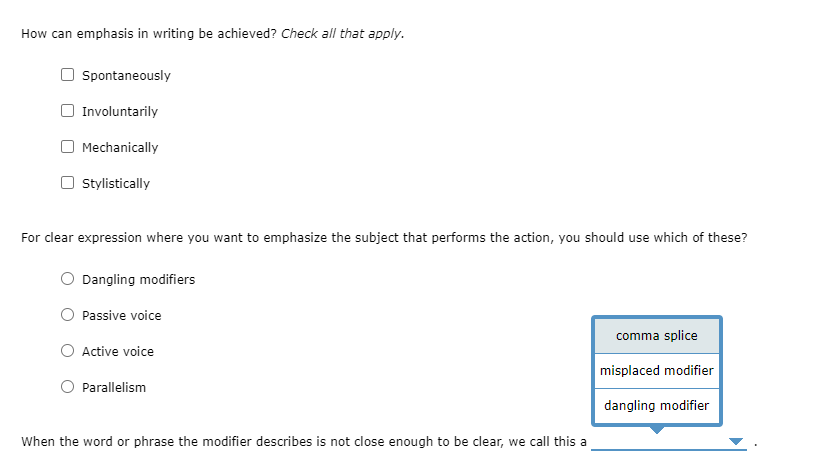
How can emphasis in writing be achieved? Check all that apply.
Spontaneously
Involuntarily
Mechanically
Stylistically
For clear expression where you want to emphasize the subject that performs the action, you should use which of these?
Dangling modifiers
Passive voice
Active voice
Parallelism
When the word or phrase the modifier describes is not close enough to be clear, we call this a
Step by Step Solution
There are 3 Steps involved in it
1 Expert Approved Answer
Step: 1 Unlock

Question Has Been Solved by an Expert!
Get step-by-step solutions from verified subject matter experts
Step: 2 Unlock
Step: 3 Unlock