



Question: Learnability Let us consider a scenario where we want to assign a quality label elements of a particular domain. For each element, we are
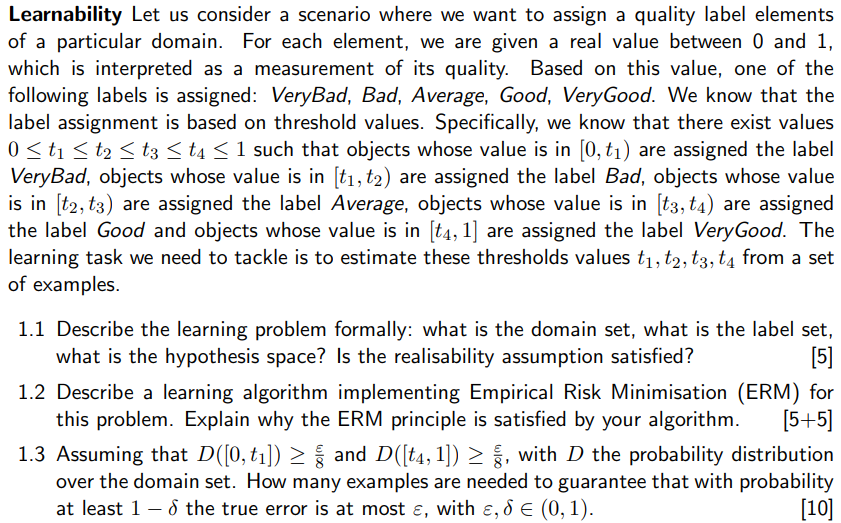
Learnability Let us consider a scenario where we want to assign a quality label elements of a particular domain. For each element, we are given a real value between 0 and 1, which is interpreted as a measurement of its quality. Based on this value, one of the following labels is assigned: VeryBad, Bad, Average, Good, VeryGood. We know that the label assignment is based on threshold values. Specifically, we know that there exist values 0titat3 t4 1 such that objects whose value is in [0,t1) are assigned the label VeryBad, objects whose value is in [t1, t2) are assigned the label Bad, objects whose value is in [2, t3) are assigned the label Average, objects whose value is in [t3, t4) are assigned the label Good and objects whose value is in [t4,1] are assigned the label Very Good. The learning task we need to tackle is to estimate these thresholds values t1, t2, t3, t4 from a set of examples. 1.1 Describe the learning problem formally: what is the domain set, what is the label set, what is the hypothesis space? Is the realisability assumption satisfied? [5] 1.2 Describe a learning algorithm implementing Empirical Risk Minimisation (ERM) for this problem. Explain why the ERM principle is satisfied by your algorithm. [5+5] 1.3 Assuming that D([0, 1]) > and D([t4, 1]) > , with D the probability distribution over the domain set. How many examples are needed to guarantee that with probability at least 1-8 the true error is at most , with , & (0, 1). [10]
Step by Step Solution
There are 3 Steps involved in it

Get step-by-step solutions from verified subject matter experts