Question: Learning action learning Koo, L C. Journal of Workplace Learning ; Bradford Vol. 11, Iss. 3, (1999): 89-94. ProQuest document link ABSTRACT This paper outlines
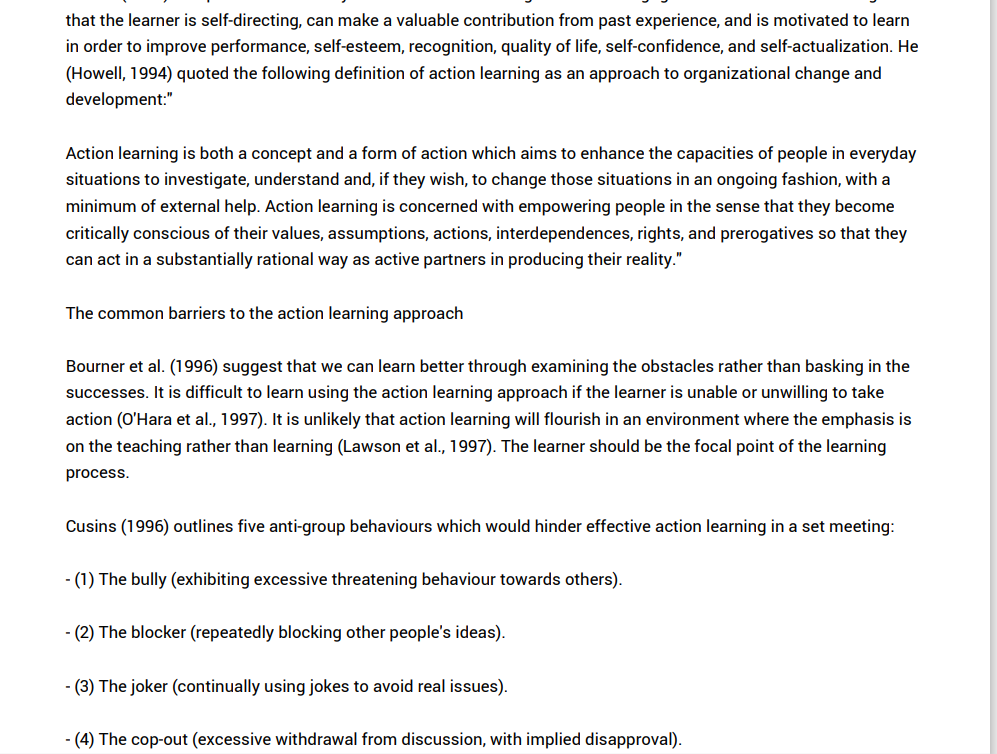
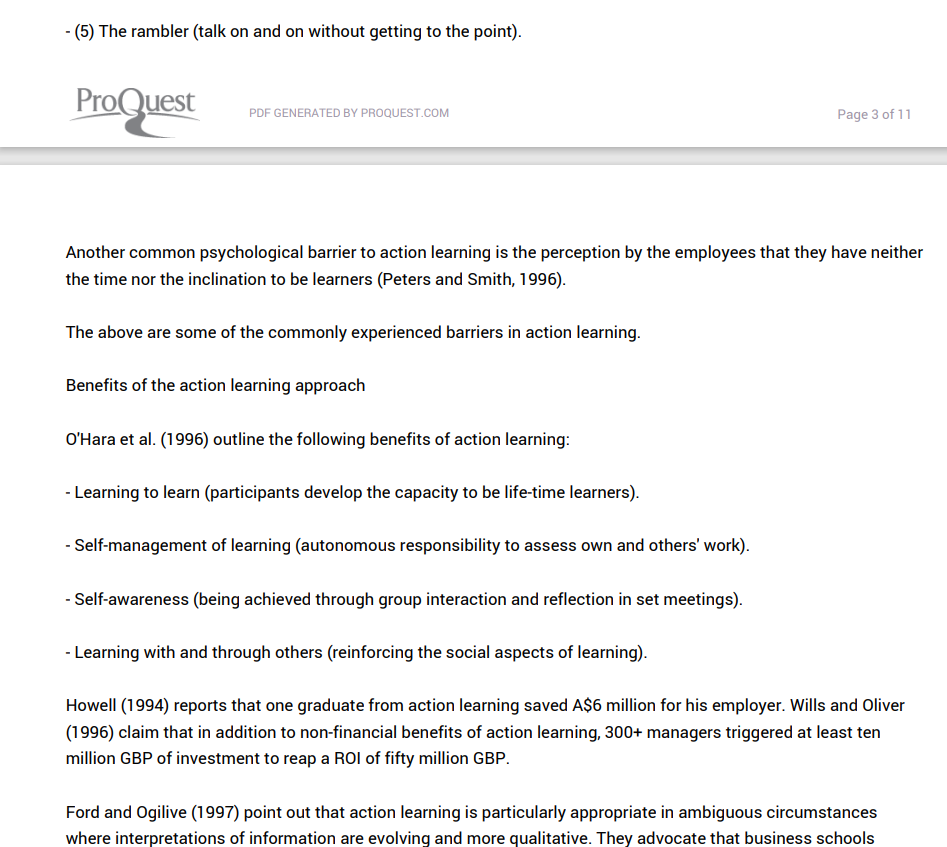
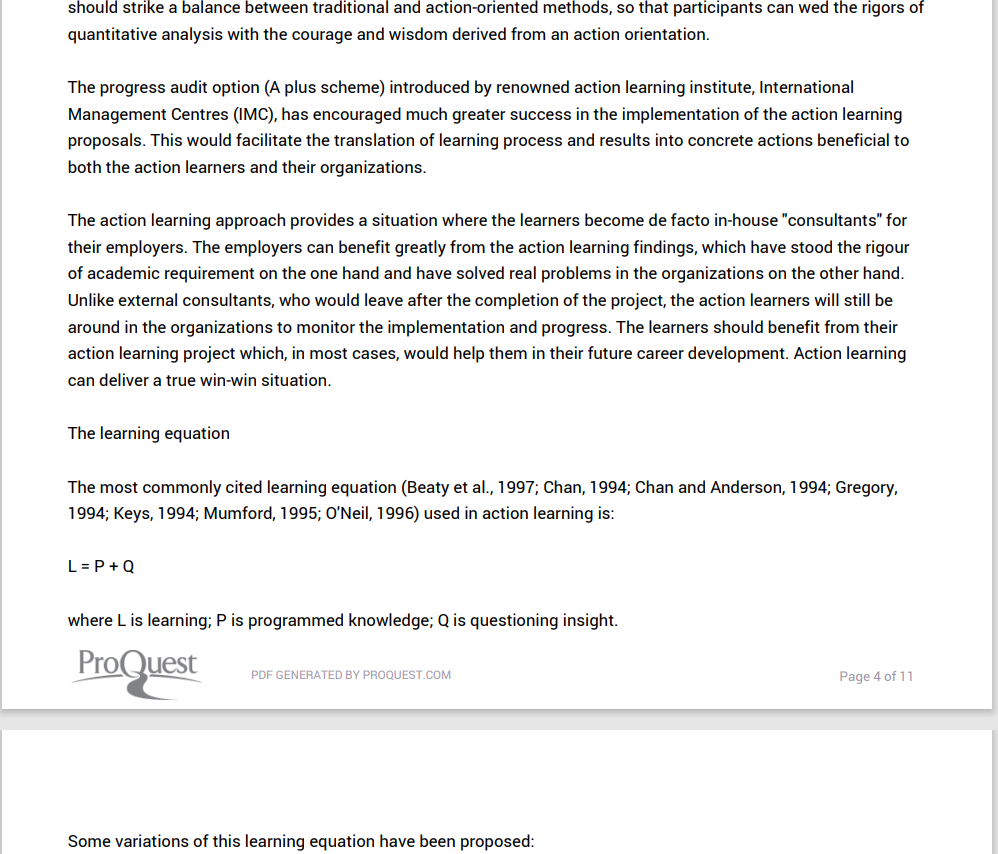
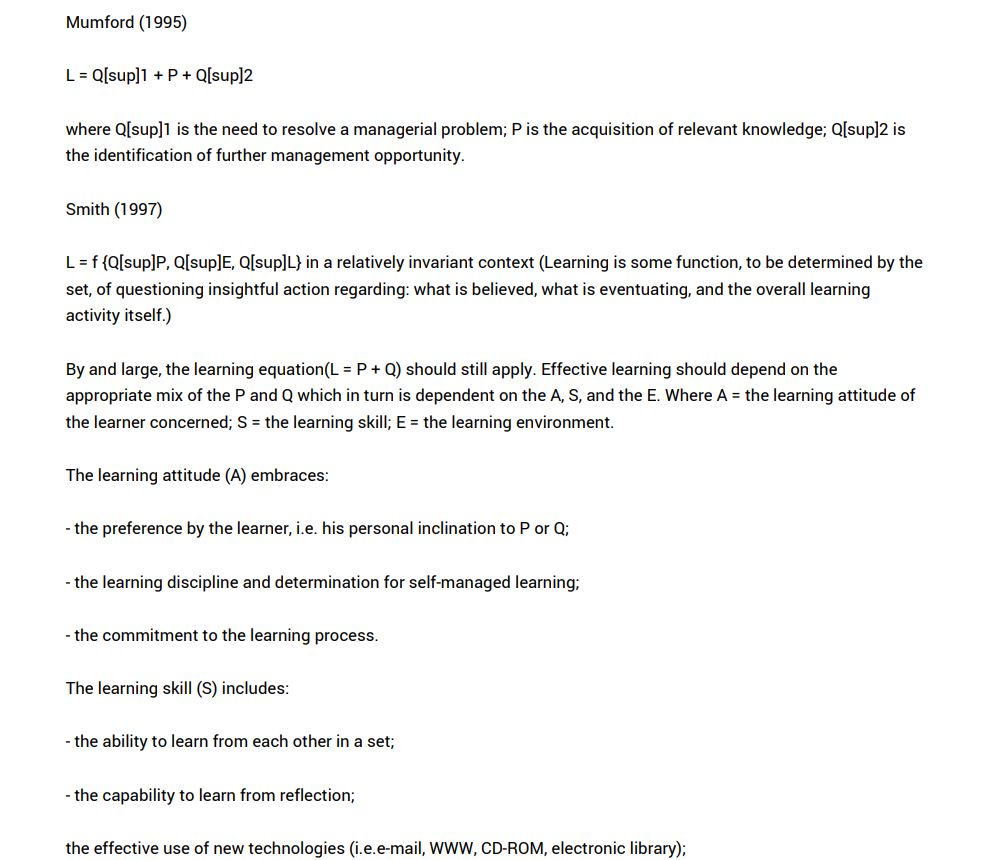
Learning action learning Koo, L C. Journal of Workplace Learning ; Bradford Vol. 11, Iss. 3, (1999): 89-94. ProQuest document link ABSTRACT This paper outlines the action learning approach in adult education. To begin, it cites some definitions of action learning and describes the characteristics of this andragogical model through contrasting the common barriers and the benefits. The concept of questioning insight is dealt with in the learning equation. The social aspects of learning from each other in a set environment have been emphasized . With the advent of new technology, the future of action learning is highly promising to the learners, their employers, the education providers, and the society. Some useful Web sites are included for those who want to approach learning more about the action learning approach. FULL TEXT L.C. Koo: L.C. Koo is Quality Service Advisor, Belgian Bank, Wanchai, Hong Kong What is action learning ?" What we have to learn to do, we learn by doing (Aristotle). I hear and | forget | see and | remember I do and | understand (Confucius)." The ancient philosophers have passed onto us the wisdom of action learning. The concept of action learning was structurally and systematically applied in education by Reg Revans in the early 1940s. As the contemporary action learning guru, Revans has never provided a single and comprehensive statement of action learning and at different times he emphasized one aspect or omitted another (Mumford, 1995). The following quotes from Revans provide some ideas about the action learning approach in adult education:" Action learning is a means of development, intellectual, emotional or physical that requires its subject, through responsible involvement in some real, complex and stressful problem, to achieve intended change sufficient to improve his observable behaviour henceforth in the problem field (Smith, 1997). ...an approach to education that emphasizes the distinctions between doing things oneself and talking about things getting done by others in general ... to ensure that managers shall learn better to manage with and from one another in the course of tackling the very problems that it is their proper business to tackle; it has no truck with academic simulation of any kind (Newton and Wilkinson, 1995). Action learning differs from normal training that its primary objective is to learn how to ask appropriate questions ProQQuest in conditions of risk, rather than to find the answers to questions that have already been precisely defined by others - and that do not allow for ambiguous responses because the examiners have all the approved answers (Keys, 1994). But learning cannot be solely the acquisition of fresh programmed knowledge ... Managers need also to improve their ability to search the unfamiliar, and inappropriate programmed knowledge may inhibit this ... Action learning is the Aristotelian manifestation of all managers' jobs: they learn as they manage, and they manage because they have learned - and go on learning (Dilworth, 1996)." Bourner et al. (1996) describe the approach of action learning as the process of reflection and action, aimed at improving effectiveness of action where learning is an important outcome. The approach involves testing out ideas and then modifying the respective ideas as a consequence. Sandelands (1998) views action learning as a form of learning by doing, i.e. working on real life issues, focusing on learning and implementing pragmatic solutions. Action learning is concerned with generating new ideas by putting them into natural experience, seeking to make meaning from experience (Raelin, 1997). The action learning approach is based on pedagogical (and andragogical) belief that people can and should learn more effectively in real-time problems in their own work setting. The action learning approach suggests that people learn best about work, at work and through work, within a structure which encourages learning (Peters, 1996). Limerick et al. (1994) cited Pedler's description of action learning as an approach to the development of people in organizations, which takes the task as the vehicle for learning. It is based on the premise that there is no learning without action and likewise no sober and deliberate action without learning. It results both self-development and organizational development. Harrison (1996) claims that action learning is a process of mutual learning within a small "set\" of managers, through questioning and reflection, in order to produce action in the workplace and at the same time develop individual's learning ability. Mumford (1995) claims that the approach of action learning is holistic in its views of the person, the management process and learning. It is highly situational, flexibly treating elusive problems, and combining a social process with individual needs. The success of action learning relies very much on learners being motivated to learn for themselves (0'Hara et al., 1997). Sandelands (1998) suggests that action learning is synergetically more effective in a set (group of colleagues who are comrades in adversity). Zuber-Skerritt (1995) claims that action learning encourages self- critical reflection and feedbacks from critical friends (i.e. fellow set members). The action learning approach always works with "sets" which encourage executives to discuss, share, pool their ambitions and experiences, thus creating a Gestalt where group synergy benefit can be reaped (Peters and Smith, 1996). Mumford (1995) proposes the following important elements for action learning approach: - (1) Learning should mean learning to take effective action. - (2) Learning to take effective action involves actually taking action not just recommending action. - (3) The action learning project must be significant to the learners themselves. Pr,q(lue_s_t - (4) Learners learn best from one another in their learning set. From a different perspective, Cusins (1996) treats action learning as a syndrome of four mutually reinforcing activities for creative decision making: - (1) Experiential learning. - (2) Creative problem solving. - (3) Acquisition of relevant knowledge. - (3) Co-learner group support. When these activities are performed effectively, action learning becomes holistically synergistic. Howell (1994) compares the similarity between action learning and the andragogical model for adult learning in - - - - that the learner is self-directing, can make a valuable contribution from past experience, and is motivated to learn in order to improve performance, self-esteem, recognition, quality of life, self-confidence, and self-actualization. He (Howell, 1994) quoted the following definition of action learning as an approach to organizational change and development:\" Action learning is both a concept and a form of action which aims to enhance the capacities of people in everyday situations to investigate, understand and, if they wish, to change those situations in an ongoing fashion, with a minimum of external help. Action learning is concerned with empowering people in the sense that they become critically conscious of their values, assumptions, actions, interdependences, rights, and prerogatives so that they can act in a substantially rational way as active partners in producing their reality.\" The common barriers to the action learning approach Bourner et al. (1996) suggest that we can learn better through examining the obstacles rather than basking in the successes. It is difficult to learn using the action learning approach if the learner is unable or unwilling to take action (O'Hara et al., 1997). It is unlikely that action learning will flourish in an environment where the emphasis is on the teaching rather than learning (Lawson et al., 1997). The learner should be the focal point of the learning process. Cusins (1996) outlines five anti-group behaviours which would hinder effective action learning in a set meeting: - (1) The bully (exhibiting excessive threatening behaviour towards others). - (2) The blocker (repeatedly blocking other people's ideas). - (3) The joker (continually using jokes to avoid real issues). - (4) The cop-out (excessive withdrawal from discussion, with implied disapproval). - (5) The rambler (talk on and on without getting to the point). PLQQE.@_St Another common psychological barrier to action learning is the perception by the employees that they have neither the time nor the inclination to be learners (Peters and Smith, 1996). The above are some of the commonly experienced barriers in action learning. Benefits of the action learning approach O'Hara et al. (1996) outline the following benefits of action learning: - Learning to learn (participants develop the capacity to be life-time learners). - Self-management of learning (autonomous responsibility to assess own and others' work). - Self-awareness (being achieved through group interaction and reflection in set meetings). - Learning with and through others (reinforcing the social aspects of learning). Howell (1994) reports that one graduate from action learning saved A$6 million for his employer. Wills and Oliver (1996) claim that in addition to non-financial benefits of action learning, 300+ managers triggered at least ten million GBP of investment to reap a ROl of fifty million GBP. Ford and Ogilive (1997) point out that action learning is particularly appropriate in ambiguous circumstances where interpretations of information are evolving and more qualitative. They advocate that business schools should strike a balance between traditional and action-oriented methods, so that participants can wed the rigors of quantitative analysis with the courage and wisdom derived from an action orientation. The progress audit option (A plus scheme) introduced by renowned action learning institute, International Management Centres (IMC), has encouraged much greater success in the implementation of the action learning proposals. This would facilitate the translation of learning process and results into concrete actions beneficial to both the action learners and their organizations. The action learning approach provides a situation where the learners become de facto in-house "consultants\" for their employers. The employers can benefit greatly from the action learning findings, which have stood the rigour of academic requirement on the one hand and have solved real problems in the organizations on the other hand. Unlike external consultants, who would leave after the completion of the project, the action learners will still be around in the organizations to monitor the implementation and progress. The learners should benefit from their action learning project which, in most cases, would help them in their future career development. Action learning can deliver a true win-win situation. The learning equation The most commonly cited learning equation (Beaty et al., 1997; Chan, 1994; Chan and Anderson, 1994; Gregory, 1994; Keys, 1994; Mumford, 1995; O'Neil, 1996) used in action learning is: L=P+Q where L is learning; P is programmed knowledge; Q is questioning insight. ProQQuest Some variations of this learning equation have been proposed: Mumford (1995) L = Q[sup]1 + P + Q[sup]2 where Q[sup]1 is the need to resolve a managerial problem; P is the acquisition of relevant knowledge; Q[sup]2 is the identification of further management opportunity. Smith (1997) L = f {Q[sup]P, Q[sup]E, Q[sup]L} in a relatively invariant context (Learning is some function, to be determined by the set, of questioning insightful action regarding: what is believed, what is eventuating, and the overall learning activity itself.) By and large, the learning equation(L = P + Q) should still apply. Effective learning should depend on the appropriate mix of the P and Q which in turn is dependent on the A, S, and the E. Where A = the learning attitude of the learner concerned; S = the learning skill; E = the learning environment. The learning attitude (A) embraces: - the preference by the learner, i.e. his personal inclination to P or Q; - the learning discipline and determination for self-managed learning; - the commitment to the learning process. The learning skill (S) includes: - the ability to learn from each other in a set; - the capability to learn from reflection; the effective use of new technologies (i.e.e-mail, WWW, CD-ROM, electronic library); - the application of learning styles. The learning environment (E) involves: - the support from the employer of the action learner (i.e. appropriate learning contract); - the access to data and information required in the study; - the relevance of the action learning project. Sets of learning associates RLQQQ@St Mumford (1996) enumerates the following process objectives for an action learning set: - Help each other to define the purposes, timescale and desired end results. - Help other associates by testing and clarifying ideas. - Motivate each other to take action. - Share ideas on resolving difficulties encountered by others. - Offer information from own experience. - Monitor progress. Manage themselves and review the effectiveness of that management. - Take charge of the individual and group learning. - Review and improve their learning. In an action learning set, individual associates should identify their learning styles through the use of a "learning styles questionnaire". It is possible to develop and build one's learning styles. Together as a set they should develop learning synergy through flexing their styles. It is important to review not only how problems are tackled but also what they are learning from the process of undertaking these things. Each of them should maintain a learning log (Mumford (1996) prefers to call it Management Learning Diary) to facilitate the review process. The impact of new technology on the development of an action learning approach The rapid development of electronic media offers learners much more convenient access to essentially unlimited sources of information. Learners become active agents in the process of learning and not passive recipients of knowledge from others. IMC has pioneered the use of the Internet in creating a virtual university for learners from every corner in the world. All faculty members and course participants have access to e-mail and the World Wide Web (WWW) for communication and information retrieval. Sandelands (1998) pointed out that a more appropriate supervisor could be located than otherwise. To approach learning the action learning approach, the following Web sites can be referred: - http://www.imc.org.uk/imc/al-inter/ http://www.anbar.co.uk/anbar.htm http://www.free-press.com/journals/gabal/ - http://www.imc.org.uk/imc/welcome.htm - http://www.imc.org.uk/imc/coursewa/alr/ alrhome.htm- http://www.imc.org.uk/ime/coursewa/ais/ ais-paper-001.htm The era of electronic publishing has offered vast opportunities for self-managed learning. Prof. Wills (1996) of IMC defines electronic publishing as: "The exploitation of electronics in any and every cost-effective and cost-beneficial way that can facilitate the process of publishing\". He further explains that publishing means: "Conceiving, creating, capturing, transforming, disseminating, archiving, searching and retrieving academic and professional knowledge and information\". With much economic advantage for the publishers, the future trend will be proliferation of electronic publishing to meet the needs of researchers and business practitioners. Action learning and researches can be greatly facilitated with this development. Access to needed knowledge will be faster, easier, more comprehensive, and hopefully much more economical. In addition to the electronic libraries, there are many news groups on the Internet where action learners can freely discuss their ideas and seek assistance from each other. Learning can be achieved rather conveniently without the need of brick and mortar and face-to-face tuition. Learning through the Internet offers an entirely new horizon with virtually unlimited boundary. Never before in mankind's history has learning been made so convenient, flexible, dynamic, exciting and challenging. The future of action learning Action learning has become more and more popular in recent years, in many parts of the world. In addition to many full-scale action learning programmes (ranging from diploma, bachelor, master and up to even doctoral level) offered by various universities and educational institutes, there are more traditional and shorter programmes or modules being blended with the action learning approach. One important yardstick of measuring education quality is the end product of the education system, namely the relevance of the knowledge and skills acquired by the learners. Action learning is particularly apt in applying what the learners have learnt. Unlike the traditional approach, where learning success is measured by the amount of programmed knowledge acquired by the learners, the key objective of action learning is to generate something useful to both the learners and their sponsoring employers. As the employment market gets tougher and tougher, more and more people realize the need for continuous self- improvement in order to keep abreast of the rapid changes which they cannot ignore. It is likely that action learners will develop an inclination to become lifetime learners. The utopia for action learning is not to help develop a learning organization but a learning society! The universities and educational institutes need to review their curricula critically to see if there are more opportunities for action learning. Perhaps a customer (i.e. the employers and students) survey would reveal more information on the requirements. The teaching faculty should likewise receive relevant training on facilitating an action learning approach. Some kind of cooperation with veteran (e.g. IMC) operators in action learning can be very useful. To conclude, it is important to learn more about action learning for those, i.e. the education providers (the government and the education institutes), the teachers (in action learning jargon the set facilitators), the students (learners), and the employers of the learners, who are interested in this training and educational approach. They should, at the least, browse those Web sites cited earlier and start their discussions on the action learning PLQ%J_QSI approach among themselves. The purpose of this paper is to pose some "Q" (questioning insight) on learning the action learning approach. Hence, it is titled "Learning action learning". References 1. Beaty, L., Lawson, J., Bourner, T. and O'Hara, S. (1997), "Action learning comes of age - part 3: action learning for what?", Education + Training, Vol. 39 No. 5 pp. 184-8. 2. Bourner, T., Beaty, L., Lawson, J. and O'Hara, S. (1996), "Action learning comes of age: questioning action learning"\4. Chan, K.C. and Anderson, G.C. (1994), "Academia-industry fusion action learning for teaching enterprise\15. Mumford, A. (1996), "Effective learners in action learning sets", The Journal of Workplace Learning: Employee PLQQA@_@I Counselling Today, Vol. 8 No. 6, pp. 3-10. 16. Newton, R. and Wilkinson, M.J. (1995), "When the talking is over: using action learning\24. Smith, P.A.C. (1997), "Q'ing action learning: more on minding our Ps and Qs", Management Decision, Vol. 35 No. 5, pp. 365-72. 25. Wills, G. (1996), "Embracing electronic publishing\
Step by Step Solution
There are 3 Steps involved in it
1 Expert Approved Answer
Step: 1 Unlock
Question Has Been Solved by an Expert!
Get step-by-step solutions from verified subject matter experts
Step: 2 Unlock
Step: 3 Unlock
Students Have Also Explored These Related General Management Questions!









 Study Help