







Question: Learning Goal: Doppler Effect - In general SelfAssessment Two train whistles, A and B, each has a buit-in frequency 540. Hz .A is stationary and
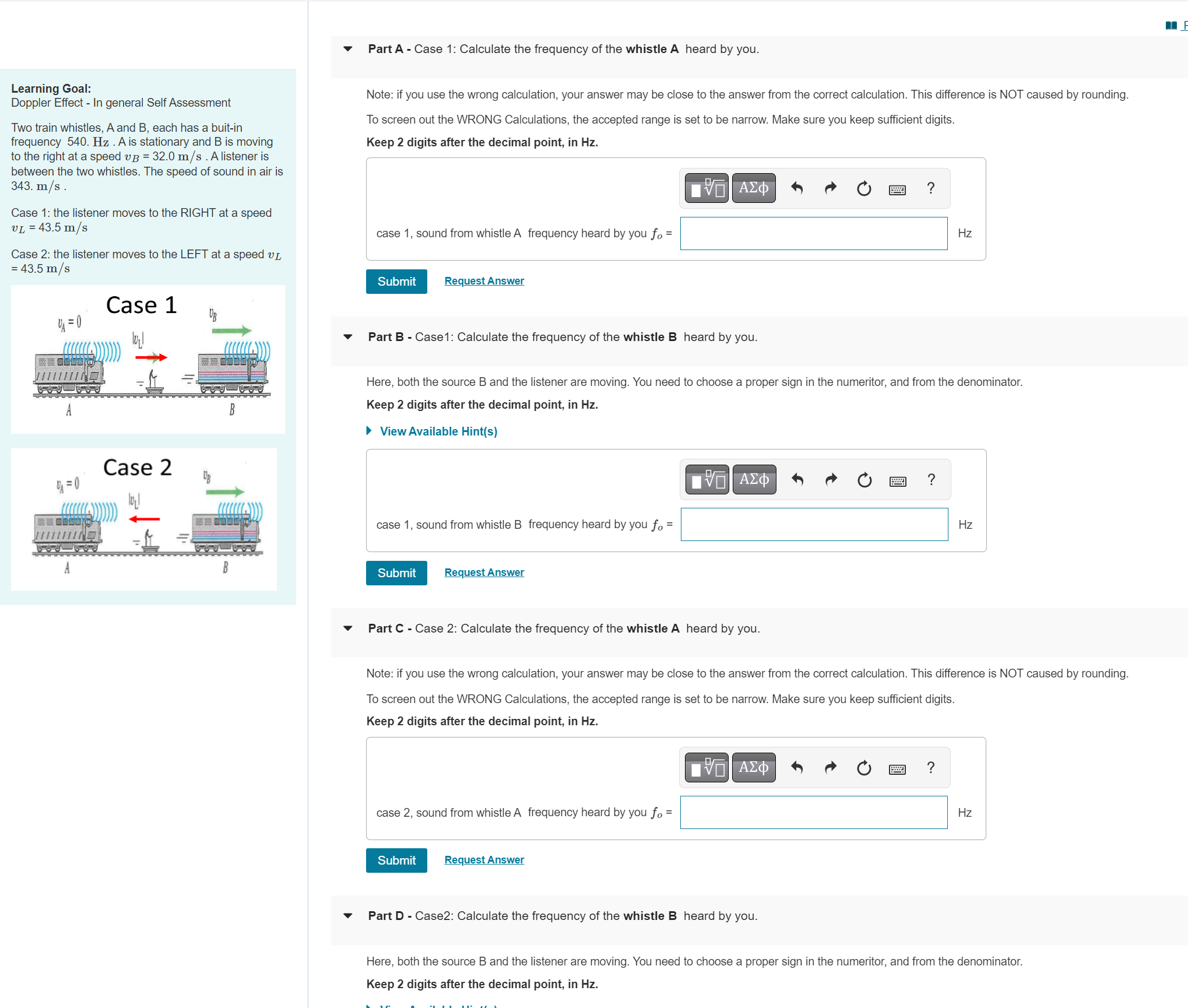
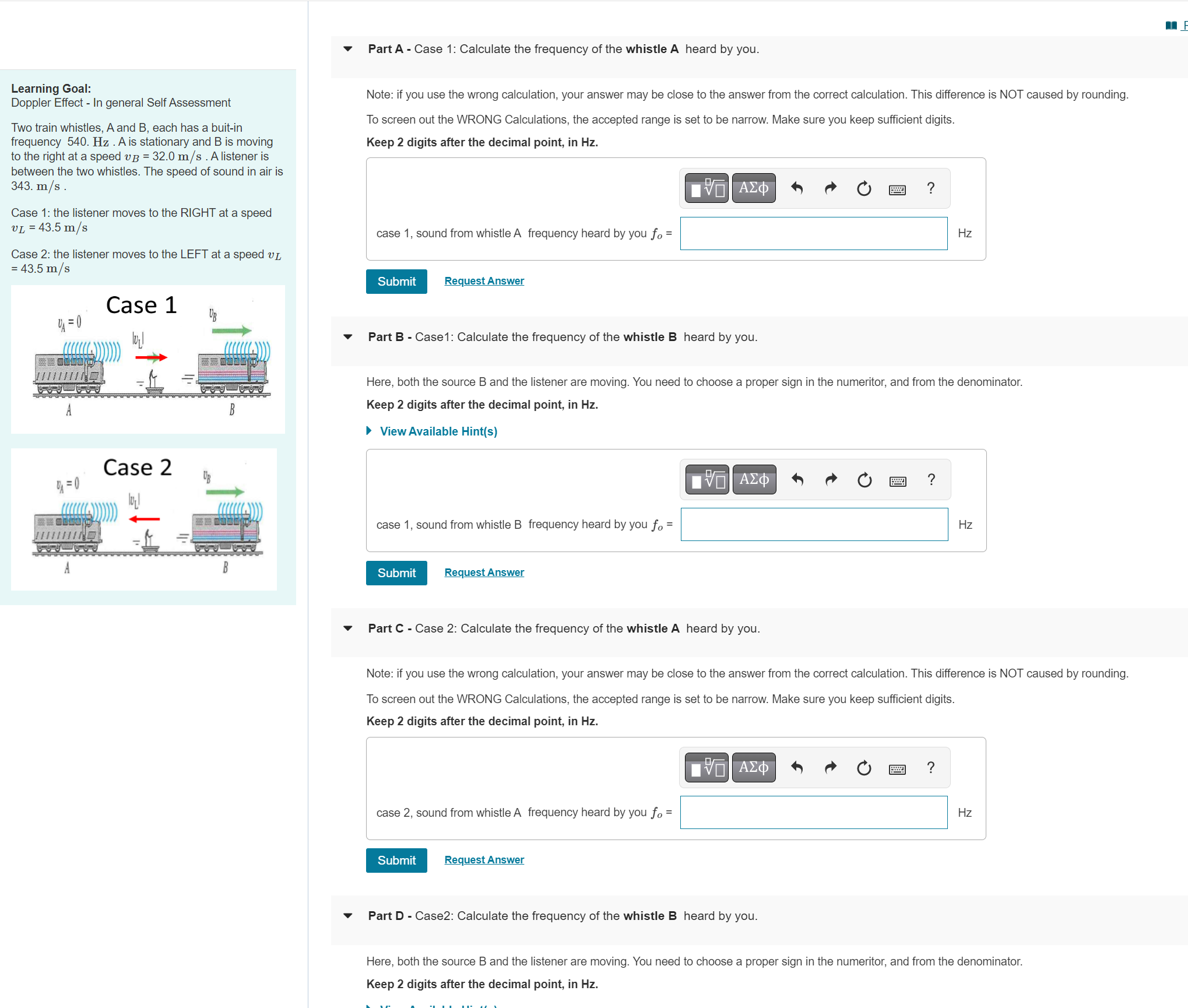
Learning Goal: Doppler Effect - In general SelfAssessment Two train whistles, A and B, each has a buit-in frequency 540. Hz .A is stationary and B is moving to the right at a speed 123 = 32.0 m/s .Alistener is between the two whistles. The speed of sound in air is 343. m/s . Case 1: the listener moves to the RIGHT at a speed 71L = 43.5 m/s Case 2: the listener moves to the LEFT at a speed \"L = 43.5 m/s Case 1 l9 7 Part A - Case 1: Calculate the frequency of the whistle A heard by you. Note: if you use the wrong calculation, your answer may be close to the answerfrom the correct calculation. This difference is NOT caused by rounding. To screen out the WRONG Calculations, the accepted range is set to be narrow. Make sure you keep sufcient digits. Keep 2 digits after the decimal point, in Hz. case 1, sound from whistle A frequency heard by you f', = Hz muest Answer 7 Part B - Case1: Calculate the frequency of the whistle B heard by you. Here, both the source B and the listener are moving. You need to choose a proper sign in the numeritor, and from the denominator. Keep 2 digits after the decimal point, in Hz. D View Available Hint(s) case 1, sound from whistle B frequency heard by you f = Hz Muest Answer 7 Part C - Case 2: Calculate the frequency of the whistle A heard by you. Note: if you use the wrong calculation, your answer may be close to the answerfrom the correct calculation. This difference is NOT caused by rounding. To screen out the WRONG Calculations, the accepted range is set to be narrow. Make sure you keep sufcient digits. Keep 2 digits after the decimal point, in Hz. case 2, sound from whistle A frequency heard by you f., = Hz Muest Answer V Part D - Case2: Calculate the frequency of the whistle B heard by you. Here, both the source B and the listener are moving. You need to choose a proper sign in the numeritor, and from the denominator. Keep 2 digits after the decimal point, in Hz
Step by Step Solution
There are 3 Steps involved in it

Get step-by-step solutions from verified subject matter experts
 Study Help