







Question: Learning Goal: = g ( s - f ) D 2 1 8 v , where s is the sphere density and f is the
Learning Goal: where is the sphere density
and is the fluid density.
Figure
of
Part B Determine the viscosity using a rotational viscometer
You have a rotational viscometer for measuring fluids with densities similar to the density of water Its dimensions are
and The angular velocity of the cylinder can be varied from to
What is the smallest viscosity that can be measured, if the torque sensor requires a torque of at least
Express your answer in to three significant figures.
View Available Hints
Part C Another kind of viscometer
Now consider Stokes flow with a steel sphere falling through honey To use the
Stokes flow approximation, the ratio should be no greater than What is the minimum viscosity the honey must
have in order to measure it using this method if the diameter of the sphere is
Express your answer in to three significant figures.
View Available Hints
To understand how the viscosity of a fluid can be
measured and how errors in the process affect the
measurement.
The viscosity of a fluid can be measured in different
ways. For some fluids, a rotational viscometer
Figure can be used. A stationary solid cylinder is
suspended centered in a larger outer cylinder,
creating a thin gap of the fluid to be measured
between the cylinders. The outer cylinder rotates at
a known angular velocity that is low enough that
the flow in the gap is orderly and does not change
with time known as laminar flow Assuming a
linear velocity profile, and neglecting the gap at the
bottom of the cylinders, the viscosity of the fluid is
where is the torque on the
inner cylinder, and are the inner and outer
radii, is the height of the cylinders, and is the
gap thickness.
For transparent, very high viscosity liquids, another
method can be used. When the viscosity is high
enough, a small sphere dropped through the liquid
will fall very slowly. This kind of flow is called
Stokes Flow. The drag force on the sphere is
where is the radius of the sphere
and is the velocity of the sphere. Rearranging this
equation and balancing the drag force with the
weight of the sphere the viscosity is
where is the sphere density
and is the fluid density.
Part A Rotational viscometer assumptions
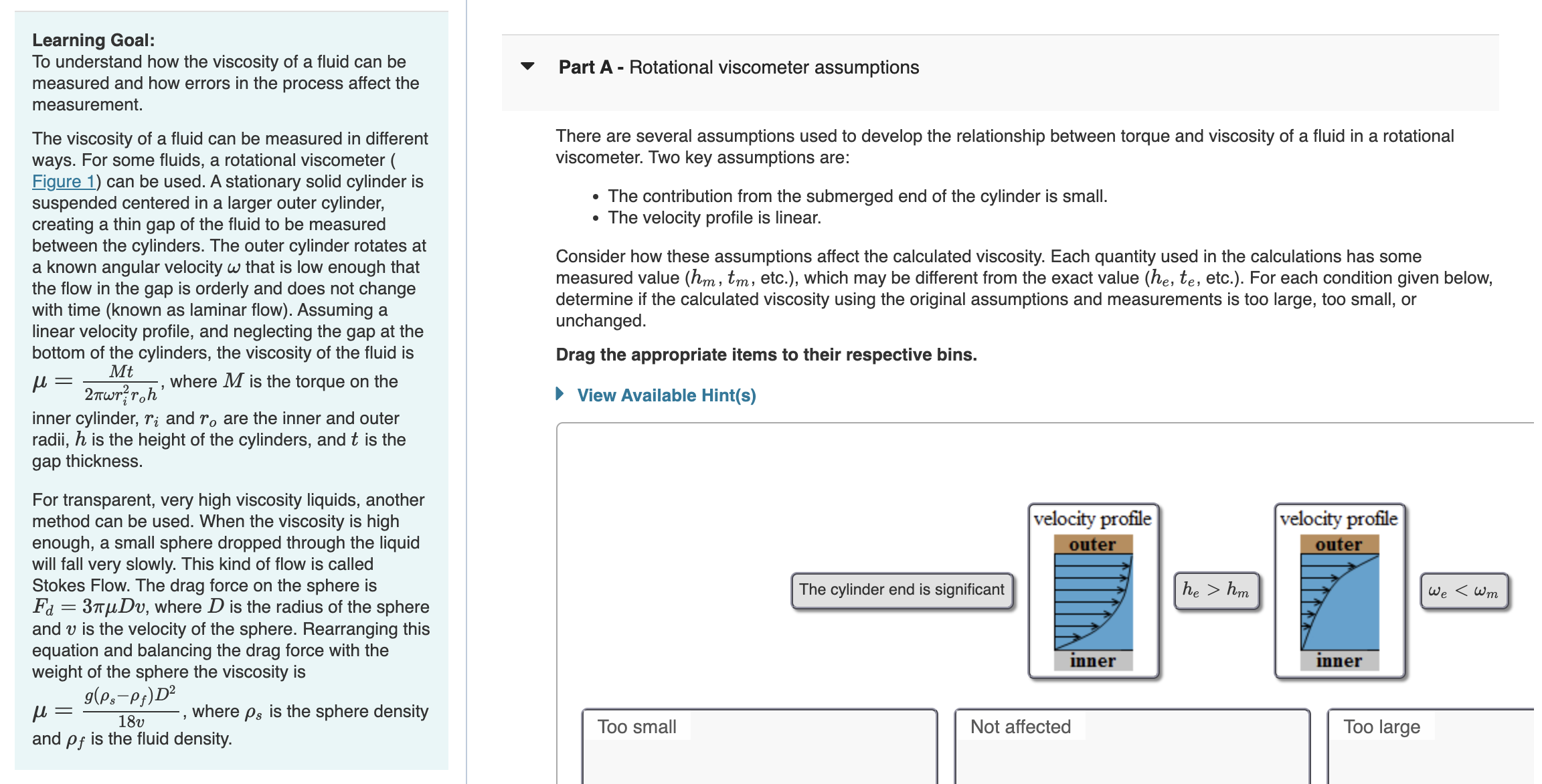
There are several assumptions used to develop the relationship between torque and viscosity of a fluid in a rotational
viscometer. Two key assumptions are:
The contribution from the submerged end of the cylinder is small.
The velocity profile is linear.
Consider how these assumptions affect the calculated viscosity. Each quantity used in the calculations has some
measured value etc. which may be different from the exact value etc. For each condition given below,
determine if the calculated viscosity using the original assumptions and measurements is too large, too small, or
unchanged.
Drag the appropriate items to their respective bins.
View Available Hints
Step by Step Solution
There are 3 Steps involved in it
1 Expert Approved Answer
Step: 1 Unlock

Question Has Been Solved by an Expert!
Get step-by-step solutions from verified subject matter experts
Step: 2 Unlock
Step: 3 Unlock
 Study Help