







Question: Learning Goal: To calculate a maximum live load for a beam and the minimum size for its bearing plate assuming that the average shear stress
Learning Goal:
To calculate a maximum live load for a beam
and the minimum size for its bearing plate
assuming that the average shear stress in the
beam and the average normal stress on the
foundation are the limiting design conditions,
while using the limit state design method.
The design procedure for a structure is a bit
more complicated than just determining the
loads, picking a geometry, and then verifying
that the design can carry the applied loads.
There is a fairly large amount of uncertainty in
the loads applied to a structure. These variable
loads come from things like wind, snow, people,
and equipment. There also is uncertainty in the
material properties.
When using limit state design, the uncertainties
in the loads and material properties are
considered separately. The design requirements
are expressed as an inequality:
where is a parameter to account for factors
like the material strength uncertainty and the
failure modes, is the nominal strength, is
an applied load, and is a factor for the
uncertainty of a load. Two common load types
used are dead loads with and live
loads with
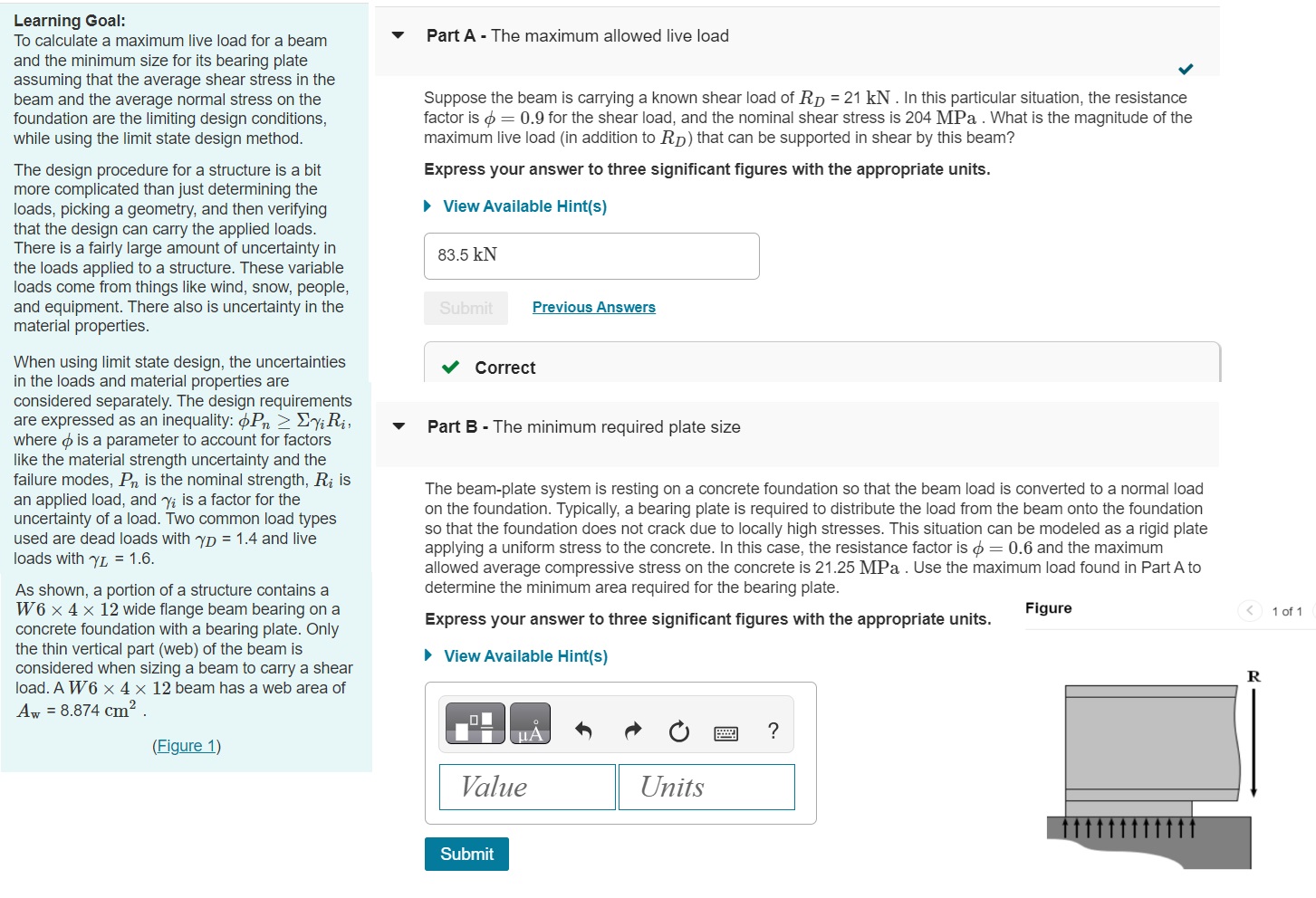
As shown, a portion of a structure contains a
wide flange beam bearing on a
concrete foundation with a bearing plate. Only
the thin vertical part web of the beam is
considered when sizing a beam to carry a shear
load. A beam has a web area of
Figure
Part A The maximum allowed live load
Suppose the beam is carrying a known shear load of In this particular situation, the resistance
factor is for the shear load, and the nominal shear stress is MPa. What is the magnitude of the
maximum live load in addition to that can be supported in shear by this beam?
Express your answer to three significant figures with the appropriate units.
View Available Hints
Correct
Part B The minimum required plate size
The beamplate system is resting on a concrete foundation so that the beam load is converted to a normal load
on the foundation. Typically, a bearing plate is required to distribute the load from the beam onto the foundation
so that the foundation does not crack due to locally high stresses. This situation can be modeled as a rigid plate
applying a uniform stress to the concrete. In this case, the resistance factor is and the maximum
allowed average compressive stress on the concrete is MPa. Use the maximum load found in Part A to
determine the minimum area required for the bearing plate.
Express your answer to three significant figures with the appropriate units.
Figure
Step by Step Solution
There are 3 Steps involved in it
1 Expert Approved Answer
Step: 1 Unlock

Question Has Been Solved by an Expert!
Get step-by-step solutions from verified subject matter experts
Step: 2 Unlock
Step: 3 Unlock
 Study Help