







Question: Learning Goal: To practice ProblemSolving Strategy 2.1 for constant acceleration problems. A car is traveling at a constant velocity of magnitude v0 when the driver
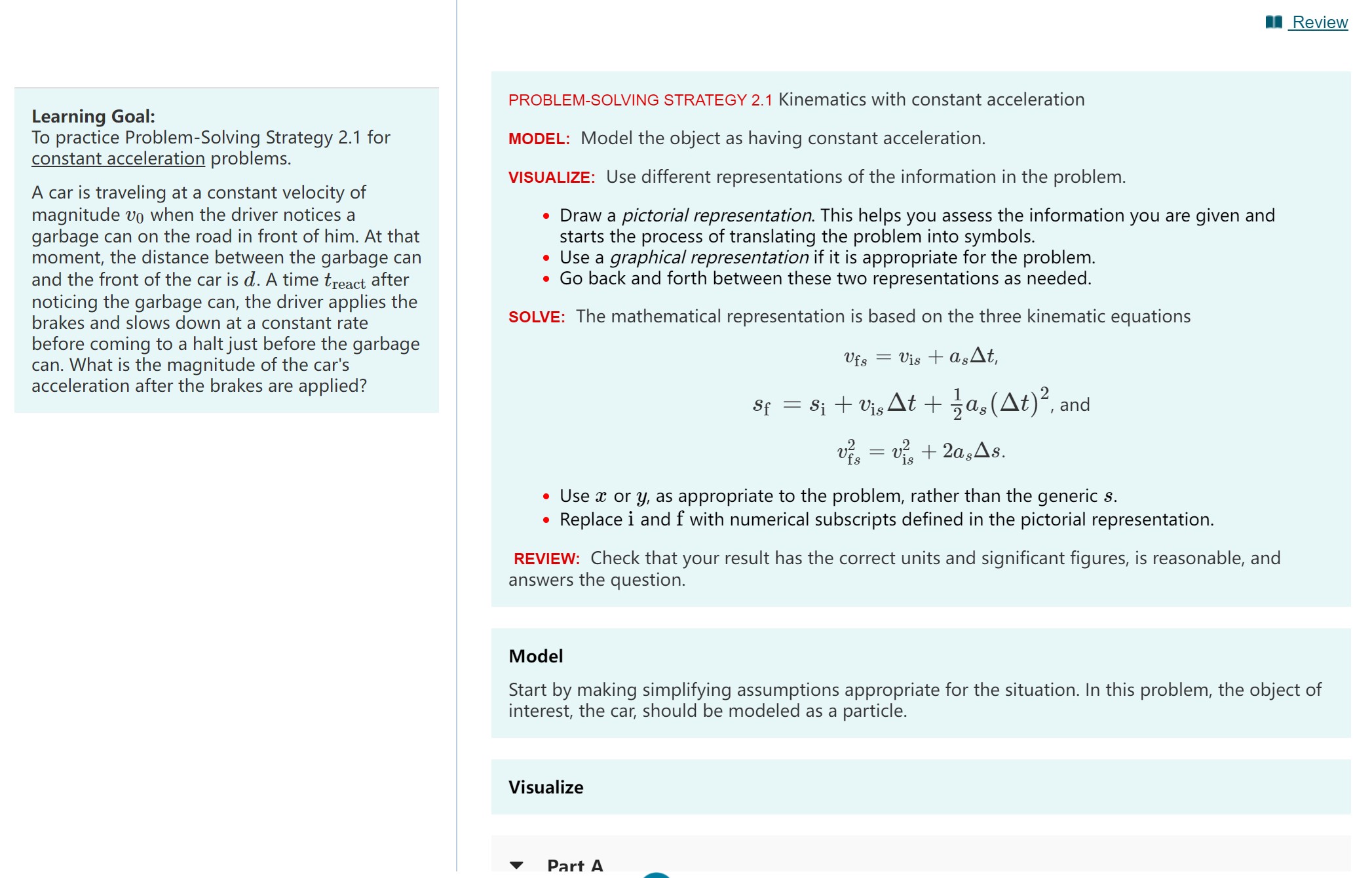
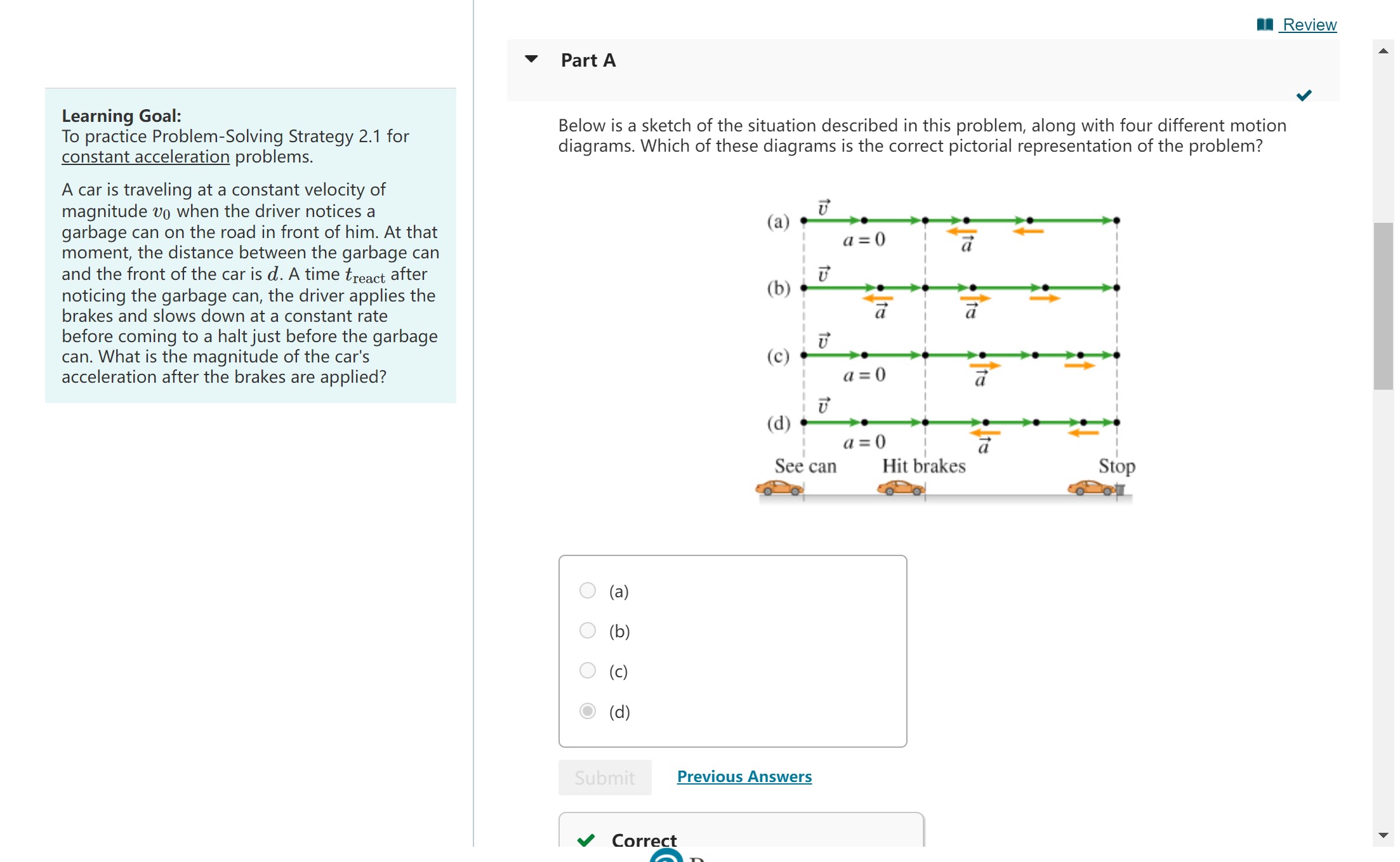
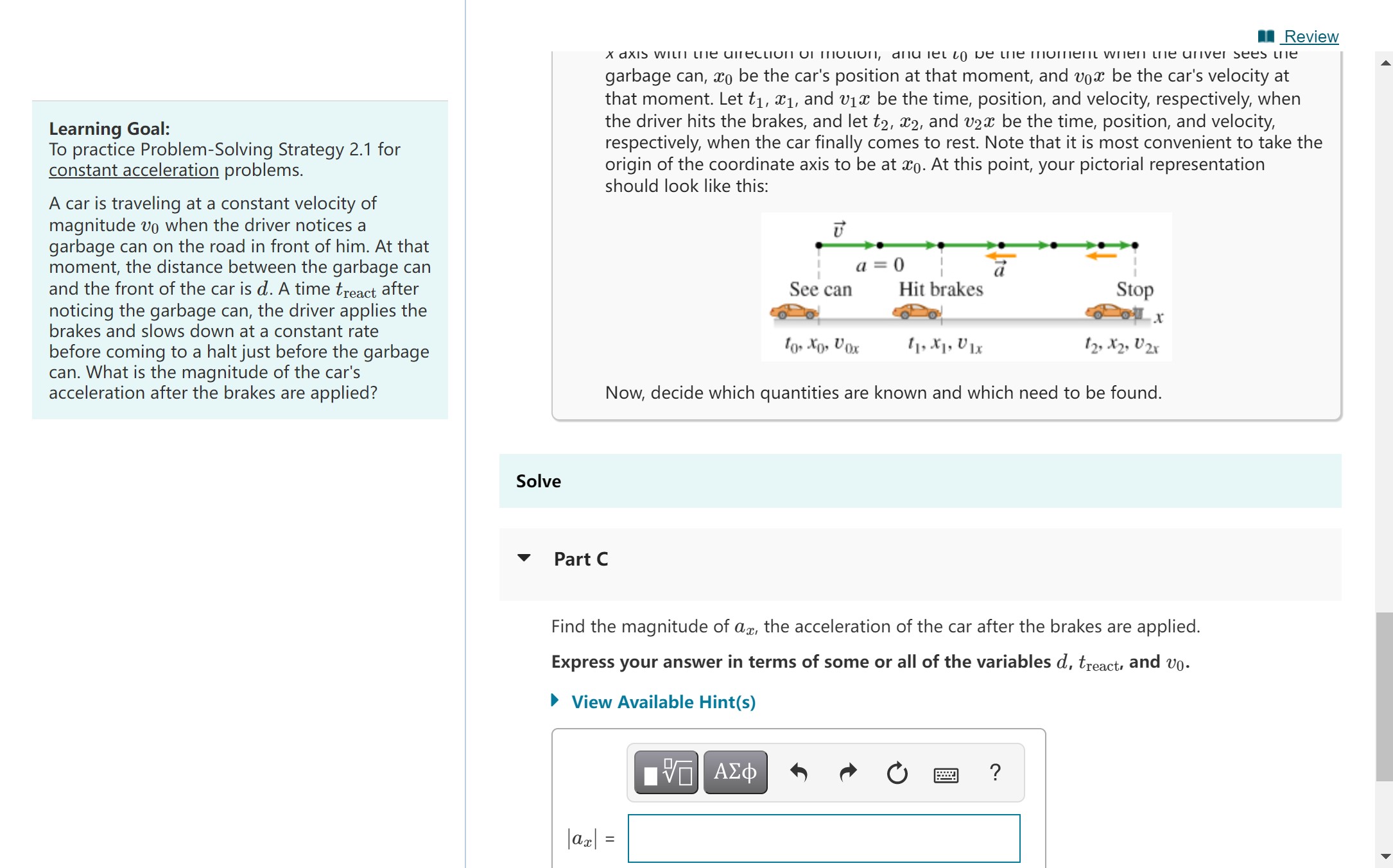
Learning Goal: To practice ProblemSolving Strategy 2.1 for constant acceleration problems. A car is traveling at a constant velocity of magnitude v0 when the driver notices a garbage can on the road in front of him. At that moment, the distance between the garbage can and the front ofthe car is d. A time tread after noticing the garbage can, the driver applies the brakes and slows down at a constant rate before coming to a haltjust before the garbage can. What is the magnitude of the car's acceleration after the brakes are applied? I Review PROBLEM-SOLVING STRATEGY 2.1 Kinematics with constant acceleration MODEL: Model the object as having constant acceleration. VISUALIZE: Use different representations of the information in the problem. . Draw a pictorial representation. This helps you assess the information you are given and starts the process of translating the problem into symbols. - Use a graphical representation if it is appropriate for the problem. - Go back and forth between these two representations as needed. SOLVE: The mathematical representation is based on the three kinematic equations \"Ur; = vis + asAt, 3f 2 51 l visAt l as (A102, and if; = 11125 + 2asAs. - Use :1: or y, as appropriate to the problem, rather than the generic s. . Replacei and fwith numerical subscripts defined in the pictorial representation. REVIEW: Check that your result has the correct units and significant figures, is reasonable, and answers the question. Model Start by making simplifying assumptions appropriate for the situation. In this problem, the object of interest, the car, should be modeled as a particle. Visualize 7 Part A Learning Goal: To practice ProblemSolving Strategy 2.1 for constant acceleration problems. A car is traveling at a constant velocity of magnitude 110 when the driver notices a garbage can on the road in front of him. At that moment, the distance between the garbage can and the front of the car is d. A time tract after noticing the garbage can, the driver applies the brakes and slows down at a constant rate before coming to a haltjust before the garbage can. What is the magnitude of the car's acceleration after the brakes are applied? V Part A I Review V Below is a sketch of the situation described in this problem, along with four different motion diagrams. Which of these diagrams is the correct pictorial representation of the problem? 13' (a)Q>o>Q>o=o_>9 : IT" I (b)+\"'+\"'a _. _.'+ 'a' I '9 l I l a I I ' u : I l L' (C) --> -> I =0 a I I I l l i" (d) 'pop?popoM 1 \"=0 . : a : See can HIt brakes Stop MQIL Previous Answers V Correct A '\\ I Review }( Xm) Wllll LII: UIICLLIUII Ul lllUllUll, dllU lt'L L0 [)6 Lil: Il'lUlllClll WIICII LIIC UIIVCI DEC) lllt' garbage can, m0 be the car's position at that moment, and 1102: be the car's velocity at that moment. Let t1, :51, and v1.1a be the time, position, and velocity, respectively, when Learning Goal: the driver hits the brakes, and let t2, 1:2, and 112$ be the time, position, and velocity, To practice ProblemSolving Strategy 21 for respectively, when the car finally comes to rest. Note that it is most convenient to take the constant acceleration problems. origin of the coordinate aXIS to be at 230. At this pomt, your pictorial representation should look like this: A car is traveling at a constant velocity of magnitude 110 when the driver notices a f; garbage can on the road in front of him. At that ?>>$'_>__>:_->9 moment, the distance between the garbage can i a = 0 l " l and the front of the car is d. A time treacl: after See can Hit brakes Stop noticing the garbage can, the driver applies the a Q Q! x brakes and slows down at a constant rate before coming to a haltjust before the garbage '0' x0, \"OX '1' x], u\" '2' '2' \"1' can. What is the magnitude of the car's acceleration after the brakes are applied? Now, decide which quantities are known and which need to be found. Solve V Part C Find the magnitude of am, the acceleration of the car after the brakes are applied. Express your answer in terms of some or all of the variables d, tread, and 110. ' View Available Hint(s)
Step by Step Solution
There are 3 Steps involved in it

Get step-by-step solutions from verified subject matter experts
 Study Help